


Clean data is the backbone of modern-day businesses. B2B and B2C companies rely heavily on their customer contact data to ensure that the marketing message reaches the target audience at the right time. It helps them achieve an edge in their respective markets. However, a lot of organizations fail to comprehend that their customer data can decay rapidly and result in massive problems and hinder their business goals.
How data gets dirty?
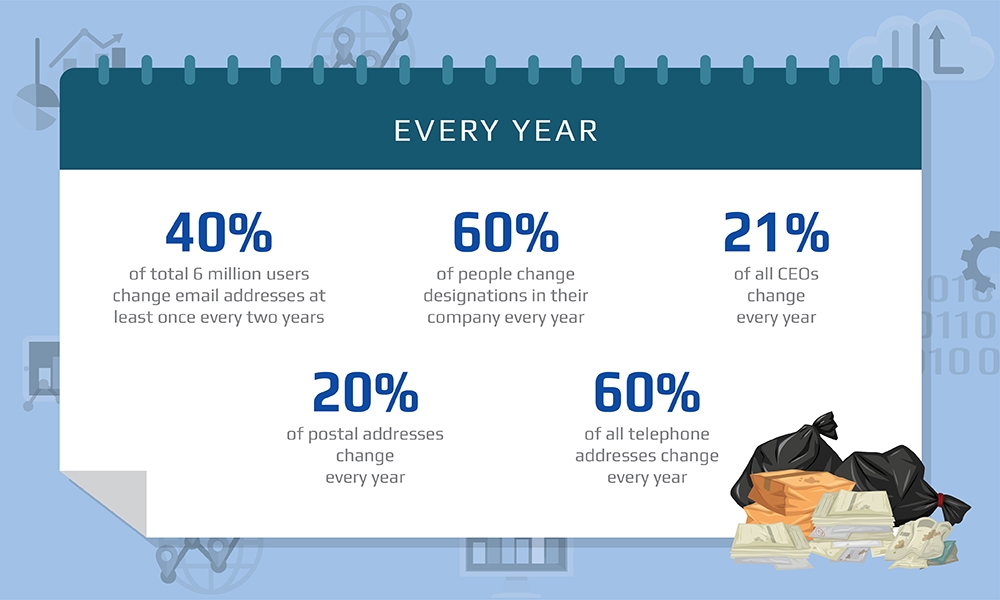
Failing to maintain the accuracy of customer data, makes it nearly challenging for organizations to market, sell, or provide customer services. In the fast-paced professional lives, people change residence, employer, email IDs, mobile numbers too often; and to maintain complete and accurate information is a mammoth task. Considering the facts that:
What is the impact of bad or dirty data?
In this business environment, data is the new oil that keeps the machinery running smoothly. But for organizations, it’s the new age challenge to maintain data hygiene, data quality, or data integrity. After the reasons as to why data gets dirty rapidly; now let’s see what is the impact of dirty data?
- Businesses in US economy suffer $611 billion each year due to bad data.
- With 95% is the delivery benchmark, of every 100 emails sent only 2 ends up as scheduled meeting. So with an email delivery rate of 75%, companies should send 133 emails to schedule 2 meetings. It is 25% more time and effort wasted due to dirty data.
- Companies report that bad data adversely impacts their 54% customer relationships, 30% finance, 66% marketing, and 80% lead generation.
- Only 16 out of 100 companies are confident about their marketing database.
- More than 40% of business objectives fail due to a dirty marketing database.
- Though successful, 64% of companies find improving data quality to be the biggest challenge.
Considering the causes and impact of bad data, focusing on ongoing data cleansing and maintenance for data hygiene has become imperative.
What are the benefits of data cleansing?
Data cleansing helps companies to achieve stronger campaigns, increased customer satisfaction, quality leads, and profitability. Data cleansing not only ensures boosting of your client acquisition efforts but also fewer errors through fewer frustrated employees and happier buyers. You not only benefit from improved staff efficiency and productivity but also improved response rate and revenue.
How to perform data cleansing?
Structure, format, spellings, duplicates, extra space, and data arrangement are amongst a few of those things which can go wrong with your data. Hence following the processes of data cleansing and enrichment is more than necessary. Enlisted are the steps that will help to understand how to perform data cleaning:
- Standardize data at the point of entry: Standardization is crucial to ensure data quality. It helps to avoid a lack of uniformity which weakens business data. Checking data at entry points helps you decide if standardization/normalization is required or not. It also helps you to choose the right data standards, implement a normalization matrix; and fix dirty data according to new data standardization values.
- Monitor structural errors: Errors like mislabeled data types, typos, and inconsistent capitalization are commonplace. Once errors are discovered, don’t just fix them. Instead, always keep track of them. Identifying areas where most errors occur will help you fix dirty data quickly and accurately.
- Remove outlier values: Considerably found distinct values are known as outliers. Remove these values else they will cause severe problems with specific models such as decision tree models and linear regression models. Remember always that you need a valid reason for removing an outlier that is unlikely to be real data.
- Search for missing values: Go ahead and search for missing values. Adding or appending missing values to your existing database proves vital in the long run. Enriching and appending process is about searching for available data points from online resources and adding missing values to existing incomplete data points.
- Scrub duplicate values: It is advised to scrub duplicate and unwanted data such as unwanted and irrelevant data. Duplicate records often arise at the time of data collection or data gathering activities such as the merging of data from multiple sources. Today, many firms exist that can utilize several tools to parse the data in bulk for de-duplication and remove copies and unrelated records.
- Utilize data validation: The last step for data accuracy is to validate your database once it is standardized. Deploy a data validation process to ensure data quality for fitness, accuracy, and coherence. Re-inspect the data set and ensure that it complies with the intended rules. Implement measures like manual revisions to rectify errors.
Automated data cleansing “ the next game-changer
Recent technological developments such as robotic process automation (RPA) and machine learning (ML) are equipped to perform a lot of routine and monotonous activities – better than humans. Advanced tools and technologies have cognitive competencies that were believed to be really challenging to automate.
Automated data cleansing and enrichment have immense potential to change the data cleansing scenario soon. A lot of leading organizations across the globe have tested the waters by successfully resorting to automated data cleansing and enrichment solutions.
Conclusion
Data cleansing is vital for your company to cut through the competition. The benefits of clean data are endless; and range from data segmentation and targeting to improved customer relationships and increased profits. Ensuring high-quality data by adhering to data cleaning process not only saves time but helps in achieving operational efficiency and improved productivity. Rope in expert data cleansing consultants to cleanse dirty data and stop it from affecting your company’s profitable growth.
