


Lately, technology disruptions in the hr domain have completely changed the way, hr, as a business function, operates in the current times. AI is one such disruptive technology that has transformed the hr duties for professionals of the domain across the world.
The responsibilities of the professionals in the said industry, now, are not limited to hiring and arranging candidate interviews but have traversed to strategizing with the higher management on talent needs, and the business impact of new hiring.
Today, the number one priority of corporations, when hiring hr professionals, is roping in those individuals that are proficient in handling new-age hr tech software and tools.
Why?
Because gone are the days when the hiring process needed manual shortlisting of candidates. Now, AI decides, which candidates are the best suited for the advertised role, based on the details mentioned in their respective CVs and resumes. Even, the reading of CVs has been automated in the hr business function in the last couple of years, as a result of AI involvement.
HR Certifications: How They Contribute to Professional Development?
Professional certifications are the second most preferred credentials after graduation degrees. Employers are willing to pay more, across each industry, to certified individuals. And amid the rapidly growing tech infusion in the hr domain, the value of professional certifications is skyrocketing.
As per Payscale, in the hr sector, certifications acquired by an individual, tell a lot about him. Recruiters and talent management leaders, see certified individuals as more competent, skilled, ROI-friendly, and potential assets to the business.
HR Certification Holders by Organizational Hierarchy
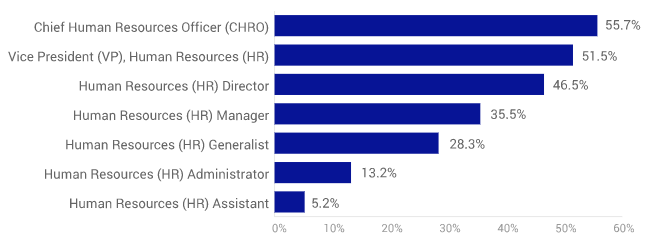
Certification-Holders By Organizational Hierarchy
Source: Payscale
A people move up the hierarchy in the hr domain, they tend to acquire more number of certification credentials. Payscale says, as high as 56% of CHROs across the globe, hold at least one, or more, professional credential. On the other hand, hr professionals at comparatively lower stature in the hierarchy, are less likely to enroll in an online hr course. And that is why, only 5% of hr assistants, hold one, or more, hr credential.
Future HR Jobs, and the Aid, Certifications Will Offer in Grabbing Those
As the job roles in the hr change in accordance with the work, the skillset required, too, will change. Individuals, currently working in the mentioned sector, would need to adapt to the new changes. The new hr skillset needs to be acquired, which mostly involves familiarity with hr tech, or else, you will be wiped out of the industry, soon.
And, herein, comes the role of skill-nurturing hr certifications, that help you develop these advanced hr tech skills.
Jobs of the Future in HR:
Chief Technology Officer/HR Data Scientist: Data analytics, in the future, will drive the hr domain, across industries, and the person in this role, will lead the efforts on this front.
Employee Experience Expert: The individual in this role would ensure the upkeep of the relationship between the organization and its employees. It will range from employment benefits to career progression guidance.
Head – Talent-Acquisition Technology: New talent acquisition software, and cutting-edge tools, are emerging every now and then, given the rapidly evolving hr tech. This person will help decide which tool suits the best as per the corporation needs while keeping in mind the industry you fall under, and the nature of business you do within that specific industry domain.
Head – Candidate/Applicant Experience: The digital hiring process that is in vogue at the moment, and will further evolve and thrive in the near future, should be an enjoyable experience for the candidates who have applied for a job role in your organization. And that is what will be this job role’s responsibility.
Performance Enhancement Coach: This job role would involve helping the workforce in producing better productivity.
Company Psychologist: Although, it’s not a core hr job role, it is closely related to hr development in many ways. Organizational, or company psychologist, will apply the principles of psychology to foster a holistic approach towards hr, sales, and marketing.
