


Different businesses continue to use the term Customer Insight to mean different things. Even in our poll of over 100 customer insight leaders, only half of you considered data management or database marketing to be part of Customer Insight. The majority also had only research reporting into them, not analytics. Does that ring true with your role?
Here’s a definition of Customer Insight that I find useful:
A non-obvious understanding about your customers, which if acted upon, has the potential to change their behaviour for mutual benefit.
I would stress 4 parts of that definition: First, that insights are non-obvious, they normally require the convergence of evidence for multiple sources to help spot themes and then dig deeper for motivations. Second, that true insights need to be actionable, as there is no point learning something unless you can change commercial results or customer experience as a result. Third, a good test of an insight is whether acting on it is powerful enough to change your customers behaviour (not just data to target those you believe will act as they have in the past). Fourth, in this Age of the Customer, the importance of trust should mean any insight has the goal of mutual benefit for the organisation and the customer, anything else is short term success for long term value erosion.
You may need to wear many hats to achieve that kind of insight production from your team. As an earlier post listed, you may need to be a Data Scientist, Psychologist, Artist, Storyteller, Sales Coach, Economist and People Leader. Quite a challenge and perhaps one reason why leaders like you are hard to find.
Some people suggest that Customer Insight is making use of your data, with the current buzzword being big data. But it is possible to be drowning in data and still none the wiser about your customers. Perhaps as a result, some leaders appear to equate CI with behavioural analysis and statistical modelling (with the buzzword here being predictive analytics). Such analytics can be very powerful, but without an understanding of why customers are behaving as they are, it wont pass the test of our Insight definition.
You may assume that Customer Insight as a term applies to research, qualitative & quantitative activities focussed on that why question. But with the unreliability of self-reporting and the need to behaviourally test what customers actually do, to identify any behavioural economic biases at play, can this really be relied upon by itself? So, you might conclude that the only way to know the reality is to test & learn, using targeted communications & measurement from database marketing. That is also very useful, but what understanding helps create what should be tested?
As is probably obvious from past posts and that definition, I would recommend that all 4 of those technical disciplines are needed, to create true customer insights. However, it is not just these separate parts operating effectively in isolation, rather the synergies and insights that can be realised by the working together in collaboration. As Ive heard different experts speak on this topic over the years and seen some of your progress in this regard, it seems to me that we are talking about an ecosystem here. So, the challenge for you Customer Insight Leaders becomes how to nurture this ecosystem, ensuring each part fulfils its potential and acts symbiotically with others to produce the healthy fruit of actionable customer insights (in a way that feels more organic that mechanistically following a set process).
Ensuring a consistent source of quality data for all the technical teams is at the heart of this ecosystem. Then using that data will need to be skilled research, analytics and database marketing teams (hopefully brought together in one CI function). Real growth however, it appears, happens when you use these parts together.
For example, converging the evidence from analysis & research to produce a more robust picture of how customers are feeling and acting and why. That should enable hypotheses to be generated as to how customers would feel and act if you did something different. Offering something different (communication/experience/product) can then be tested with experimental design using database marketing skills. Once you can see any changes in customer behaviour as a result, also check out the feelings of customers & observe the touch points to get a feel for their new experience. Such research and analysis output then brings us back to the stage of converging evidence and looking for themes (a virtuous circle of continuous improvement).
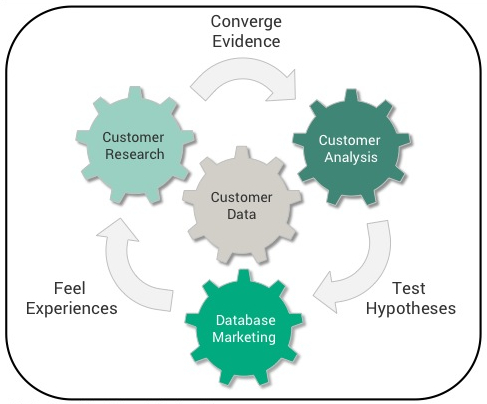
There is more to customer insight generation than that, but Ill blog another time about applications like generating insights for proposition design. For now I wanted to share what is becoming a standard model for me in helping clients.
Do those themes resonate with you? Any other tips you can share?
