You ever wondered how YouTube often plays the kind of music that you’d like to listen to? Or, Amazon comes with a recommended for you collection while shopping? The simple answer is machine learning. ML allows these organizations to offer personalized content and engage more and more users.
This blog is for you if you’ve not yet invested in machine learning or thinking of how to get started. Let’s know why you should invest in machine learning technology, especially with mobile application development. In this article, you’ll learn about:
- Machine Learning in Mobile Application Development
- Top Machine Learning Examples for Mobile App
- Applications of Machine Learning in Mobile App Development
Machine Learning in Mobile Application Development
|
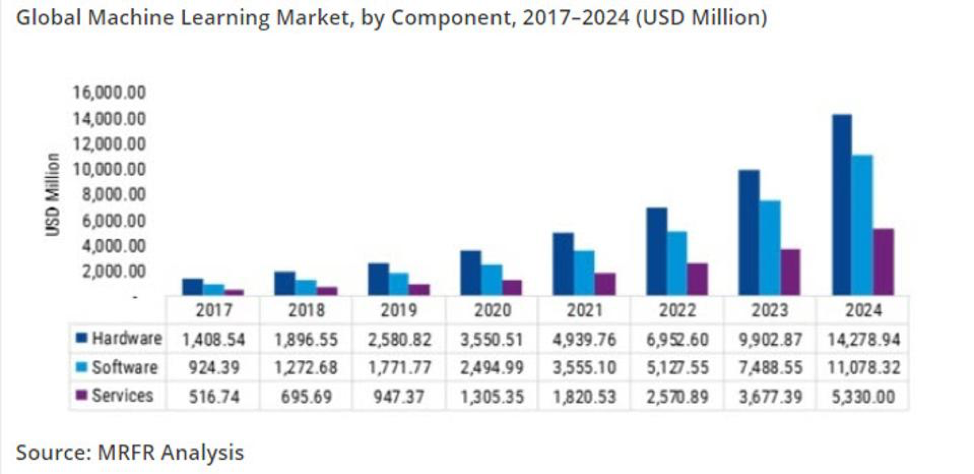
The global ML market was valued at $1.58B in 2017 and is expected to reach $20.83B in 2024, growing at a 44.06% CAGR between 2017 and 2024. |
Moving ahead and let’s explore how the integration of machine learning is beneficial in mobile app development, and that may flourish your business in upcoming years.
Improving the Personalized Experience
Personalization is when you address and understand your customers’ pain points and their requirements. You show them a situation where they can recognize themselves and suggest solutions based on product or service.
Speaking of how machine learning is driving mobile app personalization, it’s no wonder that its algorithms are savvy when it comes to analyzing the information available from social media activities.
Machine learning-based personalization provides more scalable and accurate ways to achieve unique experiences for individual users. It allows you to use algorithms to deliver one-to-one experiences in the form of recommendations for products or content.
It also helps classify users based on their interests, accumulate user information, and decide your application’s overall look. ML can be used to learn the following:
- Who are your customers?
- What are their requirements?
- What are their budgets?
- What are customers’ preferences and their pain points?
- What words are they using to talk about your services or products?
With the above-collected information, ML helps you classify, decide, and structure your customers, find out an individual approach to each customer group, and become familiar with your content’s tone. Put simply, ML lets you provide users with the most relevant information and convey the impression that your app is talking to them.
Provides an Efficient Search Experience for Apps
As the data-driven world has been continually multiplying, effective search has become essential in creating a better user experience. When the users search their queries on the Internet, they expect the results to be closer to their search intent. On the other hand, machine learning apps can achieve such objectives very seamlessly and quickly.
Advanced & Balanced Search
Machine learning in mobile app development helps to optimize and balance in-app search. It also improves contextual outcomes and controls delivery time. Users sometimes find some apps boring or time-consuming; however, machine learning in your app can give them a more tangible experience. It also helps to collect access information such as customers’ searches, history, or other activities. It also enables us to analyze data to rank the customers’ behaviors and rank them to deliver the best matching results.
Improvements in Security
Machine learning has enabled mobile apps to streamline and secure audiovisual data. Users can authenticate themselves with face, fingerprints, and biometric information with voice recognition ”for instance, apps like Zoom Login and BioID applications.
Sectors like banking and financial companies also leverage machine learning algorithms to inspect customers’ previous transactions, borrowing history, and determine credit ratings. In short, machine learning opens access to a variety of features such as:
- Logistics recognition
- Business expertise
- Image recognition
- Product tagging automation
Active Connection with Customers
Machine learning helps manage customers based on their preferences with the help of processes such as machine learning analysis and categorizing available information. It’s also possible to provide the most relevant and approachable content to convey your application’s accurate impression.
Top Machine Learning Mobile App Examples
1. Spotify
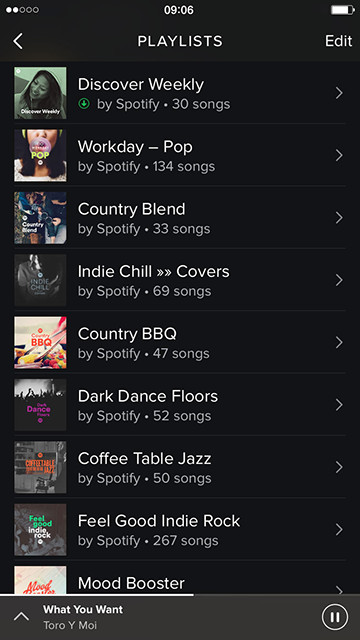
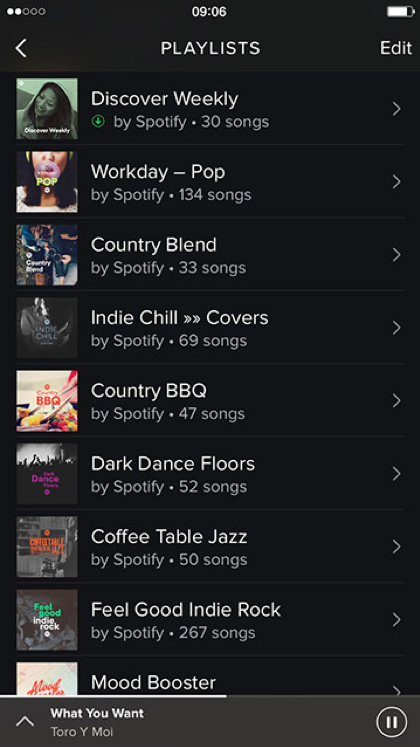
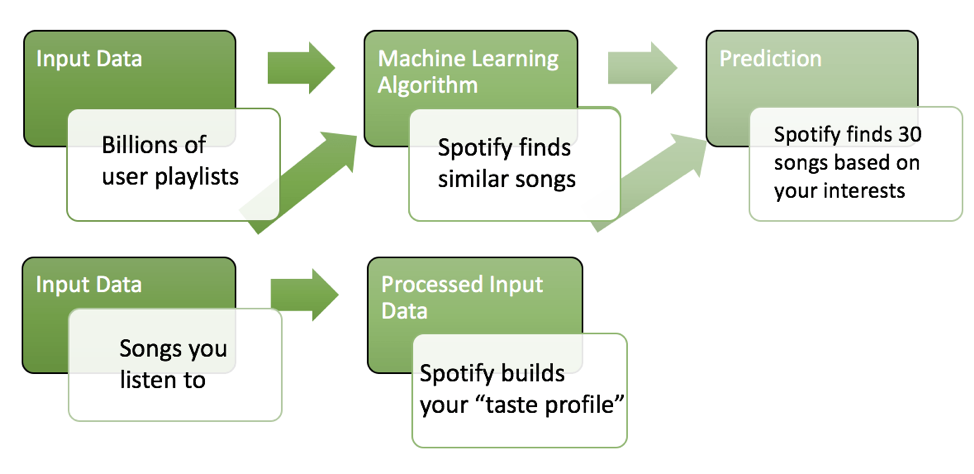
Spotify uses three types of machine learning algorithms to provide users with personalized music recommendations in the section Discover Weekly.
The first type of algorithm is Collaborative Filtering, which provides users with customized recommendations. It works only by comparing multiple user-created playlists with songs that users have listened to. This algorithm helps users to recommend the music as per their likes and interests.
The second ML algorithm is all about Natural Language Processing, which reads song lyrics, discusses specific musicians, and news articles about songs or artists on the Internet. Based on this information, the second algorithm categorizes into cultural vectors and top terms and suggests music with similar songs.
The third algorithm is the Audio model. ML tools that analyze data from raw audio tracks categorize songs, suggest other songs with similar music, and are popular among other users.
2. Quizlet
One of the edtech startup companies, Quizlet, an online studying tool, uses machine learning to improve human understanding. It lets users create quizzes, flashcards, diagrams, or use pre-existing ones. Currently, Quizlet has over 50 million active users and more than 350 million sets on many topics.
Quizlet is powered by the Learning Assistant algorithm, which uses machine learning to process data from millions of anonymous study sessions and then combines data with cognitive science and proven techniques. It considers correctness of answers, the time between previous answers, time since the last answers, and direction of study. Moreover, it allows users or students to learn new topics more efficiently and prioritizes terms that need work.
It understands how people learn and drives studying that’s more effective and efficient by only showing students the material they need to know and making it fun at the same time.
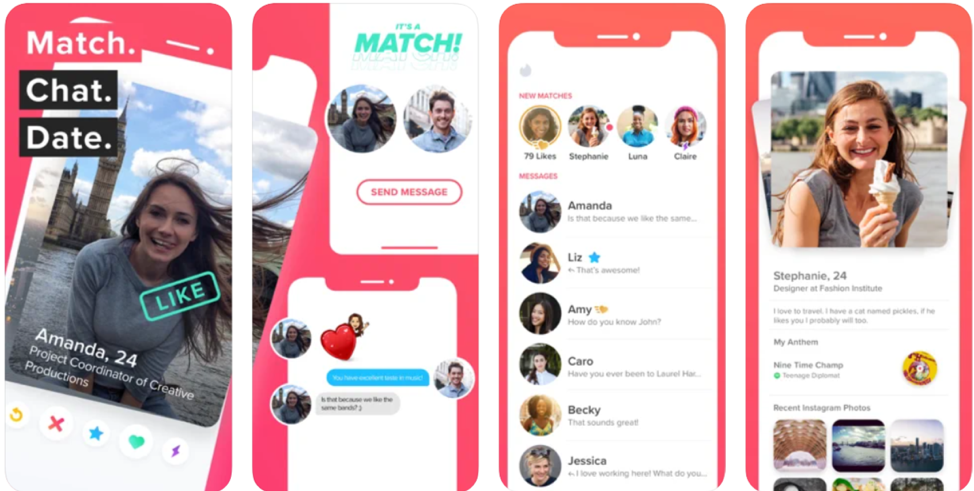
3. Tinder
Tinder app uses an algorithm with reinforcement learning for the Smart Photos features. It increases the chances of users finding the perfect match. Tinder app shows photos to users randomly. After that, machine learning analyzes how many right or left swipes each image gets. This way, it learns which photos are more attractive to other users. Thus, the algorithm reorders user photos to put popular photos first.
Applications of Machine Learning in Mobile App Development
-
Image Processing: This is one of the best ML use cases. Such ML algorithms are used to detect various objects in a given image. It comes under supervised learning, where the ML system is fed with labeled images, which contain different objects. Google Assistant and Google Photos are good examples of this. Both Amazon Rekognition and Firebase ML kit provide API for this feature.
-
NLP & Speech Recognition: It is another very famous use case of ML, all about detecting a written text and interfering with its script. There are many solutions available for integrating this, including Google Cloud ML and different offerings from AWS, including Amazon Transcribe, Translate, and Lex.
-
Predictions: Based on historical data, ML models can infer future events such as fraud detection in business, customer behavior predictions, or natural events predictions.
Closing Thoughts
Machine learning technology empowers web and mobile app development to attract a number of users. Many mobile app development companies rely on it because it has become popular. However, they prefer depending on it because it offers sophisticated research methods, secure authentication, and fraud protection.