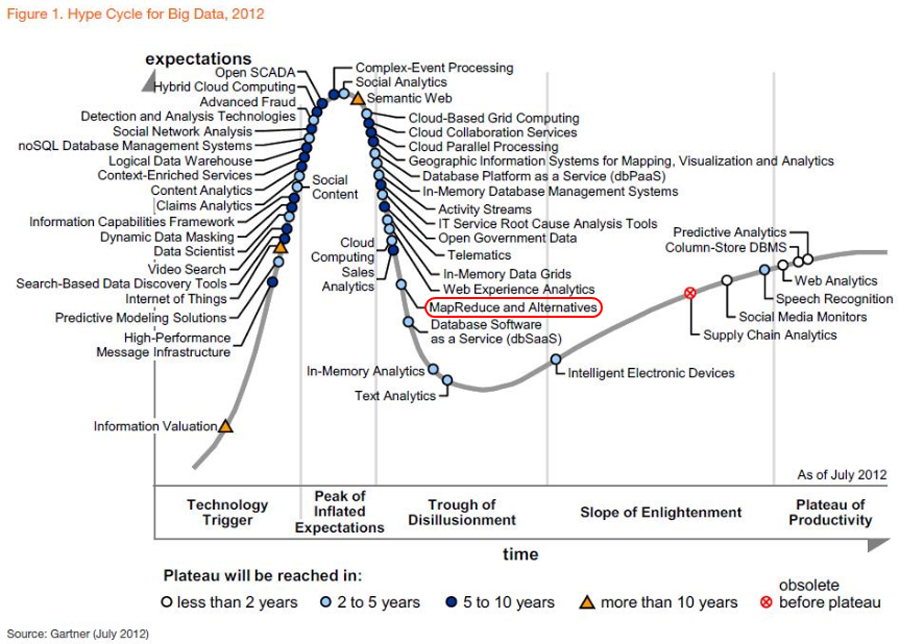
A lot has been written already about Big Data trends for 2013 and here at Datafloq we want to add a few that we believe will be important for 2013. According to the Emerging Technologies Hype Cycle published by Gartner in the summer of 2012, the trend Big Data has just entered the Peak of Inflated Expectations, meaning that everyone expects everything from Big Data. Gartner has also made a Hype Cycle dedicated to Big Data only. This Hype Cycle shows the different aspects of Big Data and how far they are already. As expected from this Cycle, the aspects Web Analytics, Social Media monitors and supply chain analytics are widely adopted by many organizations. Big Data is around us now for some time and 2012 was a year good year for Big Data with more and more companies adopting a Big Data strategy. Still, as can be seen from Gartners Hype Cycle on Big Data, there are many aspects of Big Data that still will take a long time before becoming mainstream. What are the aspects that we can expect in 2013?
On-the-go Big Data
The rise of the trend Mobile, which took flight in 2012, will have an impact on Big Data and especially on the visualizations of Big Data. Gartner even predicts that in 2013 mobile phone will take over PCs as the most common web access device. Mobile does not mean phone only, also tablets and Gartner believes that in 2015 tablets shipments will reach about 50% of laptop shipments. As more companies opt for bring-your-own-devices as well, it will require Big Data to be also accessible on mobile devices, which will require a different way of visualizing. The small screen after all only allows small portions of information to be shown at once.
Programmers will have to think beyond the desktop. Zoomdata clearly understands this, as they believe mobile devices are ideal because of their intuitive touch screens. Zoomdata allows users to view their interactive graphs on tablets as well, while incorporating all the pros of tablets. On-the-go Big Data could have ground-breaking effects on some industries. For example, the health industry; if doctors carrying all important Big Data information of a patient on their smartphone or tablet while standing next to a bedside or at the operating room. This would certainly impact the way the health industry operates at the moment. However, mobile devices are typically less secure and less controlled than (company) PCs and laptops are the moment.
Therefore, before On-the-go Big Data will be take-off seriously, this issue needs to be addressed. Luckily, IBM is working hard on this, as it recently announced a risk-based authentication control for mobile users, integration of access management into mobile application development and deployment as well as enhanced mobile device control. As the mobile era has reached us seriously now, you can expect a lot of new startups that will solely focus on bringing Big Data onto mobile devices in an intuitive manner.
Big Data Does not Require Big Budgets
Everything becomes data and therefore the challenge companies will face in 2013 is not so much how to store the data but how to analyse data. With all the available open source tools in the market nowadays, this does not require big budgets as is expected by a lot of organisations. The beauty of Apache Hadoop is that it works on large clusters of commodity hardware. Of course buying hundreds or thousands of servers is expensive; it is still a lot cheaper than buying tailor-made hardware for storing data.
A 10 Terabyte server nowadays costs just a mere $ 1.000,-. Of course, the advance is hardware technology will make storage cheaper every day. It is expected that more and more open source tools will start to appear, open source tools that offer extensive visualizations, drag-and-drop options and easy to install scripts. So, expensive subscriptions will become a thing of the past as these open-source tools require Big Data startups to adjust their pricing to match the new reality.
Big Real-time Data
Companies want to use their data and they want to use it now. The moment the data is created, they want to know it and use it. Real-time analytics will definitely see a huge growth in the coming year. Although Hadoop does not offer the possibility to do real-time analysis, there are more and more companies who do offer this. A good example is Kafka and Cloudera announced a couple of months ago a game-changing real-time query on Hadoop. This new solution allows batch and real-time operations to be performed on any type of data — structured or unstructured — within one massively, non-expensive, scalable system. In a fast information age, having access to real-time Big Data analyses can prove to be the difference between your organisation and your competitor. Therefore, more companies will move towards this and base their daily business decisions on real-time knowledge.
Big Consumer Data
Although Big Data is often referred to as useful for organisations, Big Data will become more and more relevant for consumers. More and more apps appear which allow consumers to store, track, visualize and interpret their personal data. Data about eating habits, sleeping habits, running statistics or even videos that record your entire life are becoming normal. It is only a matter of time before there will be apps which combine all the data of these individual apps into one Big Data app about your life. They can then mash it up with your geo-location data of your phone, your Twitter and Facebook activity. They will even allow you to compare yourself to your peers. They are already appearing on the market, although they are not yet so extensive as to combine everything. Those apps will therefore generate even more massive amounts of data that will allow them to map entire population groups how they eat, live, sleep, work, sport etc. Scary? Yes maybe, but consumers have always longed for information about their own life so they are happy to join the pack.
Big Data Privacy
At the moment Big Data is getting more and more attention, as we are in the phase of peak of inflated expectation of Gartners Hype Cycle about Big Data. It feels like we have fallen in love with Big Data and that we are blind for the pitfalls in Big Data. We do not want to see the backside of Big Data and the effect it will have on our privacy. Or better said: the privacy that we will not have anymore in the future. If everything is monitored, companies will know more about you. Perhaps algorithms know more about you that you know about yourself. It is closely linked to the Big Consumer Data trend as at the moment consumers freely share their data with anyone and any company.
Another issue that will arise is: who owns all the data that is generated and collected by smartphones, tablets, websites, search engines and credit card companies for example? And is it allowed for companies to collect data without consumers knowing? In The Netherlands the new cookie law generated a lot of controversy about the new strict privacy laws that could lead to an online exodus. Big Data Privacy will become more and more into focus of consumers and consumer related NGOs as Big Data will draw more attention the coming years. It is not a question of if’, but more a questions of when the long and difficult debate about Big Data privacy will start.