


Arrays are one of the vital parts of the higher-order architecture in artificial intelligence and machine learning. They can represent images, text, and many types of data.
In Python, which is one of the most favored programming languages for data scientists and AI engineers, NumPy’ is the principal array programming library. Here we review the use of NumPy in the context of array programming.
NumPy: An Introduction
Prior to NumPy, two array packages existed in Python. One, numeric package, which was developed around the 1990s and offered array objects and array-aware functions. However, to handle huge astronomical images (taken from Hubble telescope), the Numeric package was reimplemented in the form of Numarray. It provided added support of:
- Structured Array,
- Flexible Indexing,
- Byte-Order Variants,
- Memory Mapping, and more.
15 years later, NumPy came to underline about every Python library “ from SciPy, Matplotlib, sci-kit-learn, and others. So much so, it represents more than a typical library. It has become an open-source community capable of all functionalities provided by the past packages. Due to its simplicity, NumPy has become a de facto exchange for array data in Python.
NumPy in Python Ecosystem
NumPy is the base on which Python’s ecosystem is built. From among 137,000+ libraries of Python, it plays an essential role in many projects. It has applicability in deep learning and artificial intelligence programming, as well find use in a variety of fields like Physics, Chemistry, Biology, even Economics.
Did you know that NumPy is not a part of Python’s standard libraries?
Even though it doesn’t belong to a typical libraries’ camp of Python, NumPy benefits from good relationships with Python developers and their contributions from around the world. Over several years, Python has added many new features and syntaxes to NumPy and made its array notations more succinct and easier to read. By the virtue of not being a part of the standard library’ of Python, it can dictate its own policies and development.
A depiction of how NumPy derives from the entire Python ecosystem and also contributes to it. Few essential Python libraries and projects, which rely on NumPy’s API to support array protocols:
Python libraries and projects dependent on NumPy
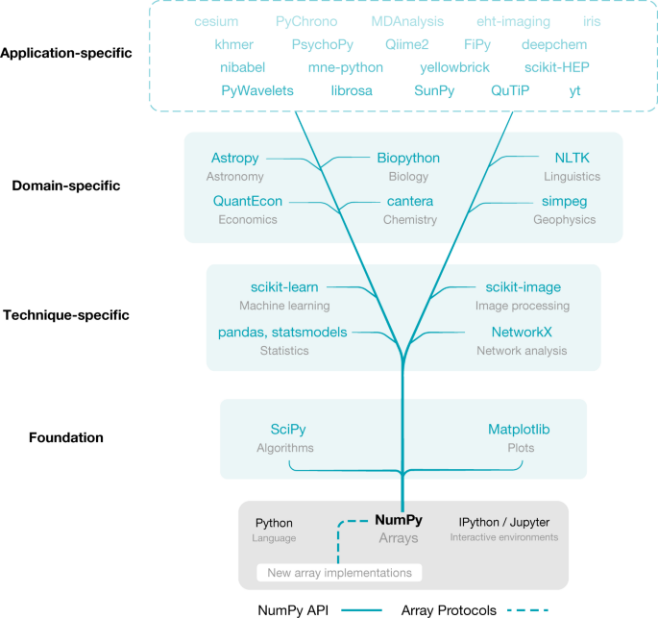
Source: Harris, Millman, and Oliphant, 2020
NumPy for Array Programming
The latest developments in the field of artificial intelligence and machine learning have furthered the scientific use of Python. NumPy is one of the most prominent libraries that form an important part of the software stack. In fact, it was instrumental in the discovery of gravitational waves, and black hole’s first-ever imaging.
NumPy library combines the power of array programming with the performance of C, and readability, reliability, and easy usability of Python amid a tested, well-documented, and well-connected community.
NumPy array has the following three characteristics:
- In-memory,
- Multidimensional (aka tensors, which enable a huge variety of scientific calculations), and
- Homogenously typed on CPUs.
- It is a data structure, which accesses multidimensional arrays and consists of a pointer to memory to interpret data store therein. It can run on all machines “ from embedded devices to supercomputers.
Because of the vast scientific Python ecosystem supporting NumPy, it incorporates a variety of most basic array concepts (shown below).
Fundamental Array Concepts in NumPy Array
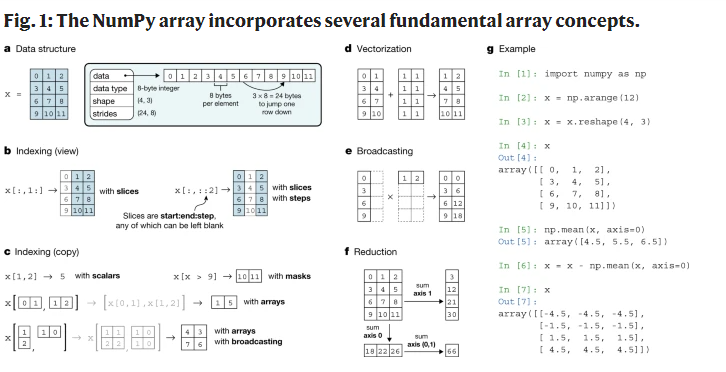
Source: Harris, Millman, and Oliphant, 2020
Role of NumPy for AI Engineers
The field of Artificial intelligence is maturing, and arrays form a huge part of solutions for AI engineers. Use of NumPy can lead to simple and powerful programs for organizing, exploring, and evaluating scientific data.
To successfully carve foundations in NumPy, AI engineers must understand:
– the differences in one, two, and n-dimensional arrays in NumPy,
– how to apply linear algebra operations to n-dimensional arrays, and
– axis and shape properties of n-dimensional arrays.
Develop your skills and understanding of NumPy and aim for top-level proficiency as an AI engineer.
