


TL;DR
- Small language models (SLMs) are optimized generative AI solutions that offer cheaper and faster alternatives to massive AI systems, like ChatGPT
- Enterprises adopt SLMs as their entry point to generative AI due to lower training costs, reduced infrastructure requirements, and quicker ROI. These models also provide enhanced data security and more reliable outputs.
- Small language models deliver targeted value across key business functions – from 24/7 customer support to offline multilingual assistance, smart ticket prioritization, secure document processing, and other similar tasks
Everyone wants AI, but few know where to start.
Enterprises face analysis paralysis with implementing AI effectively when massive, expensive models feel like overkill for routine tasks. Why deploy a $10 million solution just to answer FAQs or process documents? The truth is, most businesses don’t need boundless AI creativity; they need focused, reliable, and cost-efficient automation.
That’s where small language models (SLMs) shine. They deliver quick wins – faster deployment, tighter data control, and measurable return on investment (ROI) – without the complexity or risk of oversized AI.
Let’s discover what SLMs are, how they can support your business, and how to proceed with implementation.
What are small language models?
So, what does an SLM mean?
Small language models are optimized generative AI (Gen AI) tools that deliver fast, cost-efficient results for specific business tasks, such as customer service or document processing, without the complexity of massive systems like ChatGPT. SLMs run affordably on your existing infrastructure, allowing you to maintain security and control and offering focused performance where you need it most.
How SLMs work, and what makes them small


Small language models are designed to deliver high-performance results with minimal resources. Their compact size comes from these strategic optimizations:
- Focused training data. Small language models train on curated datasets in your business domain, such as industry-specific content and internal documents, rather than the entire internet. This targeted approach eliminates irrelevant noise and sharpens performance for your exact use cases.
- Optimized architecture. Each SLM is engineered for a specific business function. Every model has just enough layers and connections to excel at their designated tasks, which makes them outperform bulkier solutions.
- Knowledge distillation. Small language models capture the essence of larger AI systems through a “teacher-student” learning process. They only take the most impactful patterns from expansive LLMs, preserving what matters for their designated tasks.
- Dedicated training techniques. There are two primary training techniques that help SLMs to maintain focus:
- Pruning removes unnecessary parts of the model. It systematically trims underutilized connections from the AI’s neural network. Much like pruning a fruit tree to boost yield, this process strengthens the model’s core capabilities while removing wasteful components.
- Quantization simplifies calculation, making it run faster without demanding expensive, powerful hardware. It converts the model’s mathematical operations in a way that it uses whole numbers instead of fractions.
Small language model examples
Established tech giants like Microsoft, Google, IBM, and Meta have built their own small language models. One SLM example is DistilBert. This model is based on Google’s Bert foundation model. DistilBert is 40% smaller and 60% faster than its parent model while keeping 97% of the LLM’s capabilities.
Other small language model examples include:
- Gemma is an optimized version of Google’s Gemini
- GPT-4o mini is a distilled version of GPT-4o
- Phi is an SML suit from Microsoft that contains several small language models
- Granite is the IBM’s large language model series that also contains domain-specific SLMs
SLM vs. LLM
You probably hear about large language models (LLMs) more often than small language models. So, how are they different? And when to use either one?
As presented in the table below, LLMs are much larger and pricier than SLMs. They are costly to train and use, and their carbon footprint is very high. A single ChatGPT query consumes as much energy as ten Google searches.
Additionally, LLMs have the history of subjecting companies to embarrassing data breaches. For instance, Samsung prohibited employees from using ChatGPT after it exposed the company’s internal source code.
An LLM is a Swiss army knife – versatile but bulky, while an SLM is a scalpel – smaller, sharper, and perfect for precise jobs.
The table below presents an SLM vs. LLM comparison
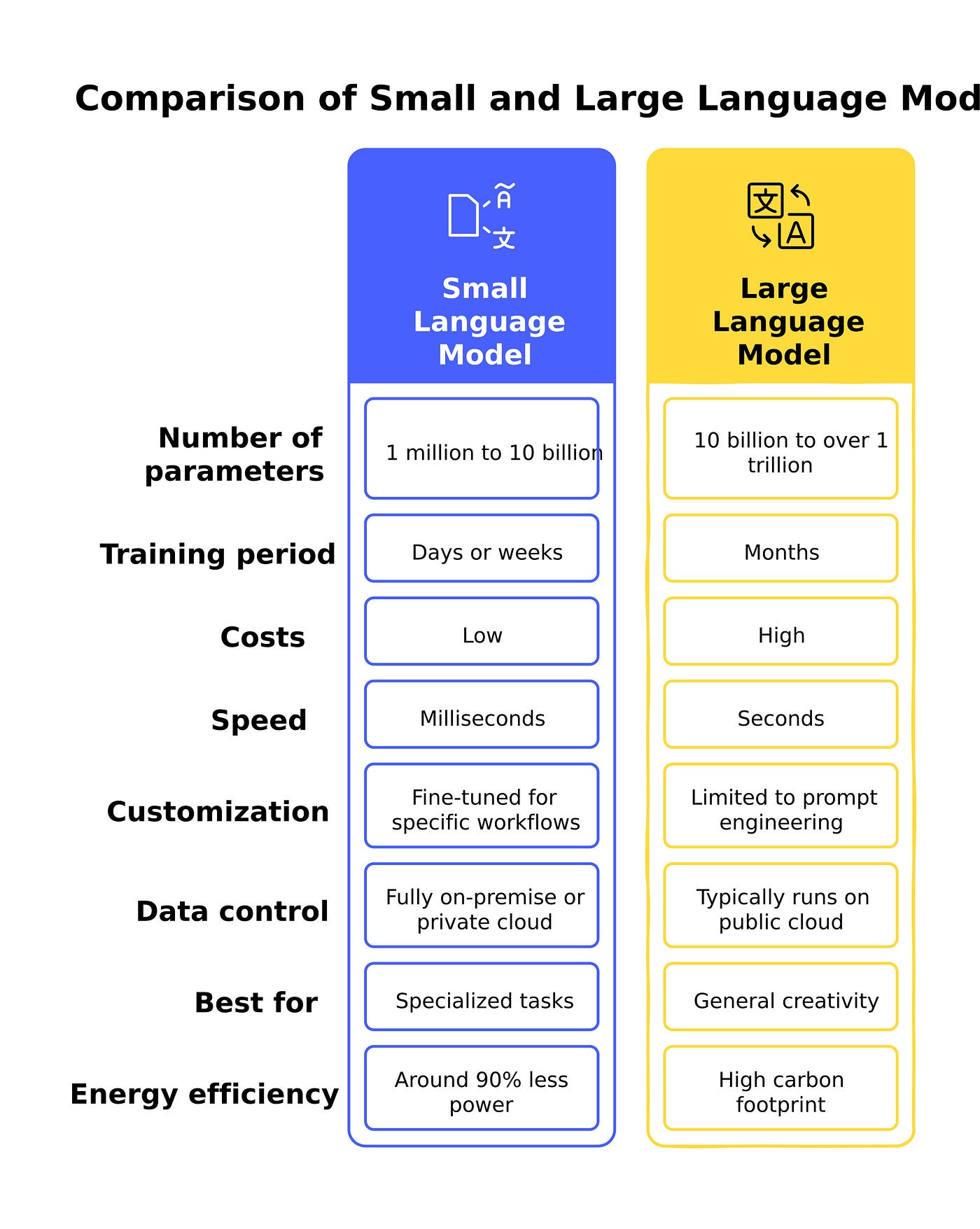

Is one language model better than the other? The answer is – no. It all depends on your business needs. SLMs allow you to score quick wins. They are faster, cheaper to deploy and maintain, and easier to control. Large language models, on the other hand, enable you to scale your business when your use cases justify it. But if companies use LLMs for every task that requires Gen AI, they are operating a supercomputer where a workstation will do.


Why use small language models in business?
Many forward-thinking companies are adopting small language models as their first step into generative AI. These algorithms align perfectly with enterprise needs for efficiency, security, and measurable results. Decision-makers choose SLM because of:
- Lower entry barriers. Small language models require minimal infrastructure as they can run on existing company hardware. This eliminates the need for costly GPU clusters or cloud fees.
- Faster ROI. With deployment timelines measured in weeks rather than months, SLMs deliver tangible value quickly. Their lean architecture also permits rapid iterations based on real-world feedback.
- Data privacy and compliance. Unlike cloud-based LLMs, small language models can operate entirely on-premises or in private cloud environments, keeping sensitive data within corporate control and simplifying regulatory compliance.
- Task-specific optimization. Trained for focused use cases, SLMs outperform general-purpose models in accuracy, as they don’t contain any irrelevant capabilities that could compromise performance.
- Future-proofing. Starting with small language models builds internal AI expertise without overcommitment. As needs grow, these models can be augmented or integrated with larger systems.
- Reduced hallucination. Their narrow training scope makes small language models less prone to generating false information.
When should you use small language models?
SLMs offer numerous tangible benefits, and many companies prefer to use them as their gateway to generative AI. But there are scenarios where small language models are not a good fit. For instance, a task that requires creativity and multidisciplinary knowledge will benefit more from LLMs, especially if the budget allows it.
If you still have doubts about whether an SLM is suitable for the task at hand, consider the image below.


Key small language models use cases
SLMs are the ideal solution when businesses need cost-effective AI for specialized tasks where precision, data control, and rapid deployment matter most. Here are five use cases where small language models are a great fit:
- Customer support automation. SLMs handle frequently asked questions, ticket routing, and routine customer interactions across email, chat, and voice channels. They reduce the workload on human employees while responding to customers 24/7.
- Internal knowledge base assistance. Trained on company documentation, policies, and procedures, small language models serve as on-demand assistants for employees. They provide quick access to accurate information for HR, IT, and other departments.
- Support ticket classification prioritization. Unlike generic models, small language models fine-tuned on historical support tickets can categorize and prioritize issues more effectively. They make sure that critical tickets are processed promptly, reducing response times and increasing user satisfaction.
- Multilingual support in resource-constrained environments. SLMs enable basic translation in areas where cloud-based AI may be impractical, like in offline or low-connectivity settings, such as manufacturing sites or remote offices.
- Regulatory document processing. Industries with strict compliance requirements use small language models to review contracts, extract key clauses, and generate reports. Their ability to operate on-premises makes them ideal for handling sensitive legal and financial documentation.
Real-life examples of companies using SLMs
Forward-thinking enterprises across different sectors are already experimenting with small language models and seeing results. Take a look at these examples for inspiration:
Rockwell Automation
This US-based industrial automation leader deployed Microsoft’s Phi-3 small language model to empower machine operators with instant access to manufacturing expertise. By querying the model with natural language, technicians quickly troubleshoot equipment and access procedural knowledge – all without leaving their workstations.
Cerence Inc.
Cerence Inc., a software development company specializing in AI-assisted interaction technologies for the automotive sector, has recently introduced CaLLM Edge. This is a small language model embedded into Cerence’s automotive software that drivers can access without cloud connectivity. It can react to a driver’s commands, search for places, and assist in navigation.
Bayer
This life science giant built its small language model for agriculture – E.L.Y. This SLM can answer difficult agronomic questions and help farmers make decisions in real time. Many agricultural professionals already use E.L.Y. in their daily tasks with tangible productivity gains. They report saving up to four hours per week and achieving a 40% improvement in decision accuracy.
Epic Systems
Epic Systems, a major healthcare software provider, reports adopting Phi-3 in its patient support system. This SLM operates on premises, keeping sensitive health information safe and complying with HIPAA.
How to adopt small language models: a step-by-step guide for enterprises
To reiterate, for enterprises looking to harness AI without excessive complexity or cost, SLMs provide a practical, results-driven pathway. This section offers a strategic framework for successful SLM adoption – from initial assessment to organization-wide scaling.
Step 1: Align AI strategy with business value
Before diving into implementation, align your AI strategy with clear business objectives.
- Identify high-impact use cases. Focus on repetitive, rules-based tasks where specialized AI excels, such as customer support ticket routing, contract clause extraction, HR policy queries, etc. Avoid over-engineering; start with processes that have measurable inefficiencies.
- Evaluate data readiness. SLMs require clean, structured datasets. Review the quality and accessibility of your data, such as support tickets and other internal content. If your knowledge base is fragmented, prioritize cleanup before model training. If a company lacks internal expertise, consider hiring an external data consultant to help you craft an effective data strategy. This initiative will pay off in the future.
- Secure stakeholder buy-in. Engage department heads early to identify pain points and define success metrics.
Step 2: Pilot strategically
A focused pilot minimizes risk while demonstrating early ROI.
- Launch in a controlled environment. Deploy a small language model for a single workflow, like automating employee onboarding questions, where errors are low-stakes but savings are tangible. Use pre-trained models, such as Microsoft Phi-3 and Mistral 7B, to accelerate deployment.
- Prioritize compliance and security. Opt for private SLM deployments to keep sensitive data in-house. Involve legal and compliance teams from the start to address GDPR, HIPAA, and AI transparency.
- Set clear KPIs. Track measurable metrics like query resolution speed, cost per interaction, and user satisfaction.
You can also begin with AI proof-of-concept (PoC) development. It allows you to validate your hypothesis on an even smaller scale. You can find more information in our guide on how AI PoC can help you succeed.
Step 3: Scale strategically
With pilot success proven, broaden small language model adoption systematically.
- Expand to adjacent functions. Once validated in one domain, apply the model to other related tasks.
- Build hybrid AI systems. Create an AI system where different AI-powered tools cooperate together. If your small language model can accomplish 80% of the tasks, reroute the remaining traffic to cloud-based LLMs or other AI tools.
- Support your employees. Train teams to fine-tune prompts, update datasets, and monitor outputs. Empowering non-technical staff with no-code tools or dashboards accelerates adoption across departments.
Step 4: Optimize for enduring impact
Treat your SLM deployment as a living system, not a one-off initiative.
- Monitor performance rigorously. Track error rates, user feedback, and cost efficiency. Use A/B testing to compare small language model outputs to human or LLM benchmarks.
- Retrain with new datasets. Update models regularly with new documents, terminology, support tickets, or any other relevant data. This will prevent “concept drift” by aligning the SLM with evolving business language.
- Elicit feedback. Encourage employees and customers to flag inaccuracies or suggest model improvements.
Conclusion: smart AI starts small
Small language models represent the most pragmatic entry point for enterprises exploring generative AI. As this article shows, SLMs deliver targeted, cost-effective, and secure AI capabilities without the overhead of massive language models.
For the adoption process to go smoothly, it’s essential to team up with a reliable generative AI development partner.
What makes ITRex your ideal AI partner?
ITRex is an AI-native company that uses the technology to speed up production and delivery cycles. We pride ourselves on using AI to enhance our team’s efficiency while maintaining client confidentiality.
We differentiate ourselves through:
- Offering a team of professionals with diverse expertise. We have Gen AI consultants, software engineers, data governance experts, and an innovative R&D team.
- Building transparent, auditable AI models. With ITRex, you won’t get stuck with a “black box” solution. We develop explainable AI models that justify their output and comply with regulatory standards like GDPR and HIPAA.
- Delivering future-ready architecture. We design small language models that seamlessly integrate with LLMs or multimodal AI when your needs evolve – no rip-and-replace required.
Schedule your discovery call today, and we’ll identify your highest-impact opportunities. Next, you’ll receive a tailored proposal with clear timelines, milestones, and cost breakdown, enabling us to launch your AI project immediately upon approval.
FAQs
- How do small language models differ from large language models?
Small language models are optimized for specific tasks, while large language models handle broad, creative tasks. SLMs don’t need specialized infrastructure as they run efficiently on existing hardware, whereas LLMs need cloud connection or GPU clusters. SLMs offer stronger data control via on-premise deployment, unlike cloud-dependent LLMs. Their focused training reduces hallucinations, making SLMs more reliable for structured workflows like document processing.
- What are the main use cases for small language models?
SLMs excel in repetitive tasks, including but not limited to customer support automation, such as FAQ handling and ticket routing; internal knowledge assistance, like HR and IT queries; and regulatory document review. They’re ideal for multilingual support in offline environments (e.g., manufacturing sites). Industries like healthcare use small language models for HIPAA-compliant patient data processing.
- Is it possible to use both small and large language models together?
Yes, hybrid AI systems combine SLMs for routine tasks with LLMs for complex exceptions. For example, small language models can handle standard customer queries, escalating only nuanced issues to an LLM. This approach balances cost and flexibility.
Ready for an SLM that actually works for your business? Let ITRex design your precision AI model – get in touch today.
Originally published at https://itrexgroup.com on May 14, 2025.