

The current pandemic has accelerated the race to modern infrastructure. Earlier modernization was a long-term goal that most organizations were achieving in bits, but now it is in the ambit of business continuity. Leaders across industries have realized that an obsolete infrastructure is the biggest limitation that can potentially keep them off from operating in the future, cater to emerging customer needs, and adapt to newer business models.
Enough has been discussed about the best practices of infrastructure modernization “ what are the benchmark KPIs for modernization, how to select vendors, which is the best on-prem/cloud mix to get started, and so on. Yet not much has been discussed about the drivers of a successful modernization initiative that every organization can bank upon, without paying an extra dollar.
There are time-proven strategies that optimize the cost of modernization, accelerate the achievement of milestones, improve chances of long-term relevance, and drive success beyond simple dollar savings. Most of them are observations of seasoned leaders who have registered big wins in infrastructure revamp and have established resilient technology frameworks across business functions. Let’s call them covert drivers of modernization or secret ingredients, as they are still to be discovered and celebrated.
Reuse Before You Reinvent
If you’re faced with a legacy challenge, the best approach depends on the problem you’re trying to solve. Replacement isn’t the only option. “ Stefan van der Zijden, Research Director, Gartner.
New SaaS applications are a great way to reinvent the infrastructure. But they come with a price tag not just in terms of dollars but also in terms of opportunity cost that is attached to employee training. Not many modernization partners will tell you about this, but the strategy of reuse before you reinvent’ will save dollars and minimize the need for extensive employee training.
Most of the hardware solutions, including but not limited to storage servers, operating systems, applications, middleware, or network devices that are legacy can be upgraded to efficiency, at-par with cloud or SaaS solutions, through the implementation of intelligent integration.
This strategy is fair when the software in question is outdated but not-broken “ users are able to work with it and it has a reputation of a still-a-good-system. Such systems were a result of the modernization drive of decades gone by, organizations invested heavily in them in terms of employee skilling, and they were the keystone of transformation.
These systems can be made efficient through integrations that add a layer of cloud computing or take data to web or mobile applications. For example, APIs or microservices easily decouple applications or systems with the data and facilitate seamless access through newer technologies.
Cost Now vs. Cost in Future
Another secret driver of infrastructure modernization that keeps on rewarding is “ Total Cost of Ownership assessment for a timeline of 10 years. Infrastructure modernization is not something that organizations can afford to entertain often. How trivial it sounds, but organizations should consider the TCO for at least a decade.
Consider the following scenarios,
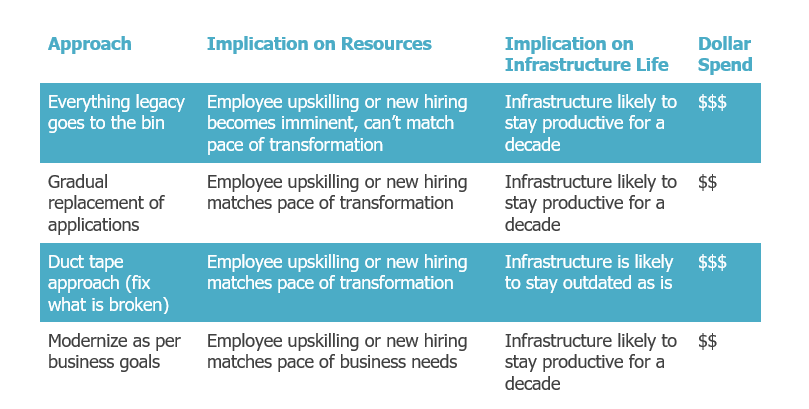
Of course, each business situation is unique and requires multifactorial consideration, yet the principle stays the same “ organizations need to look beyond present challenges. The idea here is to make the investment worthwhile and let the change stick longer. It will save them from the maintenance trap “ putting money into a sub-par infrastructure to save upfront costs in the present.
Invest in User Upskilling
The wrong software can cause us to waste time and grow frustrated “ even to the point of leaving a company. “ State of Software Happiness Report 2019
In a knowledge organization, user happiness and tool efficiency go together. Hence, another important driver of infrastructure modernization is user upskilling, precisely the approach of organizations towards the user experience.
Many organizations that took the accelerated onboarding route ended up with a slimmer ROI. Reasons “ new technology was not in unison with the rest of the software populace and users struggled to accomplish tasks or documentation was not thorough enough to allow self-troubleshooting of common hiccups, or (the most common) in-house IT team was not trained enough to support employees.
Renowned technology leaders have gone to an extent to say that modernized infrastructure would be inferior in performance to its legacy counterpart if users are not guided well in the adoption journey. A solid adoption program that develops over a smooth transition instead of an overnight metamorphosis, rewards champions, and drives a self-sustained peer-to-peer training system is an underrated yet significant driver of successful infrastructure modernization.
Don’t Rush with Pilot
This strategy is the corollary of the above. If users are exposed to the new infrastructure, little by little “ starting with an MVP, the adoption curve would be smoother. Rushing with the pilot phase of modernization, in fact, delays the process. Exposing users to the minimum viable product and addressing the concerns in the early stage itself ensures that full-implementation is free of major flaws “ the ones users could see coming.
Several organizations, especially the ones with complex infrastructure have faced operational turbulence with the buy and use approach of cloud software. No matter the level of faith vendors want you to put in, the good old business logic says “ try before you buy.
Especially for the applications that push and pull data to and from multiple data warehouses, there must be a phased trial ending up in longer load testing. The point is to have sufficient time to test the ability to work in the future IT and improvise based on feedback received early on.
The Bottomline
Infrastructure modernization is a tough recipe, takes longer to simmer and even longer to serve. Yet the success stories across business processes and industry verticals suggest it is worth investing in and waiting for the result to turn in. Usually, the goals are not static and change as the process matures. Therefore, it is important to see beyond what vendors recommend and deep into where the processes and users stand.
The modernization approach that focuses on generating lasting business advantage and incremental value to the organization doesn’t delve into combination-permutation of least budget or least business disruption, rather it looks at the bigger picture “ agility, employee confidence, and sustainable results.
