


The traditional customer journey has changed. With ever increasing innovations in technology, consumers now have access to an unprecedented array of channels and devices that give them control over exactly when and how they shop. As a result, influencing customer touchpoints and critical decisions along the path to purchase has become steadily more complex for businesses.
Despite this, a great number of customer engagement opportunities are presented by gaining an understanding of individual customer journeys and the various touchpoints involved.
The challenge for businesses is being able to track, store and effectively interpret the infinite amounts data associated with every transaction. Big Data can be daunting for many organisations, especially those who dont have a team of data scientists and analysts on staff. Not dealing with data adequately means that these businesses are missing out on actionable insights than can be essential for the development of successful customer experiences. This is where the holy grail of data marketing, the Single Customer View comes in.
The Single Customer View
A SCV is the result of collating, sorting and interrogating a myriad of customer data from a multitude of touchpoints. Giving marketers an accessible total view of customer activity, the SCV acts as an intelligent central repository for aggregated data that can understand and process the relationship between all potential touchpoints.
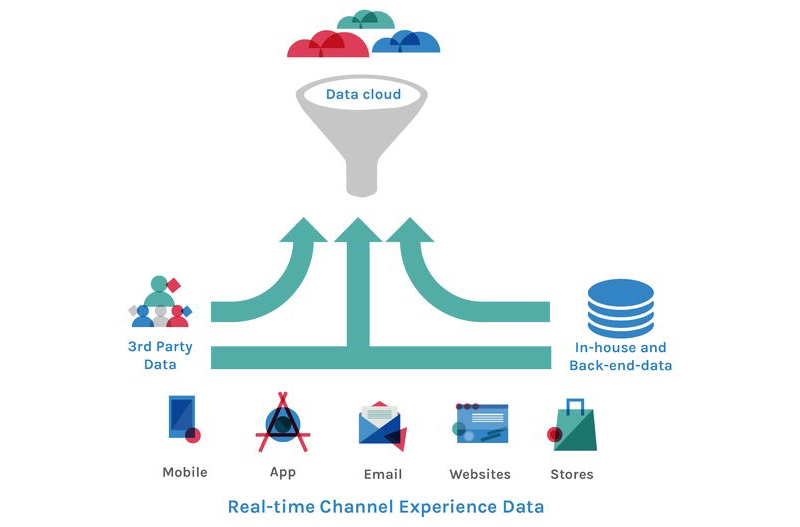
No matter how many customers a business has, an SCV can provide in-depth data on an individual customer, with activity presented in chronological order to allow tracking of an entire journey. Having a powerful holistic view of activity can provide enabled you to understand when, where and how each action was performed, giving you deep, actionable insights.
In traditionally structured companies, there will often be different customer data held in different departments, on different platforms, all analysed separately for each teams own purposes. This separation means its almost impossible to track customer journeys across multiple channels and platforms. If the internal teams are centred around different channels and operating in silos, how can any of them get a complete view of any one customer and their journey?
The Path to Purchase
Cross-channel paths to purchase are the new normal for consumers, but many organisations arent prepared for this. For example, a customer might read a marketing email from a company on their mobile during their commute, follow this up with a browse on their work PC at lunchtime, start adding items to their basket on the app, and then end up completing a purchase at home on their laptop in the evening. When viewed separately, these could be seen as four separate journeys, with only one converting to a final purchase. When theyre connected up, we can see not only the whole journey that the customer has taken, but also the touchpoints that contributed to the final sale.
The Customer Experience
Once a company has developed an understanding of the touchpoints, timing and context of individual customer journeys, they are able to add value to the customer experience by personalising interactions. This personalisation is informed by the data on specific customer preferences and behaviours that has been collected at various points along the journey.
A Single Customer View has become essential to brands who want to ensure that providing a great customer experience is at the heart of everything they do. The SCV aggregates data from all touchpoints and sources to give marketers a view of the ‘what’, ‘when’ and ‘how’ of every individual customer interaction, making it much easier to figure out the ‘why’. When the ‘why’ is understood, brands have the foundations in place to implement personalised, automated communications that can address any identified shortcomings in the product/service offering and help customers further along the sales funnel.
The Tangible Benefits
There are a number of obstacles to implementing a Single Customer View in organisations, from integrating legacy systems to a lack of resource, so its important to understand exactly what the business stands to gain from investing in this technology. Should a deeper understanding of customers and the ability to personalise communications not be persuasion enough, here are the key benefits:
- Better targeting of marketing messages, increasing effectiveness of communications and reducing wasted budget
- Increased opportunities for cross-selling, leading to a higher Average Order Value
- Identifying negative touchpoints in the customer journey, allowing for them to be corrected and increasing the likelihood of conversions
- Better informed decisions using deep data insights
- Identify customers at every touchpoint to provide better customer service and create happier, more loyal customers
We Are All Customers
As customers, we want to expend as little effort as possible to make our purchases, and have access to all of the support we might need, when we need it. We want to be confident that our decisions were the right ones, and feel satisfied enough to tell our friends and family about our shopping experiences. We want successful, satisfying customer experiences, and we want the ability to repeat them whenever we want.
In this increasingly competitive environment, businesses have to adapt to succeed. As many as 89% of companies expect that customer experience is going to be their main point of competition this year (Gartner), but less than a third are using a central data management function to collate and manage their data effectively (Royal Mail Data Services). Only 20% think that they have an actionable Single Customer View in place (Experian), so nows the time to get ahead of the curve.
