


Working with cloud applications can unlock efficiencies for small, medium, and large scale enterprises. With the added accessibility, agility, cost-effectiveness, and security, the idea of a cloud migration might seem obvious to the uninitiated decision-maker. However, transition to a cloud platform that does not match your enterprise need can do more harm than good. Hence, it is critical to work with a structured cloud migration strategy.
What is Cloud Migration?
In the simplest terms “ cloud migration is the process your business undergoes when it is trying to shift most of its data, workflow, processes, and applications to the cloud. Unlike switching between enterprise applications, the cloud migration process has a more extended gestation period since the decision will impact every touchpoint in the company‘s digital infrastructure. This is a key reason why cloud migration requires considerable groundwork, strategic planning, and reviews before the transition is conducted.
Quite frequently, cloud migration is an umbrella term used for a complete transition from legacy IT infrastructure to cloud and moving between different cloud service providers. While both the processes will look significantly different, this post covers everything you will require to make a well-informed decision.
6 Commonly Trusted Cloud Migration Strategies
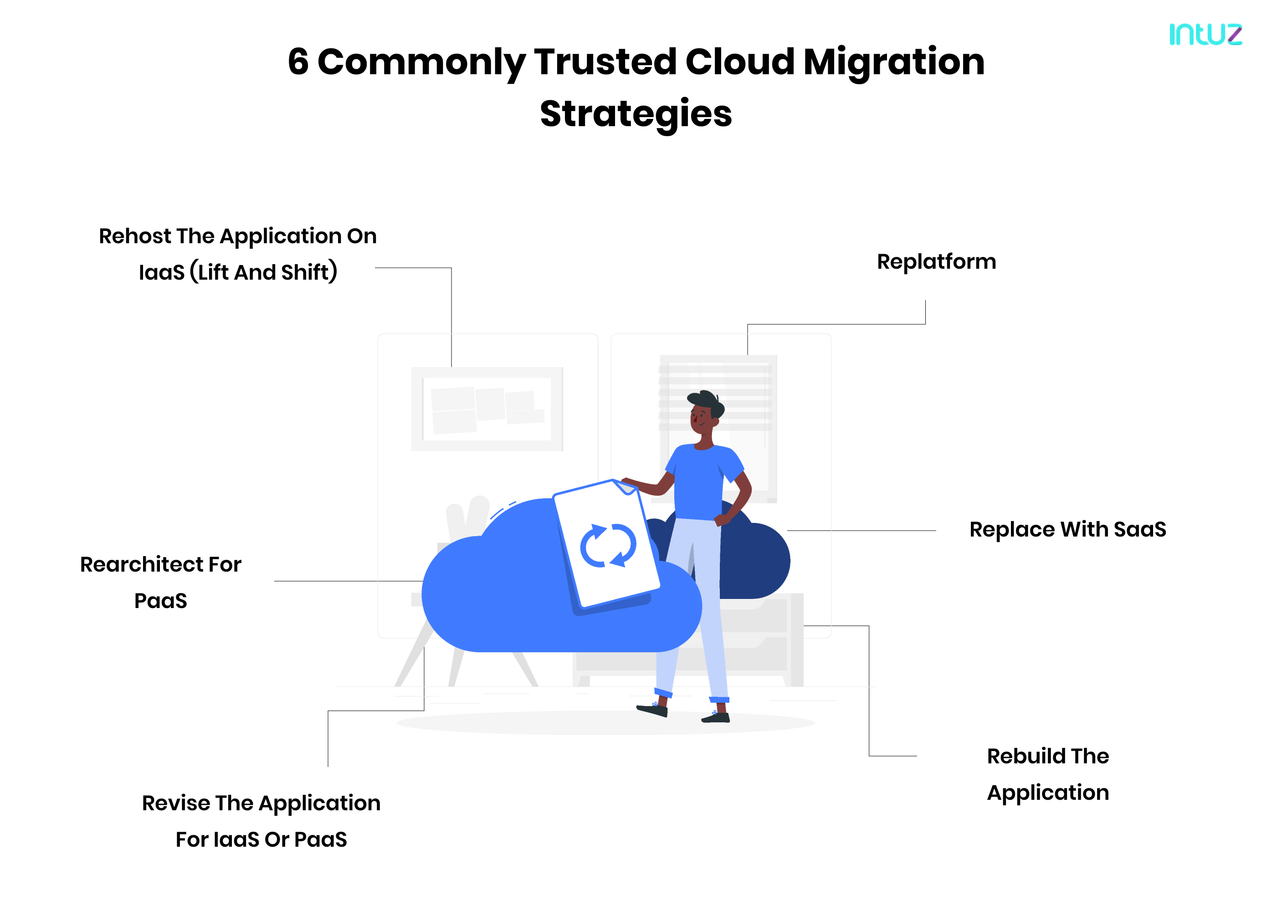
Here are the most common cloud migration techniques used by businesses of varied scales and industries:
1. Rehost the Application on IaaS (Lift and Shift)
If you are starting on your cloud migration strategy, have budget constraints, are not sure how your cost structure will scale with time and are working with a fixed deadline “ this is the strategy you should consider.
Rehost is often referred to as a lift & shift strategy since all the applications, server data, and processes are shifted to a public cloud environment. The servers are accessible in terms of both payments and scaling. Most businesses using this strategy are making payments based on their usage. This smoothens the transition process. Your IT team will use a third-party platform, a compute instance exportable image, or a containerized process to execute the transition.
2. Rearchitect for PaaS
This particular strategy is also termed refactoring or modernization. It is deployed by businesses that want a specific set of applications to be refactored for cloud use-cases. All the data, analytics, and compute workload are shifted to the cloud.
Rearchitecting applications have a significant advantage if business process continuity is a high priority concern for your team. You can decide and rank the applications that have to be refactored to the cloud, and while the process is still unfolding, your enterprise users will still have access to the onsite application data. This way, you can utilize the sunk cost in your legacy systems for a longer time, even as you migrate to a cloud platform.
3. Revise the Application for IaaS or PaaS
If you plan to work with a specific IaaS or PaaS partner and want to leverage its unique features, the revised strategy can be of great help to your business. You will end up optimizing your application to take advantage of the cloud infrastructure your applications are about to migrate to. The strategy can generate value if the features and benefits in the cloud environment eliminate considerable costs in the long run.
The strategy also has its constraints. It requires considerable investments in the early stages as the codebase must be optimized for the cloud platform. Post this, you can use any of the other strategies to perform the actual migration.
4. Rebuild the Application
Much like the revised strategy, if your goal is to operate with a Platform-as-a-Service model, the rebuilding strategy can be of tremendous help. Your team will have to initiate the process by abandoning the existing codebase and internally used frameworks. Then, the application will have to be rearchitected for the new platform.
The underlying assumption that makes this strategy work for several companies is mainly dependent on the cloud platform’s value proposition. If the features, functionalities, and tools offered by the platform can help your developers get a better grip on the application and enhance security, accessibility, and productivity, the strategy might be worth considering for your cloud migration plan.
The critical issue with the strategy is that it creates dependence on the PaaS partner. If for any reason, the cloud vendor undergoes a price revision, Service Level Agreement breach, or technical issues, your team will lose access to the applications in the cloud environment.
Â
5. Replace with SaaS
If your company has been planning to forego its internal legacy applications and migrate to a more sophisticated third-party platform “ this is the strategy you should consider. The primary benefit of proceeding with this strategy is the frictionless application migration process. You are not putting upfront costs to migrate the applications. You are not even supposed to upgrade your existing infrastructure or focus on Rearchitecting applications.
The seamless transition is great if you are working with a trustworthy vendor. But, like other cloud-vendor-centred strategies, this one also has the issue of dependence. If the cloud services platform does not match your accessibility, security, and flexibility requirements, you might face data semantics inconsistencies, vendor lock-in, and suboptimal output.
6. Replatform
Once you have decided to migrate your applications to the cloud comprehensively, you will find a ton of value in replatforming. You can focus on this particular strategy after you have reasonably executed the application rehosting and refactoring. The performance of the cloud-based workload will have an impact on the replatforming strategy’s output as well.
From a cost standpoint, replatforming is cost-effective but requires some investments. It sits perfectly between refactoring and rehosting. If you can stick to migrating standard applications, invest in basic cloud automation, and keep the project scope under check, you can take advantage of the replatforming strategy. With minute changes to the codebase, you will be able to extend the capabilities of your applications to practically any cloud provider without worrying about lock-in issues. Essentially, the cloud development process is streamlined due to the lesser need for revising the legacy codebase.
It would be best if you considered this strategy only after examining the expected operational changes your company is planning in the next few months & years.
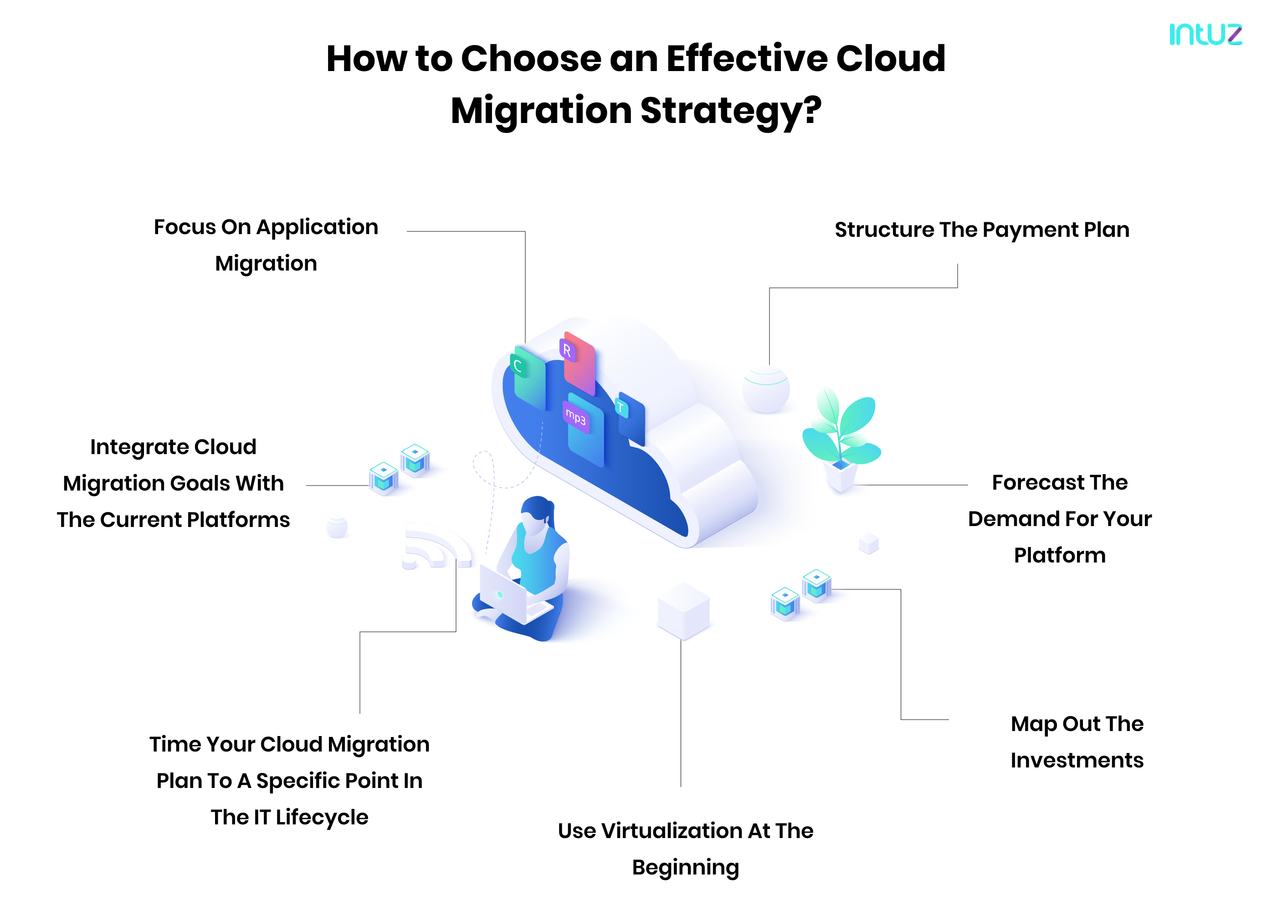
How to Choose an Effective Cloud Migration Strategy?
Â
Here are some tips you can consider to simplify your cloud migration plan further:
1. Focus on application migration out of need realized posed deliberate analysis.
2. Your application performance, IT operating costs, and enterprise technology’s alignment with corporate strategy should be optimized with the cloud migration plan.
3. Time your cloud migration plan to a specific point in the IT lifecycle when considerable changes are around the corner “ legacy assets reaching the limit of their usable life, data centre contract expiry, technology stack changes, higher demand for cloud capability from users, etc.
4. There will be some redundancy when your cloud migration plan is still unfolding. You will have applications hosted on both on-premise infrastructure and the cloud. But, as the migration is completed, you can shift entirely to the cloud. This point will help you answer any opposition you face within the business against investing in redundant assets.
5. Use virtualization at the beginning of the migration lifecycle instead of focusing entirely on lift & shift.
6. Map out the investments already allocated to your legacy infrastructure capacity upgrades.
7. Forecast the demand for your platform and structure the payment plan that best suits it. For instance “ some industries have cyclical storage needs based on buyer behaviour. Business operating in such industries should focus on pay-as-you-go plans to optimize costs.
Conclusion
Â
The strategies presented here are not mutually exclusive. They can be used in combination and phased approaches to ensure optimal transition to the cloud. Ensure you take a complete account of your existing legacy on-premise infrastructure, its usage, and the need for cloud expansion before you chart your cloud migration plan. This will help you get inputs on deciding whether you must Rehost, Rearchitect, Revise, Rebuild, Replace, or Replatform your applications.Â
