


At the heart of good marketing is data. And when data drives your marketing, the average return on investment (ROI) is a whopping 224%! (VB Insight)
VB Insight surveyed over 3,000 marketers and looked at tools used on over 3 million websites. Even small improvements have the potential to drive higher ROI. According to the research, if your business has a 4-phase customer acquisition funnel, and you improve each phase of the customer acquisition funnel by as little as 5%, the overall improvement is 22% at the bottom of the funnel.
Customer data has clearly become a valuable currency for marketers of all sizes and across all industries. However, if you feel as if you are downing in a sea of data, here are some key ways to drive more revenue with better marketing and better data.
Break Down the Silos
You may have loads of data, but if its sitting in different systems and in various formats, your data is doing you no good. For example, your billing records may be stored in one system with certain customer details, and your customer service logs may be stored in another database with an entirely different set of customer information.
Each of these sources contain important customer details basic information such as contact details, as well as more detailed information, such as behavior information (frequency of purchase, transaction value, email click-throughs, and so on.)

A data management solution should be implemented to integrate multiple data sources and automate data quality processes. Data management software will perform functions such as:
- Cleanses and standardizes data so consistent formats can be integrated
- Consolidates customer data into a single record
- Eliminates duplicate data records
- Monitors data to ensure it remains accurate
- Appends missing customer information (email address, street address, etc.)
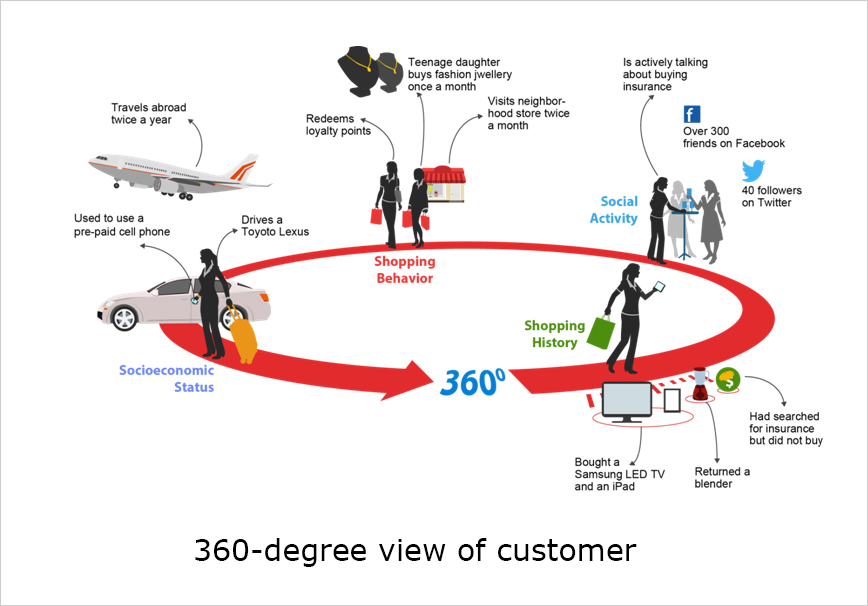
A 360-degree Customer View
By merging these systems of data into a single repository, customer details come together into a 360-degree view. With this singular customer view, you can apply analytics to accurately understand what your best customers look like and find answers to key questions such as:
- What products have they purchased, and what is their purchasing behavior?
- How do I keep my best customers loyal?
- What channels do my customers and prospects prefer?
- What opportunities are there to maximize customer value through up-sell or cross-sell offers?
- What patterns may indicate unhappy customers and how can I mitigate attrition risk?
Customers Want Personalized Experiences
Your customers ultimately want to be understood they expect a seamless experience with your company, want personalized offers and are more receptive to messages sent through the channels they prefer.
Salesforce.com asked consumers how they felt about their data being collected by companies to establish this comprehensive customer view. The overall feeling was that if their marketing data allowed companies to personalize offers, provide better customer service, or prevent situations in which they have to give the same information to multiple people over and over, then it was a good thing. One respondent said, I dont want to have to repeat my information to 5 different people when I call their support line, and according to another, It dramatically increases the likelihood that I would continue to give a company my business.
Research shows that 45% of consumers are more likely to shop on a site that offers personalized recommendations, and 56% are more likely to return to a site that recommends products. (Invesp)
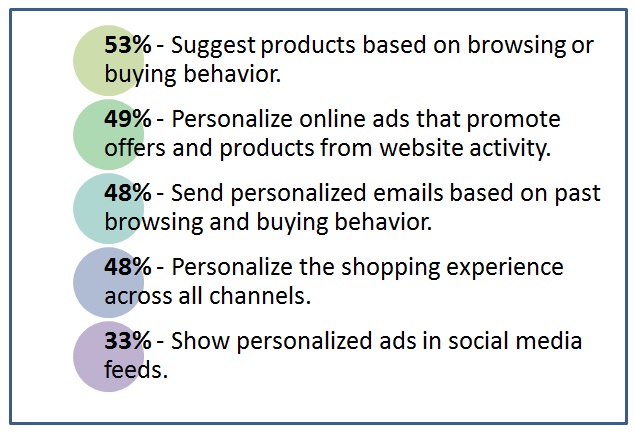
When deciding which types of personalization to utilize, consider the following statistics from MyBuys 2015 Personalization Consumer Survey. Consumers purchase more from brands who:
While there is obviously huge uplift when personalizing consumer interactions, many marketers are unaware of the negative impacts of sending impersonal messaging. A recent survey by Gigya revealed that 67% of consumers have unsubscribed from an email list when sent irrelevant information. An additional 43% ignored future communications from the company, and 32% stopped visiting the companys website or mobile app.
At the heart of good marketing is data. Your data can tell you who your customers are, what will keep them loyal, what offers they will respond to, and ultimately, how to drive higher revenue.
