


I. Introduction: The Double-Edged Sword of GenAI
The development of enterprise automation through Generative AI (GenAI) enables virtual assistants and chatbots to understand user intent, so they can create suitable responses and predictive actions. The promising benefits of continuous intelligent interaction at scale create multiple ethical challenges that include biased outputs and misinformation alongside regulatory non-compliance and user distrust. The deployment of GenAI is no longer a question of capability, but it has evolved into a matter of responsibility and appropriate implementation methods. The McKinsey report indicates that more than half of enterprises have started using GenAI tools which primarily focus on customer service and operational applications. The growing scale of this technology produces corresponding effects on fairness standards and security measures and compliance requirements. GenAI chatbots have already started transforming public and private interactions through their implementation in banking virtual agents and multilingual government helplines.
II. Enterprise-Grade Chatbots: A New Class of Responsibility
Consumer applications usually tolerate chatbot errors without consequence. The risks in enterprise environments such as finance, healthcare and government are much greater. A flawed output can lead to misinformation, compliance violations, or even legal consequences. Ethical behavior isn’t just a social obligation; it’s a business-critical imperative. Enterprises need frameworks to ensure that AI systems respect user rights, comply with regulations, and maintain public trust.
III. From Prompt to Output: Where Ethics Begins
Every GenAI system starts with a prompt-but what happens between input and output is a complex web of training data, model weights, reinforcement logic, and risk mitigation. The ethical concerns can emerge at any step:
- Ambiguous or culturally biased prompts
- Non-transparent decision paths
- Responses based on outdated or inaccurate data
Without robust filtering and interpretability mechanisms, enterprises may unwittingly deploy systems that reinforce harmful biases or fabricate information.
IV. Ethical Challenges in GenAI-Powered Chatbots
- The training process using historical data tends to strengthen existing social and cultural biases.
- The LLMs produce responses which contain both factual inaccuracies and fictional content.
- The unintentional behavior of models can result in the leakage of sensitive enterprise or user information.
- The absence of multilingual and cross-cultural understanding in GenAI systems leads to alienation of users from different cultural backgrounds.
- GenAI systems lack built-in moderation systems which enables them to create inappropriate or coercive messages.
- The unverified AI-generated content spreads false or misleading data at high speed throughout regulated sectors.
- The lack of auditability in these models creates difficulties when trying to identify the source of a particular output because they function as black boxes.
These challenges appear with different levels of severity and display different manifestations based on the specific industry. The healthcare industry faces a critical risk because hallucinated data in retail chatbots would confuse customers but could result in fatal consequences.
V. Design Principles for Responsible Chatbot Development
The development of ethical chatbots requires designers to incorporate values directly into their design process beyond basic bug fixing.
- The system includes guardrails and prompt moderation features which restrict both topics and response tone and scope.
- Human-in-the-Loop: Sensitive decisions routed for human verification
- Explainability Modules: Enable transparency into how responses are generated
- The training data must include diverse and representative examples to prevent one-dimensional learning.
- Audit Logs & Version Control: Ensure traceability of model behavior
- Fairness Frameworks: Tools like IBM’s AI Fairness 360 can help test for unintended bias in NLP outputs
- Real-Time Moderation APIs: Services like OpenAI’s content filter or Microsoft Azure’s content safety API help filter unsafe responses before they’re seen by users
VI. Governance and Policy Integration
All enterprise deployments need to follow both internal organizational policies and external regulatory requirements.
- GDPR/CCPA: Data handling and user consent
- EU AI Act & Algorithmic Accountability Act: Risk classification, impact assessment
- Internal AI Ethics Boards: Periodic review of deployments
- Organizations should implement real-time logging and alerting and auditing tools for continuous compliance monitoring.
Organizations should assign risk levels to GenAI systems based on domain, audience and data type which can be low, medium or high risk. AI audit checklists and compliance dashboards help document decision trails and reduce liability.
VII. A Blueprint Architecture for Ethical GenAI Chatbots
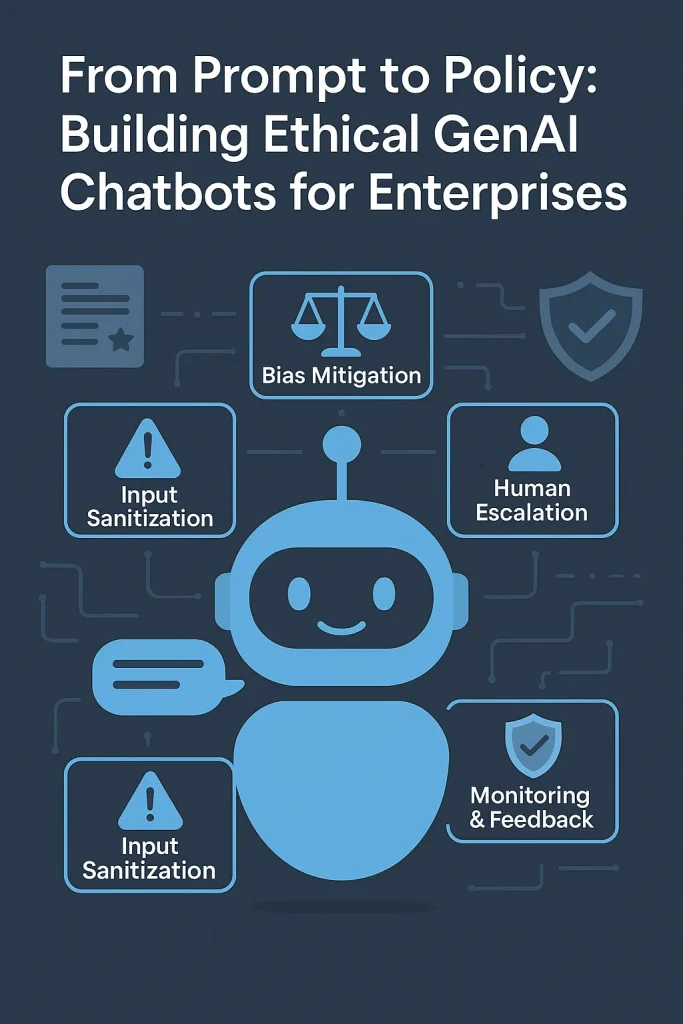
An ethical GenAI chatbot system should include:
- The Input Sanitization Layer identifies offensive or manipulative or ambiguous prompts in the system.
- The Prompt-Response Alignment Engine is responsible for ensuring that the responses are consistent with the corporate tone and ethical standards.
- The Bias Mitigation Layer performs real-time checks on gender, racial, or cultural skew in responses.
- Human Escalation Module: Routes sensitive conversations to human agents
- The system includes a Monitoring and Feedback Loop that learns from flagged outputs and retrains the model periodically.


Figure 1: Architecture Blueprint for Ethical GenAI Chatbots (AI-generated for editorial clarity)
Example Flow: A user enters a borderline medical query into an insurance chatbot. The sanitization layer flags it for ambiguity, the alignment engine generates a safe response with a disclaimer, and the escalation module sends a transcript to a live support agent. The monitoring system logs this event and feeds it into retraining datasets.
VIII. Real-World Use Cases and Failures
- Microsoft Tay: A chatbot became corrupted within 24 hours because of unmoderated interactions
- Meta’s BlenderBot received criticism for delivering offensive content and spreading false information
- Salesforce’s Einstein GPT implemented human review and compliance modules to support enterprise adoption
These examples demonstrate that ethical breakdowns exist in real operational environments. The question is not about when failures will occur but when they will happen and whether organizations have established response mechanisms.
IX. Metrics for Ethical Performance
Enterprises need to establish new measurement criteria which surpass accuracy standards.
- Trust Scores: Based on user feedback and moderation frequency
- Fairness Metrics: Distributional performance across demographics
- Transparency Index: How explainable the outputs are
- Safety Violations Count: Instances of inappropriate or escalated outputs
- The evaluation of user experience against ethical enforcement requires assessment of the retention vs. compliance trade-off.
Real-time enterprise dashboards display these metrics to provide immediate ethical health snapshots and detect potential intervention points. Organizations now integrate ethical metrics into their quarterly performance reviews which include CSAT, NPS and average handling time to establish ethics as a primary KPI for CX transformation.
X. Future Trends: From Compliance to Ethics-by-Design
The GenAI systems of tomorrow will be value-driven by design instead of just being compliant. Industry expects advances in:
- New age APIs with Embedded Ethics
- Highly controlled environments equipped with Regulatory Sandboxes for testing AI systems
- Sustainability Audits for energy-efficient AI deployment
- Cross-cultural Simulation Engines for global readiness
Large organizations are creating new roles such as AI Ethics Officers and Responsible AI Architects to monitor unintended consequences and oversee policy alignment.
XI. Conclusion: Building Chatbots Users Can Trust
The future of GenAI as a core enterprise tool demands acceptance of its capabilities while maintaining ethical standards. Every design element of chatbots from prompts to policies needs to demonstrate dedication to fairness transparency and responsibility. Performance does not generate trust because trust exists as the actual outcome. The winners of this era will be enterprises which deliver responsible solutions that protect user dignity and privacy and build enduring trust. The development of ethical chatbots demands teamwork between engineers and ethicists and product leaders and legal advisors. Our ability to create AI systems that benefit all people depends on working together.
Author Bio:
Satya Karteek Gudipati is a Principal Software Engineer based in Dallas, TX, specializing in building enterprise grade systems that scale, cloud-native architectures, and multilingual chatbot design. With over 15 years of experience building scalable platforms for global clients, he brings deep expertise in Generative AI integration, workflow automation, and intelligent agent orchestration. His work has been featured in IEEE, Springer, and multiple trade publications. Connect with him on LinkedIn.
References
1. McKinsey & Company. (2023). *The State of AI in 2023*. [Link](https://www.mckinsey.com/capabilities/quantumblack/our-insights/the-state-of-ai-in-2023 )
2. IBM AI Fairness 360 Toolkit. (n.d.). [Link](https://aif360.mybluemix.net/ )
3. EU Artificial Intelligence Act – Proposed Legislation. [Link](https://artificialintelligenceact.eu/ )
4. OpenAI Moderation API Overview. [Link](https://platform.openai.com/docs/guides/moderation )
5. Microsoft Azure Content Safety. [Link](https://learn.microsoft.com/en-us/azure/ai-services/content-safety/overview )