


Sports events fascinate and charm millions of people around the world, whether it is one of the Grand Slams, the UEFA Champions League, or the Olympics. But in the backstage, there’s a number of things, with technology at the top, that make those events brighter and smarter.
Indeed, today’s sports world is becoming tech savvy by bringing together athletes’ natural talent, accurate analytics, and artificial intelligence (AI). The latter two are also successfully used to enhance decision-making and gain a competitive advantage over the competitors.
This article will discuss various uses of AI in sports, including real time reporting, robotic coaching, and journalism.
An expert statistician
In combination with sensor systems, AI is able to analyze players’ performance and provide accurate real time match statistics: scores, speed, distance, strength, percentages of possession, and more ” depending on type of sport.
A notable example is Hawk-Eye, a sophisticated vision processing technology combined with an intelligent video replay and a creative graphics platform. This AI-driven tool tracks balls to millimeter accuracy and is adopted in many sports, including but not limited to tennis, football, baseball, and snooker.
At some events, this technology is applied to make the game fairer, safer, and smarter. For instance, in tennis and volleyball, players and coaches have the right to make an official call to the system if they are not sure about the judges’ decisions.
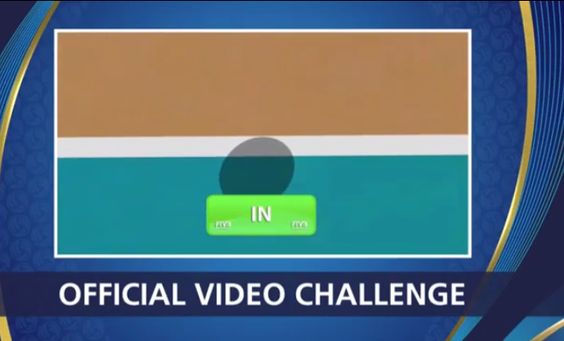
Hawk-Eye in volleyball; source: hawkeyeinnovations.com
In snooker, in turn, the Hawk-Eye software is aimed at entertaining and educating viewers by showing them animated shots, possible angles and cannons, potting distance, or ball paths.
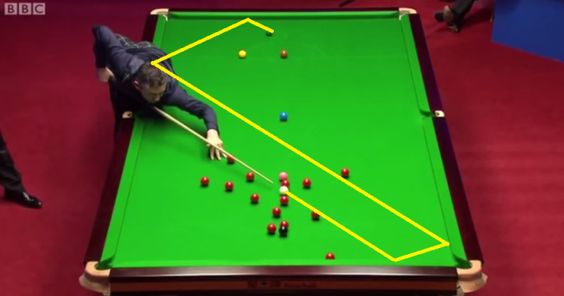
Source: maximummedia.ie
In tennis, AI has gone further, assisting sensor systems in providing such data as serve speed and direction, ball placement, groundstroke hit points, topspin speed and rate, bounce height, and more.
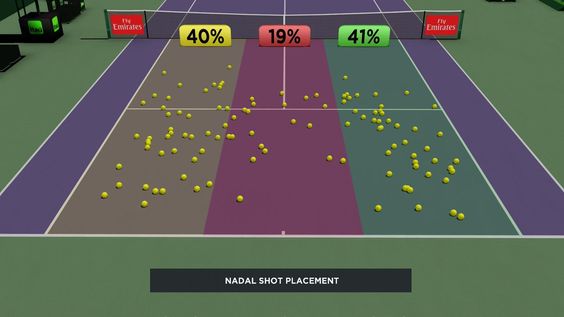
Source: twimg.com
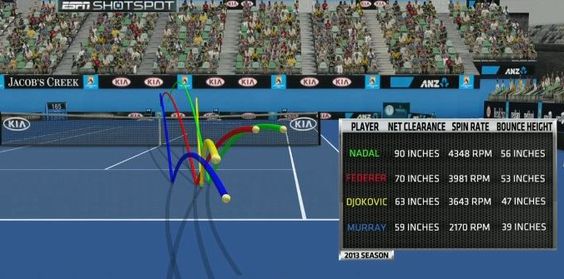
Source: ESPN
A smart assistant coach
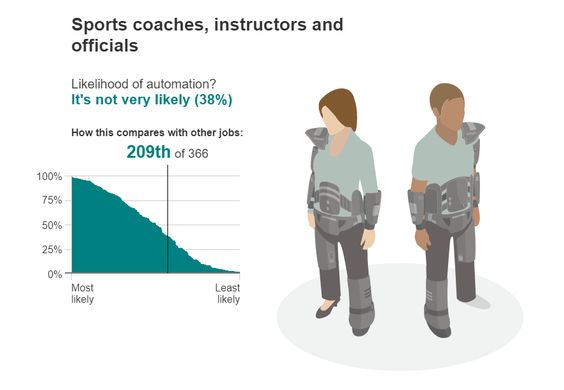
Oxford University and Deloitte predict a bright future for robots in an array of professions. According to their system, able to assess the automation risk of any job, coaches are unlikely to be replaced by robots in the next two decades, though the percentage is quite high, compared to other careers.
Source: bbc.com
AI may become a professional assistant coach. By relying on data analytics, managers and coaches can enhance the winning chances of their teams. They get a possibility to track sportsmen both on and off the field and to create a database with all of the player intelligence stored in: current conditions, strengths and weaknesses, field dynamics, and more. The analysis of this information helps to improve decision making within the team.
Beyond that, coaches can benefit from a machine analysis of rivals. The obtained data may play a key role in changing the tactics and strategy for next matches.

Source: bbc.com
Scouting in sports is becoming digital as well. Providers of custom business intelligence solutions offer a wealth of ways to improve marketing efforts.
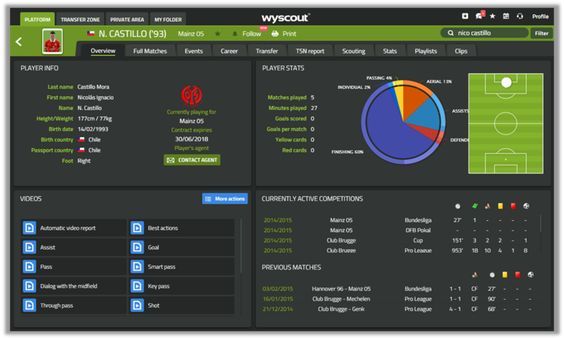
For example, the Wyscout platform delivers all the relevant data and helps famous football clubs, such as Real Madrid and Juventus, to make better purchasing decisions. The Manchester City FC, in turn, has its own approach to transfers and marketing.
Source: live-production.tv
Despite the fact that AI tools are becoming widespread in many sports (basketball, cricket, baseball, horse riding, and more), football and rugby seem the most prosperous ones in terms of collecting and processing data for coaches.
A journalist who never sleeps
According to Oxford job automation research, the chance of robots stealing journalists’ jobs within the next two decades is merely 8%. However, the situation may change at any moment. Let’s see why.
In 2015, Automated Insights (Ai), an American software company, hit the tech world with its new NLG solution ” Wordsmith. This AI system processes lots of data, performs a quantitative analysis, and uses style and grammar rules to create stories.
Ai’s major customers are Associated Press (AP) and Yahoo! that effectively implement this NLG solution to write quick summaries of sports events without human intervention.
The Associated Press

Source: automatedinsights.com
This non-profit news agency is sure AI proves its worth, giving the name to such a term as robo-journalism .
The AP has already put this technology into practice to expand its coverage of Minor League Baseball. Wordsmith uses the relevant data provided by Major League Baseball Advanced Media (MLBAM) and then turns raw stats into well-written recaps.
Here you can find a report from one of the matches and see for yourself that AI in sports is not a chapter from a sci-fi book.
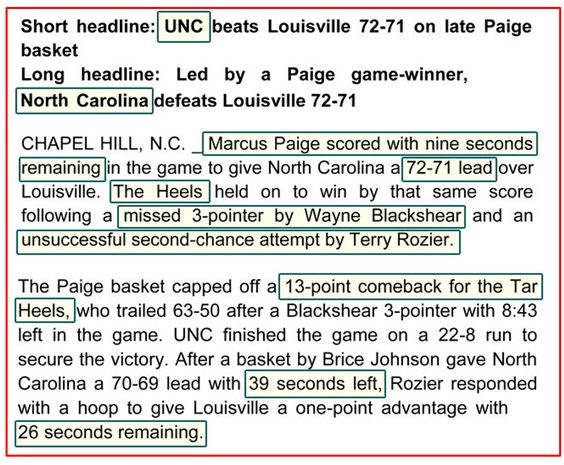
Baseball is not the only type of sports covered by AI. The AP also employs this technology to deliver fully automated recaps of basketball matches.
Here you can see some extracts from one of such matches:
Source: bbc.com
To compare the efforts made by the machine and human journalists, check CBS Sports‘ and ESPN‘s reports about the same event.
Yahoo!
Source: automatedinsights.com
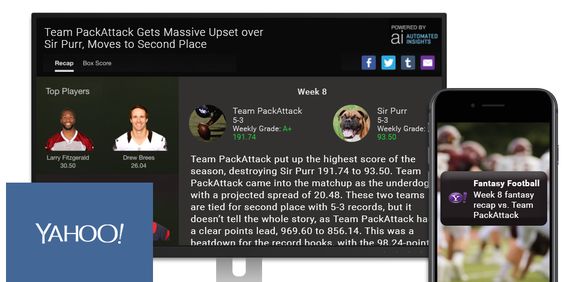
This web services provider has found another application for Wordsmith in sports. Yahoo! collaborates with Automated Insights within the framework of its Fantasy Football League. They turn fantasy football data into commentaries, previews, and digests, allowing every fantasy owner to make their team worthier.
Thanks to this technology, Yahoo! has increased the average number of readers, engaging its audience to the full, and, as a result, growing its profit margins.
How machines analyze sports matches
Researchers from India have shown that machines are able to produce cricket match commentaries with 90% accuracy. To make all that possible, computers surveyed hundreds of cricket videos from YouTube and commentaries of about 300 matches from the Cricinfo database.
According to the scientists, machines analyzed YouTube videos, grouped them into certain categories, and broke longer videos into smaller ones to examine each shot. After that, machine learning algorithms came into the picture. They found the already available text descriptions from the database and matched them with video shots. As a result, such algorithms managed to exactly categorize shots by using visual recognition.
The same researchers say tennis represents another sport where applying computer algorithms could result into accurate text commentaries.
On a final note
This article has outlined a wide range of AI uses in sports. Some of these practices, for instance, real time statistics and Hawk-Eye, has already won the trust of team managers, coaches, athletes, and fans.
However, other uses, such as robo-journalism, need improvements and enhancements to be widely implemented. In particular, text commentaries are not as sophisticated as those written by human journalists, and machines are far from creating appealing sports articles.
All in all, it’s evident AI is disrupting the future, making big advances in sports.
