


Henry Ford was not the first to use an assembly line process for manufacturing, he was one of the most innovative. He reached higher efficiency on his production floor than his competitors and did it all without the analytics we have today. While not all of his techniques are proving to be as useful in office settings as they are in the factory, other industries can learn a lot from Ford’s methods.
One of the most useful things to take in is to focus on doing things in a way that helps achieve peak productivity rather than the way it has always been done.
The reason we still work an eight-hour workday, five days a week is because that was the optimal production schedule Ford discovered 100 years ago. Today, however, many businesses are taking a page out of Ford’s book by exploring a shorter workweek and flexible schedules.
What worked best in a factory almost a century ago may not help the modern workforce achieve the greatest results. Whether in the office or on the factory floor, the key to optimizing efficiency is data. Without data, we wouldn’t know for sure what are the bottlenecks, where the productivity decreases, and what are the optimal workflows to grow on.
Here are 5 reasons data is one of the most important factors in the modernization of any assembly lines.
1. Artificial Intelligence Can Find Critical Patterns To Help Us Optimize Performance
Human intelligence will always trump artificial intelligence because humans can make intuitive leaps to cover gaps in data that artificial intelligence cannot. AI has at least one distinct advantage over human intelligence “ it can scan thousands of items of data in a fraction of the time it would take the human brain to do the same.
Thus the big data term. The emergence of cloud storage that can accommodate a huge amount of data gave rise to analytic platforms that do the work for us and revolutionize many industries.
Artificial intelligence can also find patterns in a whim that would humans longer to find. While past performance may not be a guarantee of future improvements that doesn’t mean the factors that affected past performance aren’t critical to understanding for ongoing optimization.
Data analysis of both past performance and other contributing factors can help businesses optimize their stations and production cycles. Manufacturing companies are becoming not only data-driven but also greener, and those jobs are now seen rather as green-collar jobs than gold collar ones. Analytics play a huge part in that area.
Data allows factories to figure out how much waste they produce, how to optimize inventory and production cycles and move closer to just-in-time production.
2. Artificial Intelligence Can Run Thousands Of Simulations To Determine Optimal Performance
Mountains of generated data give modern day factories a significant advantage that Ford did not have. While Ford may have learned by trial and error, it could sometimes take months to see what was working and what wasn’t.
Sometimes even small changes drive production down rather than up. Masses of data allow simulations of different scenarios so we can determine optimal performance conditions that take both humans and machinery into account.
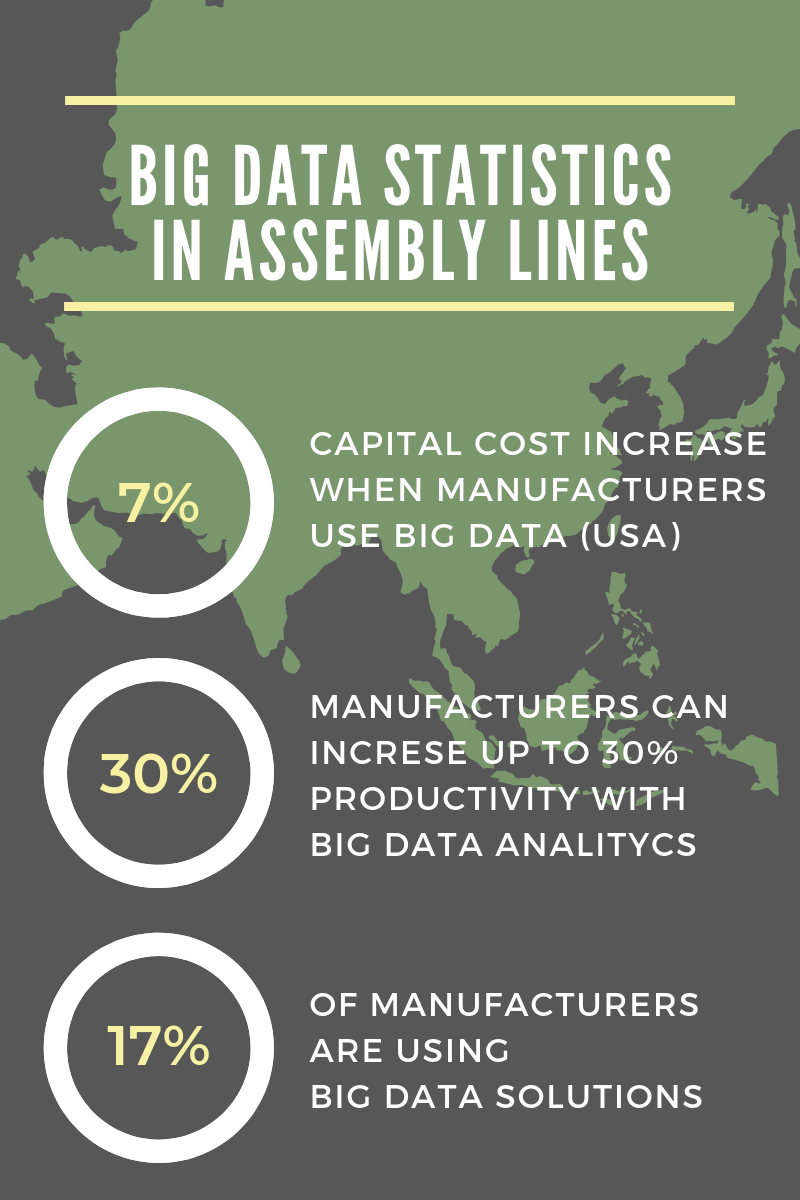
Together, data analytics and artificial intelligence can help to:
- Shorten production cycles
- Improve product quality
- Increase employee safety
- Predict equipment functionality
- Minimize unplanned stops
- Better manage supply chain
- Achieve better robot-human collaboration, and more
For instance, running machinery for a certain period at certain speeds may lead to overheating or wearing out some machine parts. Machines may always work at the same pace or speed while we can’t. For both machine and human work optimization, data and analytics go a long way.
Data reports allow factory management predictive maintenance of machines and to figure out which workers speed up over the course of their shift and which ones slow down, so they can tailor the floor operations based on those insights.
3. Data Doesn’t Have A Perspective Or An Agenda
In the 1930s a Toyota executive named Taiichi Ohno visited Ford’s plant in Detroit. He was impressed by Ford’s assembly line but also impressed by the delivery system used by the local supermarket chain.
Ohno returned to Japan and was instrumental in creating the Toyota Production System, elements of which have been modeled by businesses as far reaching as 3M and Apple. One improvement that Ohno made upon Ford’s system was the participation of every employee in continual process improvement.
As beneficial as this may be, human beings are and will always be complex creatures that act on a variety of motivations. We are infamous for not seeing what we don’t want to see. Computers suffer no such uncertainty. This makes data collection an indispensable mean for human intelligence.
4. Data Can Be Collected From External Sources About External Factors That Can Affect Production
There are millions of variables that can affect production, from shipping to mining operations halfway across the world. Connected tech is helping factories analyze data from around the world that might impact operations.
For example, a small civil riot in rural China may not even make national news. If that uprising occurs in a village of larger producers of cadmium, that could have a significant effect on battery production, which could affect the manufacturers of a wide range of electronics.
By recognizing a small event that could have a massive ripple effect, data collecting bots can help businesses prepare well in advance for what could otherwise be cataclysmic events that no one saw coming.
5. Data Can Help Actively Optimize Production
Even if you were to achieve a perfect production level, it would not stay perfect for long. There are too many variables that are changing. Once again, artificial intelligence is no substitute for human intelligence, but it provides a priceless source of information to help humans make better decisions. Poor decision making stems from one of two sources:
- a lack of information
- an abundance of information that’s too big to process
Artificial intelligence bridges this gap by providing a wealth of information and the means to process it. By 2020 there will be over 21 billion connected devices generating an unprecedented amount of data. This data would be useless without the means to compile and analyze it. Artificial intelligence and machine learning do just that.
Data combined with artificial intelligence can help usher manufacturing into the next century of progress, allowing it to continue to be one of the front runners in innovation that all other businesses follow.
