


Modern technology is gaining steam by the month, changing the way we live our everyday lives. Without a doubt, the field of eCommerce is no exception, with virtual assistants, bots, and artificial intelligence-powered technologies becoming an inevitable part of the online world.
Business owners do their best to keep up with the trends, constantly investing in the implementation of top-notch features to the site, building progressive web applications to enhance mobile conversions, and optimizing what they can to stay at pace. Of course, AI is already impacting online sales one way or another, thus, in this post, we’ll cover five interesting ways that AI is changing the eCommerce game. We’ll give examples of such AI use for inspiration too. Let’s get started!
1. Image Search via Recognition
The first point that surely deserves attention deals with image search. While Google‘s ability to help you find similar images based on what you’ve uploaded is cool in itself, using such capabilities to enhance the customer‘s shopping experience is simply outstanding. Let’s face it, everyone is online, sharing looks and ideas about what they’ve bought or created. Just take the Pinterest phenomenon as an example.
As a person browses social media or the web, he/she often comes across something they see on someone else and that they like and want. Habitually, they save the picture for later, create a pin, or make a screenshot. What happens next? They may start keeping an eye out for something similar as they shop. And if they come across the item by some quirk of fate, there’s a pretty big chance that they’ll buy it.
So how does AI boost these chances? Yes, by offering to do the hunt based on the uploaded photo. For instance, below is a screenshot taken on the page of StyleSnap by Amazon. The user gets the chance to make a search on the basis of a photo that they have on their device. Look at the central image (the uploaded photo), StyleSnap detects the items of the look that it should looks for and marks it with dots and highlighted rectangle. Then, in just a few seconds we see the results of the products that you can buy in the store among the Featured Similar Styles .
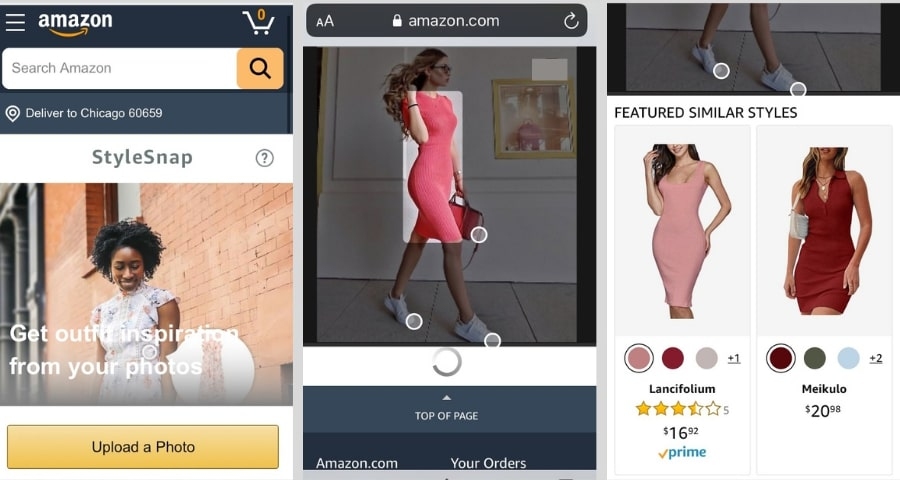
Screenshot taken on the official Amazon website
This approach saves a bunch of your clients’ time and can ultimately make them happier as they could quickly obtain a desired item without the need to spend a ton of time searching the web for a suitable match on their own. On another note, this move also gives online sales the benefit of striking while the iron’s hot , meaning that you can close the sale while the potential buyer is still enthusiastic about buying something.
2. Search Using Voice
Without a doubt, the second way that artificial intelligence is impacting the sphere of online sales deals with voice search. More and more people use Alexa, Siri, and other analogous voice assistants and technology for making search requests.
In essence, this means that to be successful and compatible in the long run, any online store should be capable of communicating and answering such queries. What’s implied by this is that people search for things with text and by voice using different wording and phrasing. And this means that classic SEO is, therefore, changing as well.
Case in point to compare. Let’s assume that you want to purchase an air humidifier. If you’d use text search this inquiry would most likely be air humidifier buy or something along those lines. If you were to ask Alexa this would sound like a full-sentence request just as you’d talk to your friend Alexa, I want to buy an air humidifier. Could you please find me one with free shipping and no more than 130$? .
With such a leap in request content, your online store has to be able to respond to both types of queries, to help IoT and AI-assistants find you, which requires a different way of handling SEO. Even Google already has a microphone icon right within the search bar for you to activate voice search. Thus, do your best to start optimizing your store for voice requests.
3. AI-Powered Digital Assistants
Speaking of enhancing communication, smart chatbots that are incorporated right into your eCommerce website can bring way more advantages than you might think at first. Well, to say the least, it can take a big load off your shoulders as it can answer your customers‘ most commonly asked questions in real-time. And round-the-clock too!
Even if the same idea is typed in by a person with different wording, the bot recognizes the intent and gives replies that do cover over half of the queries that could have fallen on your customer support team. Automation, efficiency, and learning on the go (these are the main strengths of such chatbots).
Take a look at the Digital Assistant on the official Calvin Klein website. It starts communication right after being launched and offers several topic categories to simplify the dialogue. Plus, since it runs on the basis of a script, it gives automatic replies without wasting the client’s time for waiting for a real human to give a consultation.
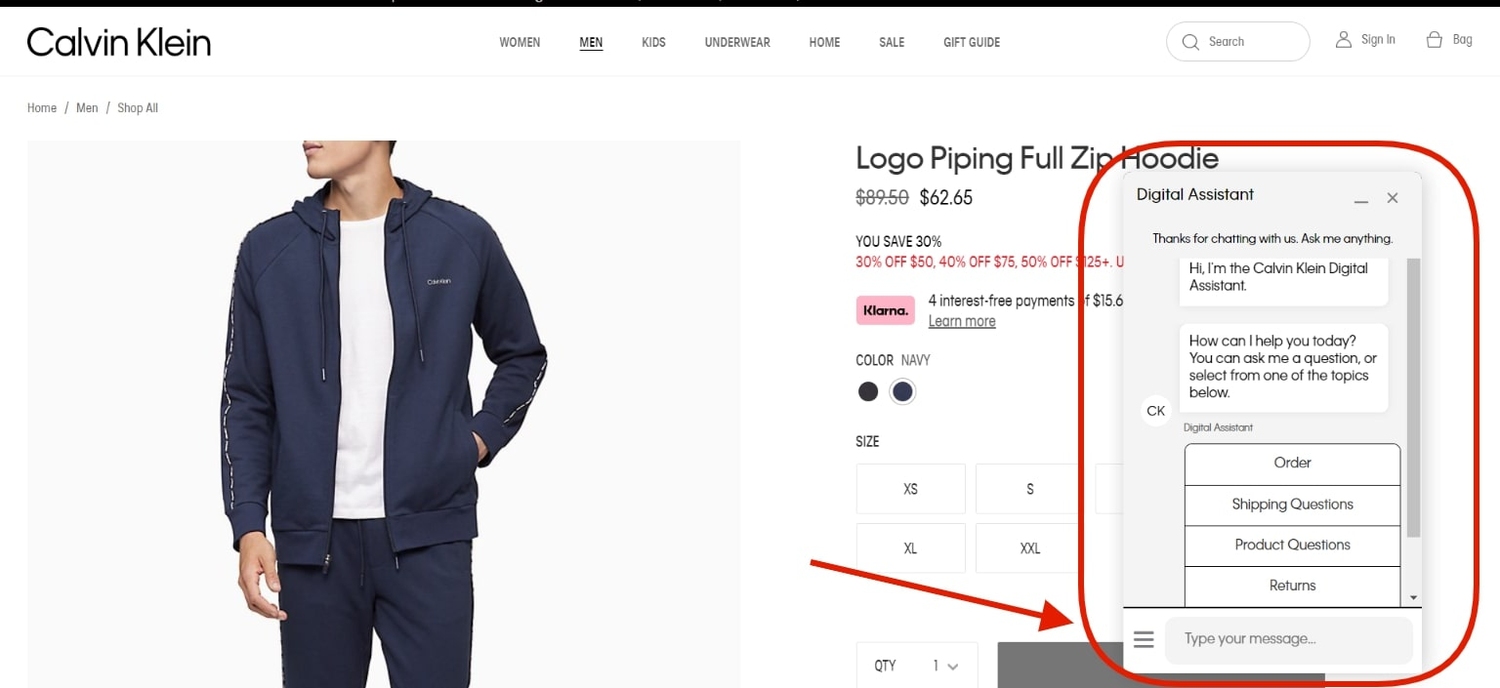
Screenshot taken on the official Calvin Klein website
4. Smart Upselling Sections
Anyone who knows at least one thing about sales will agree that a big deal of the revenues come from selling additional goods. This is exactly why it makes a lot of sense to pick up your game and start offering something a bit more than just a casual set of upselling blocks featuring something X Brand Recommends .
Artificial intelligence already has smart solutions that are capable of monitoring user behavior and allocating those items that should be put in the You May Also Like sections of a product page. As a rule, these blocks don’t just pitch similar products. If the block is run on AI, it’ll offer those things that this specific client may like and add to their cart. This is done, again, by analyzing the browsing and search history on the site, the person’s earlier purchases, or the previous buys of someone with similar tastes.
The same story applies to those collections and lines of products that tend to sell well together. These combinations are placed in a separate section like Goes Well With . If handled properly, this can bring additional sales and bigger order sizes. Being a human, you might not be able to track all of these trends, but AI can.
Here’s an amazing Complete the Look block that’s present on a product page on the official Puma website. What’s great about this cross-selling section is that it suggests more than 5 matching items that are already assembled into looks . This practically works as if an assistant would dress up and display several mannequins for inspiration, and this greatly raises the odds of the things being bought additionally.
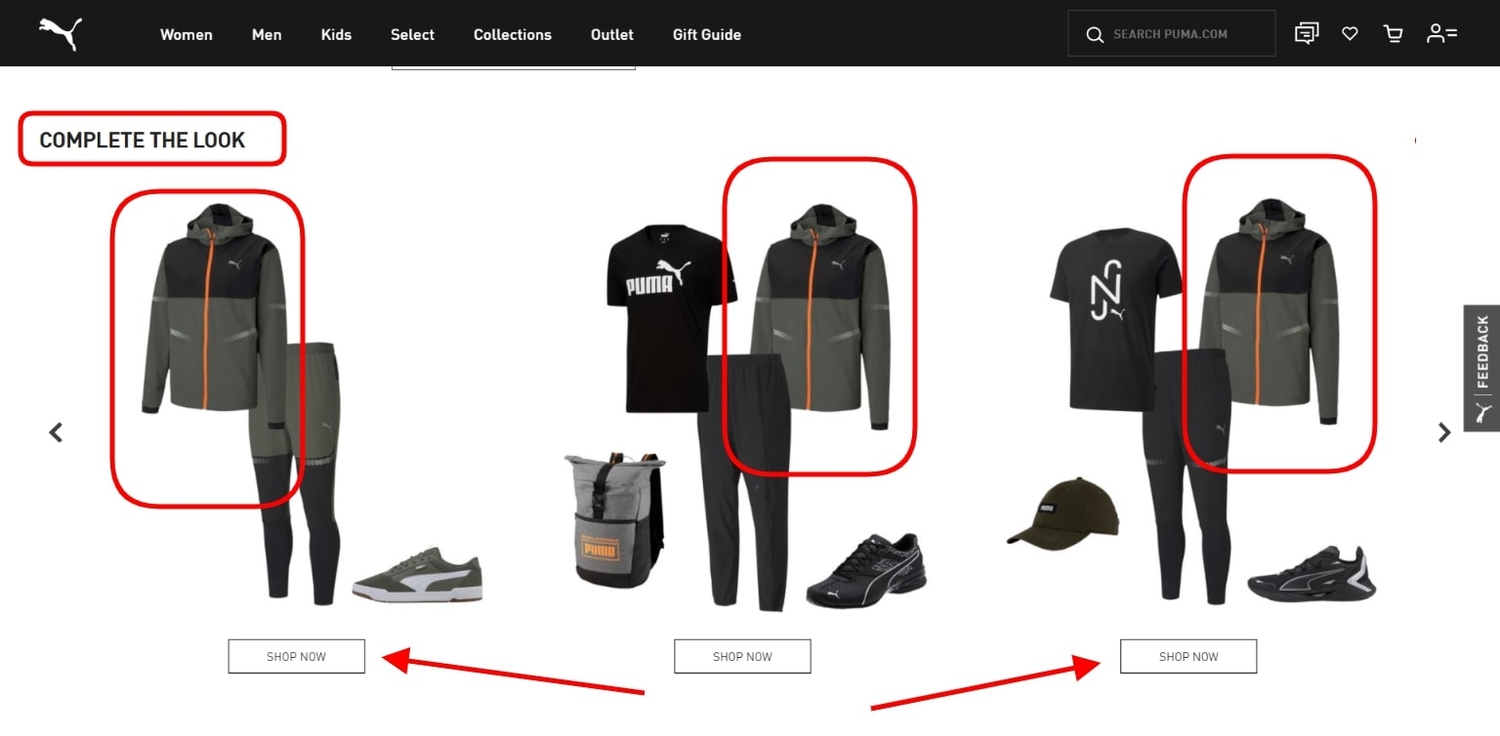
Screenshot taken on the official Puma website
At this point, you might be thinking that you can assemble such so-called mannequins yourself. Well, sure you can but keep in mind that it’ll become harder to do so with your store continuously growing. Plus with AI these blocks will be matched with things that your customers are actually likely to buy (not just your personal guesses).
5. Virtual Try-On
Finally, the fifth point we’d like to bring up deals with functionality that occurred as a result of blending the best of what augmented reality has to offer. Try It On virtually is a serious crunch point in online sales. Did you know that it is capable of not only entertaining your customers to some extent, but it also works as a pill for getting rid of purchase doubts?
Whether providing the opportunity to see how a pair of sneakers looks like on you through the lens of your smartphone, what this corner table will look like in your apartment, or giving the chance to put on eyeshadow or other makeup, this technology is a real revolution for uplifting sales in various niches.
To give an example, the official Yves Saint Lauren website is fitted with Try It On . Product pages give such an option, and the user can either test out makeup with their camera working live or by uploading a photo of themselves. This way, in the case of the Rouge Pur Couture lipstick, users can switch through the 7+ shades and compare which of them is a better fit.
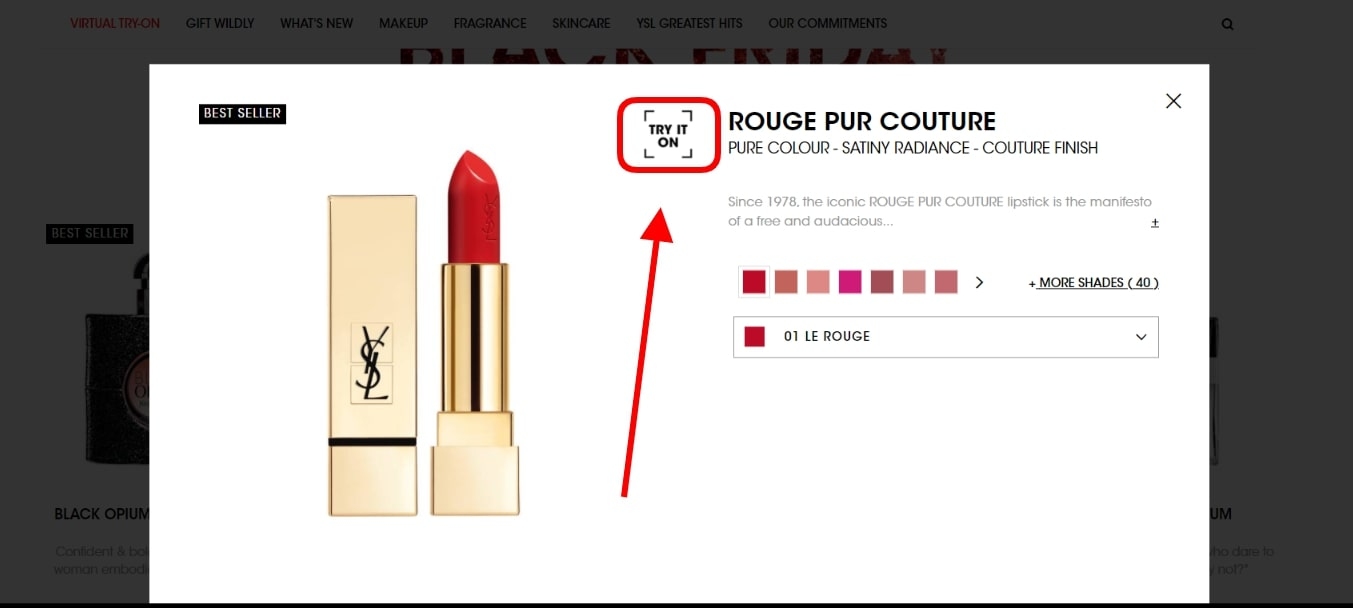
Screenshot taken on the official Yves Saint Laurent website
In Closing
To sum up what was covered in this article, technology is continuously moving onward. This brings up the necessity to raise your game and make sure that your eCommerce store isn’t lacking behind. After all, features that are based on artificial intelligence can have a positive impact on your sales, therefore it doesn’t make sense to delay getting them later than sooner.
