



TL;DR
- How much does it cost to build an AI agent? While there’s no single price tag, market benchmarks shed some light on the matter. For a simple rule-based bot, US-based AI developers usually charge $5,000-$25,000. Such bots are best for FAQs or rigid workflows. Moderately advanced machine learning agents, which can handle specific tasks in industries like retail and education, cost $25,000-$80,000 to develop. If you’re eyeing enterprise-grade generative AI agents for autonomous workflows, banking and healthcare use cases, or tasks involving complex reasoning, the AI agent pricing range will be $100,000-$500,000 (and counting). And should you want to challenge OpenAI and create a large language model (LLM) from the ground up, expect to pay no less than $100M in data collection, model training, and infrastructure costs.
- Why do AI agent costs vary so much? There are several factors. First, it’s the type of intelligence you’re aiming for. Generative AI is significantly pricier than traditional rule-based logic due to compute and data needs. Next, there’s the autonomy. Agents that simply answer questions are inexpensive; agents that plan, reason, and carry out actions across multiple software systems are costly. There is also the “compliance tax.” You should expect to pay ~25% more for a HIPAA-compliant healthcare agent or a fintech solution that meets GDPR and AML regulations. Lastly, there are hidden AI agent development costs. Data preparation often eats 30% of the budget before a final model is even selected, as data quality dictates which architectures are viable. Businesses should also budget 15-20% of their total AI agent costs annually for retraining and model drift corrections.
- AI agent development costs aside, there are several challenges to be aware of. Agentic systems – especially those powered by Gen AI – consume significant computing resources. To avoid unexpected cloud costs, use pre-trained models via APIs or deploy open-source small language models (SLMs) locally instead of training from scratch. Data scarcity is another hurdle; many teams lack the labeled datasets required for model fine-tuning. Retrieval-augmented generation (RAG) bypasses this restriction by allowing the model to “read” your existing documents in real time rather than memorizing them. Finally, don’t underestimate the integration gap. LLMs are “brains in a jar” – they cannot naturally log into your CRM or ERP. Without a robust middleware layer to handle API calls and authentication, your agent can converse but cannot execute tasks like updating records or processing refunds.
How much does AI agent development cost?
In the software world, this is the equivalent of asking, “How much does it cost to build a house?”
In theory, both a French chateau and a garden shed have walls and a roof and provide shelter. However, one requires a few hundred dollars in lumber and a weekend of work, while the other calls for years of construction, a team of architects, and a budget equivalent to the GDP of a developing country.
Similarly, many business leaders researching AI agent pricing mix up agentic systems with AI chatbots. While both technologies rely heavily on artificial intelligence, there is a significant difference between them in terms of intelligence and development costs.
The financial reality is stark. A conversational chatbot typically costs between $5,000 and $40,000 to deploy. A fully autonomous agent – one that orchestrates workflows and executes tasks – starts closer to $100,000 and can easily exceed $500,000 for enterprise solutions.
We’re not just talking about smarter scripts that respond to customer questions with better grammar. We distinguish between conversational AI, which informs or educates users, and agentic AI, which does the work.
An AI chatbot can notify a customer of a delay in their order. An AI agent can detect the delay, log into your ERP, reroute the shipment, and issue a partial refund – all without you lifting a finger. Confusion between the two is not just a semantic error; it can lead to financial disaster.
Check out our AI agent guide to learn more their capabilities. Meanwhile, the purpose of this article is to offer an in-depth primer on AI agent development costs. We say “In-depth” because, when planning your 2026 AI automation roadmap, you need more than just rough estimates; you need to understand the mechanics of AI agent pricing.
Below, we explain where the money goes, why the spread is so wide, and how to build a powerful agent without depleting your capital.
What factors affect AI agent development costs?
Press enter or click to view image in full size
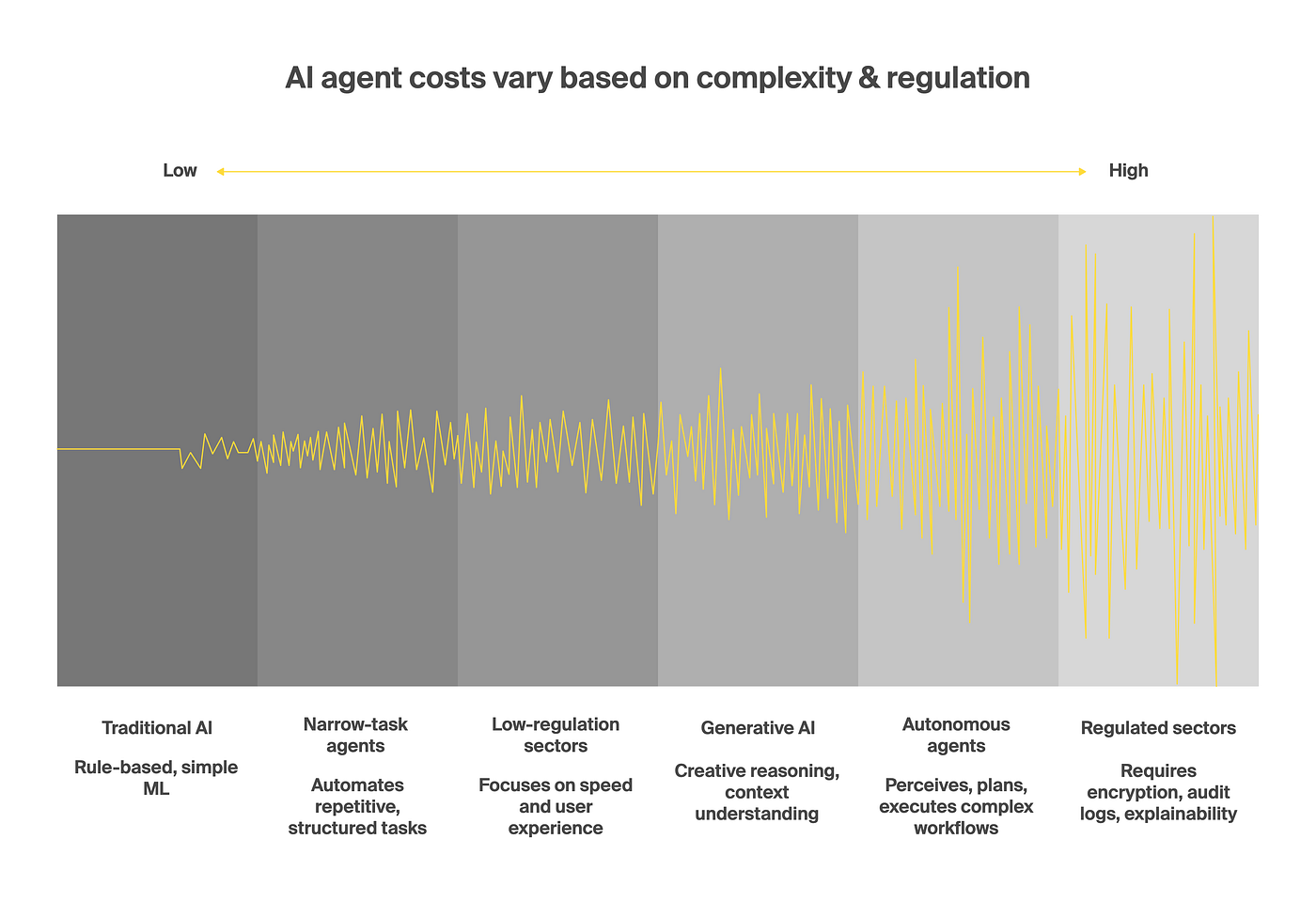

The cost gap between a five-figure pilot and a seven-figure enterprise transformation usually comes down to three specific variables: the brain (intelligence), the job (task), and the neighborhood (industry).
Factor #1: Type of AI
Traditional versus generative AI. The route you take will have the greatest impact on your AI agent development cost. Let’s see how the two superpowers stack up against each other.
Traditional AI (rule-based & simple ML)
In terms of AI development costs, these are the “economy class” intelligent assistants. Such systems rely on “if-then” logic or classical machine learning that only works with structured data. They don’t “think” in the creative sense; they follow a strictly defined path. Traditional AI agents are the most cost-effective option because they do not require massive neural networks or expensive GPUs to operate.
- Cost tier: Low
- AI agent development cost estimates: A basic custom bot for workflow automation typically lands between $5,000 and $25,000. If you need complex enterprise integrations, that might climb to $60,000.
- Why it’s cheaper: You aren’t paying for “true intelligence.” You are paying for logic programming.
Our AI cost guide examines both traditional artificial intelligence prices and the factors that drive them upward.
Generative AI (SLMs, LLMs & multimodal models)
These agents are powered by foundation models – ranging from massive large language models to efficient small language models or multimodal AI that generates images, video, and audio. They can understand context, create novel content, and adapt to vaguely phrased instructions. This flexibility comes with a heavy AI agent development price tag: extensive data to learn patterns, high-performance computing (GPUs) for inference, and specialized engineering talent.
- Cost tier: High
- AI agent development cost estimate: Building a custom generative solution often starts at $50,000 and can easily sprint past $500,000 for initial development
- Reality check: Most enterprises wisely avoid training a Gen AI model from scratch (which costs millions). Instead, they fine-tune existing models like GPT-4, Claude 3.5 Sonnet, or Llama 3. Even so, the fine-tuning and prompt engineering process is labor-intensive and costly compared to writing simple rules.
This blog post by the ITRex R&D team provides a more detailed explanation and cost estimates for real-world Gen AI projects.
Factor #2: Scope of application
The cost of AI agents also depends on their complexity, which scales non-linearly. Adding another feature to your agent’s scope may not double but triple its cost because the intelligent assistant now needs to decide which feature to use to perform specific tasks.
Narrow-task agents
In the automation world, these are the dependable “blue-collar” workers. Often built on robotic process automation (RPA) or intelligent process automation (IPA) platforms like WorkFusion or Microsoft Power Automate, narrow-task agents excel at repetitive, structured tasks.
They don’t “improvise”; they execute predefined workflows with ruthless efficiency. Because such agents rely on deterministic code rather than probability-based LLMs, they are affordable, quick to deploy, and highly reliable.
- Cost tier: Low
- AI agent development cost estimates: A standard narrow-task agent typically costs between $10,000 and $40,000. Adding complex IPA features for semi-structured data (like processing invoices) might push this price tag to $60,000.
- Why it’s cheaper: You are paying for configuration, not cognition. There is no massive GPU burn or expensive model training involved – just solid logic programming.
If your company is unsure what type of agent it needs, you could use our automation opportunity assessment services to map out your project journey.
End-to-end autonomous agents
These are the “virtual employees” of the AI world. Built on advanced orchestration frameworks like LangChain, LangGraph, or Microsoft AutoGen, such agents don’t just follow instructions – they formulate plans.
Imagine an insurance agent that receives a new claim, validates the policy coverage in your legacy database, analyzes the damage photos using computer vision, calculates a payout estimate, and drafts a settlement offer to the customer. To function autonomously, they require “memory” (contextual understanding), multi-step reasoning capabilities, and the ability to self-correct when a step fails.
- Cost tier: Very high
- AI agent development cost estimates: Creating this level of autonomy is difficult. Projects typically start at $100,000 for a robust minimum viable product (MVP) and can easily exceed $500,000 for enterprise-grade interconnected solutions.
- Why it’s expensive: You are building a system that makes decisions, not just follows rules. This demands extensive engineering to connect the “brain” (LLM) to the “hands” (APIs).
The initial build is just the down payment. Companies eyeing comprehensive autonomous agents must invest heavily in Gen AI application testing and AI model validation services. Without this rigorous (and expensive) layer of oversight, you risk model drift, hidden bias, and compliance failures. These services also help optimize infrastructure costs and prevent your “virtual employees” from making expensive mistakes at scale.
Factor 3: Industry & regulatory environment
Where you deploy an AI agent matters just as much as what you build. Recent studies estimate that compliance overhead can inflate AI development costs by 17% to 40% in high-risk sectors.
Regulated sectors – from healthcare to finance
Regulated industries in the United States and the European Union are subject to stringent regulations such as HIPAA, GDPR, and the EU AI Act, to name a few. You cannot simply enter sensitive data like patient records into a generic model. What you need is:
- Role-based access control (RBAC) and data encryption at rest/in transit
- Detailed trails for every decision the AI makes (required by 21 CFR Part 11 in life sciences) for robust audits
- Explainability tier that allows to interpret AI’s logic – think denying a loan to a customer (crucial for ECOA in the U.S. and GDPR rights in the EU)
- Cybersecurity and resilience – specifically, compliance with DORA (Digital Operational Resilience Act) for EU finance or NIST AI RMF standards in the United States
- Compliance with medical device standards, including ISO 13485 and EU MDR if the agent acts as Software as a Medical Device (SaMD)
How does it all affect AI agent development cost?
A healthcare triage assistant typically costs $45,000-$60,000+ for just moderate complexity. In banking, security and KYC/AML compliance routinely push starting costs above $50,000.
Low-regulation sectors – from retail to education
Compared to healthcare or finance, industries like eCommerce, media, and education are less constrained by the law. Although HIPAA certification and military-grade security audits are not required, the focus here shifts to user experience and scale, not compliance. Functionality-wise, you need:
- High-speed inference capabilities to avoid latency during customer interactions or shopping checkouts
- Seamless integration layers that connect to platforms like Shopify, Magento, or learning management systems like Canvas or Moodle
- Advanced personalization logic to customize product recommendations or learning modules based on user behavior
- Brand safety guardrails to prevent the agent from using offensive language or hallucinating competitors’ products
How much does such an AI agent cost then?
Prices generally settle in the mid-range because the engineering focus is on performance rather than legal defensibility. An educational AI tutor or a robust eCommerce recommendation agent typically costs between $25,000 and $40,000.
Key cost components of AI agent development
Press enter or click to view image in full size


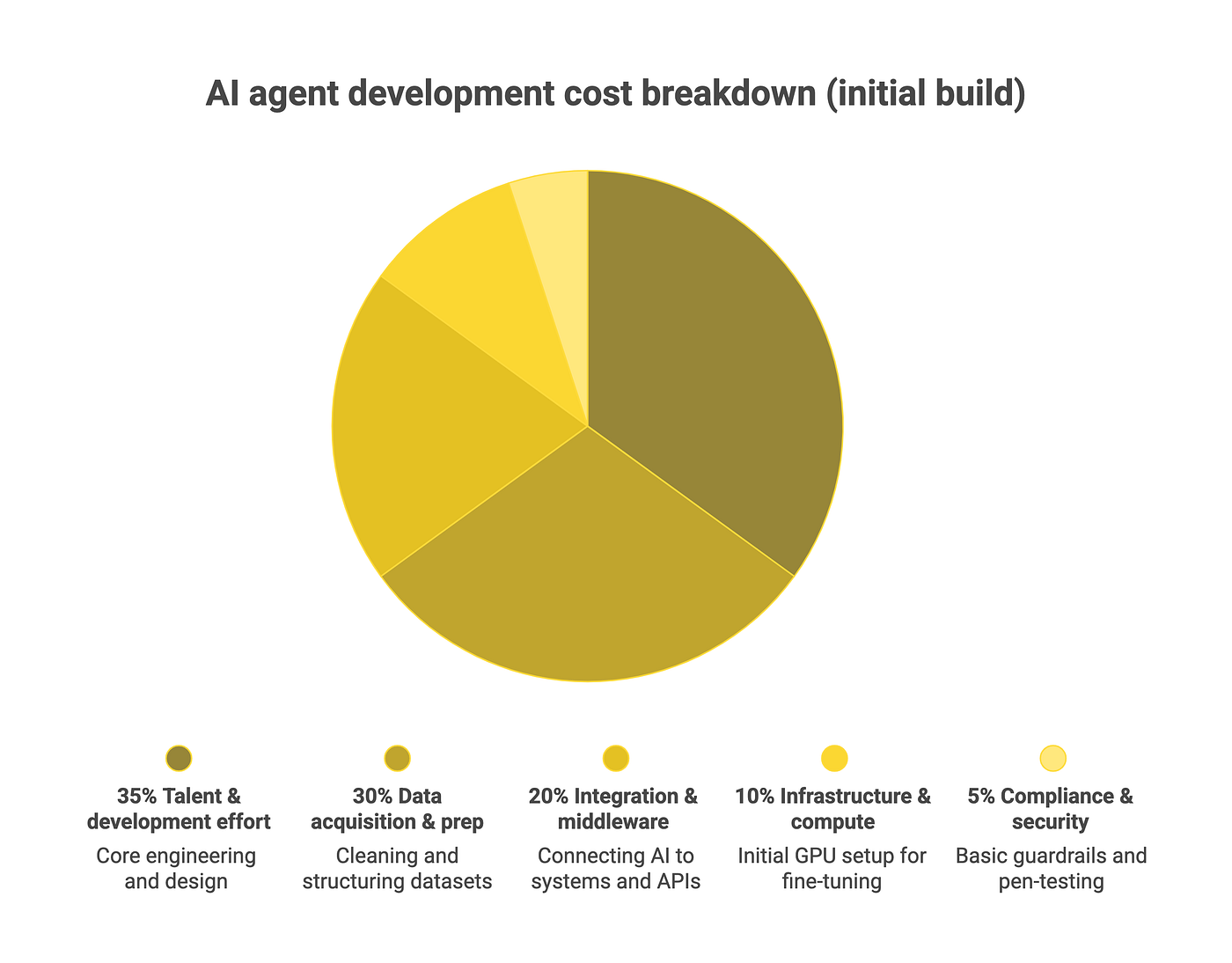
When you receive a quote from a development partner, you rarely see a single line item for “coding.” Instead, the proposal reflects a complex ecosystem of infrastructure, data engineering, and specialized labor. To help you understand where your budget actually goes, here is a detailed AI agent development cost breakdown:
- Talent & development effort (~35%). This is the core engineering phase – designing the architecture, prompt engineering, and coding the agent’s logic. AI engineers are currently among the most sought-after professionals in the technology industry, with salaries skyrocketing. As a result, core development typically consumes the largest portion of the budget. This is why many businesses collaborate with AI development companies to gain access to a readily available team of PhDs and engineers for a fixed project fee, avoiding the expense of hiring full-time employees.
- Data acquisition & preparation (~30%). Algorithms that complete tasks on your behalf are commodities, while the data they’ve been trained on is the asset. Before a model can learn patterns, data engineers must collect, clean, label, and preprocess massive datasets. Data preparation accounts for nearly a third of the total AI agent cost estimate. And if your data is unstructured (messy PDFs or handwritten notes), the cost of structuring it can push this percentage even higher.
- Integration & middleware (~20%). Building the intelligence is only half the battle; the other half is connecting it to your business systems (ERP, CRM, HRM, email agents, etc.) using custom APIs. This “last mile” connectivity accounts for a fifth of the total AI agent development cost. Without this investment, your agent is just a chatbot that can talk about work but cannot actually do it.
- Infrastructure & compute (~10%). You have to pay the “electricity bill” for your agent’s “brain.” This covers the initial setup of high-performance GPUs for model fine-tuning or hosting. Please keep in mind that this rough AI agent cost estimate is only relevant for the initial setup; ongoing inference expenses must be covered after the launch. Companies that prioritize security and opt for on-premise hardware (such as NVIDIA H100 racks) will see infrastructure costs rise dramatically.
- Compliance & security (~5%). For standard commercial deployments, this includes basic guardrails, penetration testing to prevent “jailbreaking,” and fundamental security protocols. In highly regulated industries like healthcare or finance, this portion of our AI agent cost can triple to accommodate HIPAA/GDPR audits, model interpretability, and legal review.
- Ongoing maintenance (excluded from initial build). While not part of the initial 100% AI agent development cost breakdown, this is a critical future budget item. AI models degrade as customer behavior and data patterns change. To avoid model drift, set aside 15% to 20% of your initial budget each year for maintenance, retraining, and monitoring.
The diagram below depicts the typical cost distribution for a custom AI agent project.
Press enter or click to view image in full size

AI agent development: cost estimates from across the market & ITRex portfolio
To move from abstract factors to concrete AI agent pricing, consider real-world benchmarks. Below, we examine five different AI agent examples – two from market leaders and three from our own portfolio – to demonstrate how scope and compliance influence final AI agent costs. These examples show that, while the “sticker AI agent price” fluctuates dramatically, it always reflects the level of autonomy and integration a business requires.
- Drift: Sales & support platform
Drift revolutionized marketing by moving beyond static forms to conversational AI that qualifies leads and routes them to humans. Built on robust NLP and rule-based logic, this agent handles high-volume, low-complexity interactions like scheduling and basic Q&A. Since the agent’s tasks are clearly focused on sales and support and it doesn’t make independent decisions outside of those areas, creating similar custom AI solutions usually costs between $50,000 and $200,000.
- Amelia: Enterprise AI platform
Amelia is a conversational AI platform that allows enterprises to build “digital employees” capable of handling complex IT and HR workflows. Unlike simple chatbots, agents built on Amelia can integrate deeply with legacy systems to execute tasks autonomously. The deployment of a fully operational virtual workforce on this platform typically requires an investment ranging from $500,000 to $5 million, due to the significant configuration, integration, and licensing work involved.
- Gen AI customer intelligence agent for a haircare brand
ITRex developed a Gen AI agent for a global beauty leader to unify customer feedback from scattered sources like Sephora and Trustpilot. The agent uses Snowflake Cortex AI and Streamlit to automate sentiment analysis and persona segmentation. This cuts down on the work of manual analysts by 60 hours a month. By leveraging existing data infrastructure for a rapid proof of concept (PoC), we validated the business value at a fraction of the cost of a full-fledged AI agent, fitting the $35,000-$60,000 range.
- Melody Sage: Gen AI tutor for music education
As part of our R&D work, we created an agentic music learning platform built on Google Cloud (Vertex AI, Gemini 2.5). The system ingests raw text to dynamically generate personalized course curricula, quizzes, and cover art (via Imagen3). It features a self-reflecting agent that combines RAG with live web searches to answer student queries in real-time, validating reusable architectural patterns for complex edtech agents. It would cost you $45,000-$80,000 to develop an MVP version of a similar solution.
- Gen AI sales training platform with RAG
A scalable Gen AI solution for onboarding sales managers. Built on a flexible RAG structure using GPT-4 and Mistral 7B, the platform takes in internal materials (like PDFs and videos) to automatically create tailored courses. It features adaptive chunking and few-shot learning to prevent hallucinations, ultimately reducing new hire ramp-up time by 92% (from 6 months to 2 weeks). The core AI engine that powers the agentic system can cost anywhere between $80,000 and $150,000.
How to reduce AI agent costs: expert tips from ITRex
Press enter or click to view image in full size
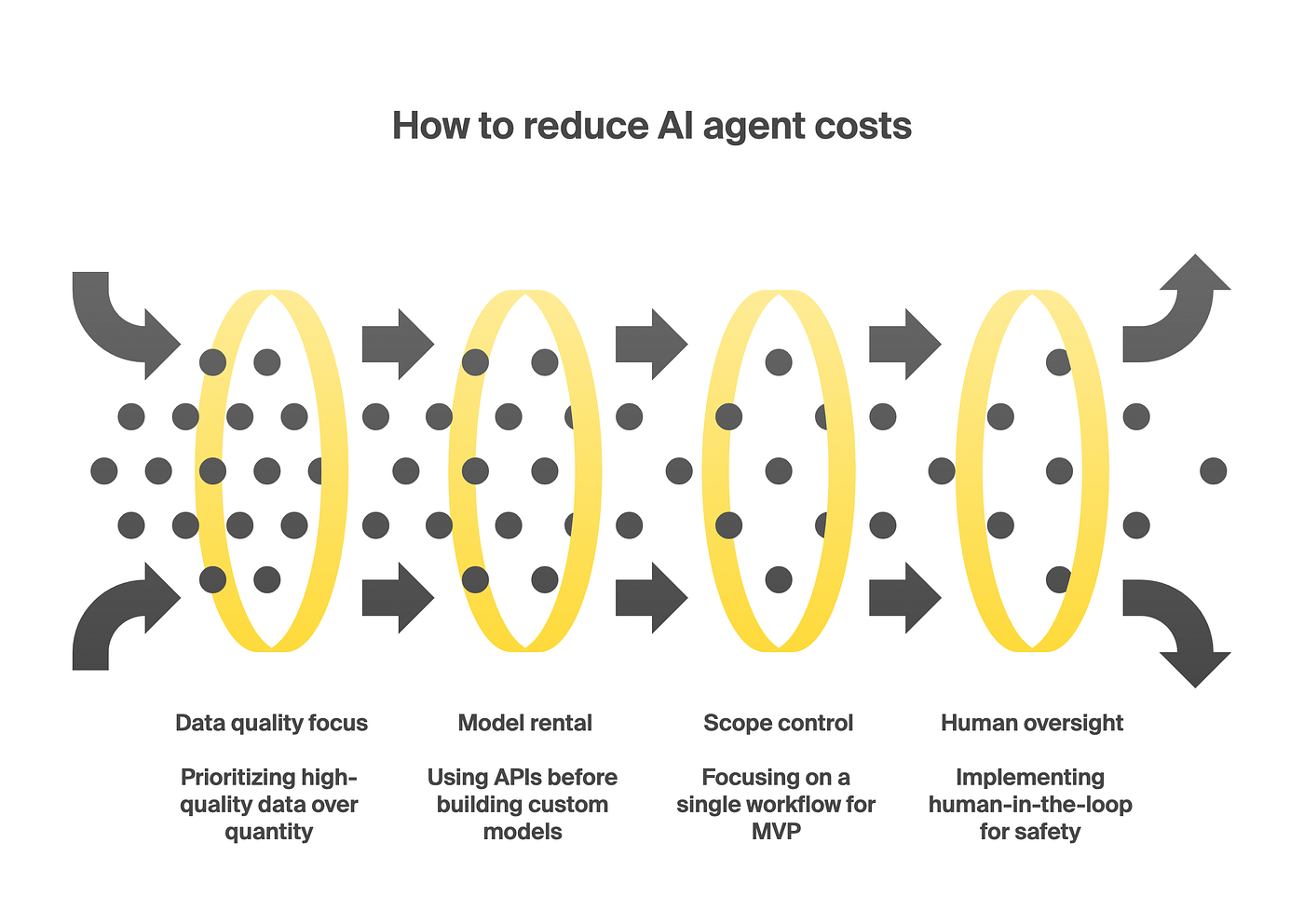

The road to deployment does not have to be fraught with financial pitfalls. After guiding dozens of businesses through their automation journeys, our experts have identified four golden rules for controlling AI agent development costs.
- Don’t boil the ocean – curate your data. Many teams waste months (and budget) trying to clean terabytes of messy logs, assuming “more data equals better AI.” It doesn’t.
The Fix: Prioritize quality over quantity. A small, well-curated dataset often outperforms a massive, noisy one. To save on expensive manual labeling, use synthetic data (training examples created with Gen AI) or semi-supervised learning to fill the gaps without expanding your payroll.
- Rent the “brain” before you build it. Launching an AI agent with a custom-trained model is the fastest way to trigger “cloud bill shock.” Deep learning models are resource hogs, and inefficient architecture can lead to autoscaling disasters.
The Fix: Start with OpEx, not CapEx. Use pre-trained models (like OpenAI or Anthropic) via APIs for your MVP to validate the business case. Once you have steady traffic, you can look into “model distillation” (shrinking the model) or deploying open-source small language models like Llama on your own infrastructure to flatten the AI agent cost curve.
- Solve for one workflow, not the whole company. The most expensive failure mode is “integration hell,” which occurs when an agent works perfectly in the lab but fails to connect to a 20-year-old legacy database.
The Fix: Avoid the “Big Bang” launch. Build an MVP that handles just one specific workflow first (e.g., “password reset” instead of “full IT support”). This method identifies integration gaps early, when they are less expensive to resolve, rather than after you’ve spent six figures on custom development.
- Budget for a human-in-the-loop” (HITL). Fixing a biased or hallucinating agent after deployment is infinitely pricier than preventing the situation early. In regulated sectors, a rogue agent isn’t just embarrassing; it’s a compliance fine waiting to happen.
The Fix: Bake safety into your budget. Implement HITL workflows where the AI drafts a response, but a human approves it during the early learning phase. Combine this with rigorous bias testing during development to avoid expensive rework later.
Finally, keep in mind that an AI agent’s cost is ultimately determined by its value. A $10,000 bot can save your support team several hours of work. A $500,000 enterprise agent can transform your entire supply chain logic, bringing millions in efficiency gains. The secret is not just spending money but spending it wisely: clean data, solid integration, and user-centered design.
At ITRex, we don’t just guess at these numbers. We have guided global enterprises and ambitious startups through the AI agent pricing maze, helping them build assistants that are profitable, compliant, and truly intelligent.
AI agent development cost FAQs
- How much does it cost to build an AI agent?
There is no “one-size-fits-all” price tag, but market benchmarks provide clear tiers. A simple, rule-based bot for internal FAQs typically costs $5,000-$25,000. If you need a specialized machine learning agent for retail, media, or education, expect to invest $25,000-$80,000. For enterprise-grade autonomous agents – the kind that can plan workflows, execute financial transactions, and integrate with legacy ERPs – budgets start at $100,000 and can scale beyond $500,000. The level of autonomy and the strictness of your industry’s compliance regulations are the two major cost drivers for AI agents.
- How do I control costs when scaling AI agents?
Scaling often brings “bill shock” if you rely solely on pay-per-token APIs like GPT-4. To reduce AI agent costs, use a distillation strategy: begin with a powerful, expensive model to validate your MVP, then transition to smaller, open-source models (such as Llama 3 or Mistral) hosted on your own infrastructure for high-volume tasks. Also, cache common queries so your AI doesn’t have to “think” about the same question twice. This approach converts unpredictable variable costs into predictable fixed costs.
- AI chatbot vs. human agent cost: Which is better?
While the upfront development cost of an AI agent ($50k+) may seem steep compared to a single monthly salary, the long-term ROI significantly outweighs it. Human agents cost about $1.35 per contact and are limited by shift lengths and burnout. An AI agent costs pennies per interaction, operates around the clock, and scales instantly during peak seasons without incurring overtime fees. For high-volume support, AI not only replaces costs but also recovers revenue lost due to long wait times and unhappy clients.
- What are the hidden costs of enterprise AI agent implementation?
The initial AI agent development cost is often only the tip of the iceberg. Data preparation (cleaning messy legacy data can consume 30% of your budget) and change management (training your staff to work with AI) are the true budget busters. The “compliance tax,” which includes audits, encryption, and bias testing, can add a 25-40% premium in regulated industries such as finance and healthcare. Finally, don’t forget about maintenance: set aside 15-20% of your development budget each year to retrain the model as your business grows.
- Can I use off-the-shelf AI agents to save money?
Yes, but with a caveat: you trade customization for convenience. Off-the-shelf platforms (like generic customer support bots) have low monthly fees and zero development time, making them perfect for standard tasks. However, they often fail at complex, company-specific workflows – like “check inventory in SAP, then email the warehouse manager.” If your competitive advantage relies on a unique process, a custom agent offers a better ROI because it adapts to your business rather than forcing your business to adapt to the software.
Originally published at https://itrexgroup.com on December 11, 2025.