

Deep learning is a sub-category within machine learning and artificial intelligence. It is inspired by and based on the model of the human brain to create artificial neural networks for machines. Deep learning will allow machines and devices to function in some ways as humans do.
Dr. Rodrigo Agundez of GoDataDriven is a co-author of this article and very enthusiastic about the improvements that deep learning can offer. He’s been involved in the data science and analysis field for some time and is already working on implementing models for practical applications.
Rodrigo notes that the new generation of users wants to interact with devices and appliances in a human-like manner. Take the example of Apple‘s Siri, which allows for voice command and voice recognition. Communicating with Siri is similar to interacting with a human.
The user interface for Siri seems simple enough. However, the A.I. algorithms that are designed on the back-end are quite complex.
Designing this kind of interaction with a machine was not possible a few years ago. System designers now have access to complex deep learning algorithms that make it possible to integrate such behaviour into machines.
Importance of Deep Learning
Artificial Intelligence will never truly come of age without giving machines the powerful capabilities of deep learning.
The idea of designing deep learning models can be difficult to grasp for many people. This is because understanding human concepts come naturally to us. But giving the same ability to machines is a very complex process of design.
One way to do it is by structuring data in a way that makes it easier to process for machines. Take the word fat for instance. If we say to a friend, This burger has too much fat, they would understand what we mean, and the word would have a negative connotation here. But if we told a friend that I would love to get fat from this meal any day, the word would mean something entirely different.
Creating machines that are capable of understanding minute differences in words embedded in a context may seem like a very small thing, but requires a very large set of data and complex algorithms to execute.
The difference from Traditional Machine Learning
One way to differentiate between traditional machine learning and deep learning is through the use of features. These are the characteristics of the data that help us differentiate and identify one entity from another.
To understand features better, take the example of a normal bank transaction. Features of the transaction help us identify the timing of the transaction, the value transferred, names of the parties to the transaction, and other important information.
In a traditional machine learning model, features have to be designed by humans. In a deep learning model, features are identified by the A.I. itself.
We can take another example of differences between a cat and a dog. If we showed a person a cat and a dog and asked them to point to the cat, they would immediately identify it. However, if the same person was asked to identify the exact features that differentiate the two, they would have a problem. Both creatures have four legs, a body, a tail, and a head. They appear very similar in terms of features. Humans can distinguish one from the other in an instant. Yet, they would have trouble identifying the features that differentiate any pair of a cat and a dog.
This is a problem that data scientists and A.I. developers hope to solve with deep learning. Features can be found even in unstructured data with the help of deep learning algorithms.
Benefit from Deep Learning for the Customer Experience
Rodrigo states that deep learning models are superior at certain A.I. characteristics than any traditional machine learning models, as the models have shown its effectiveness. This can be traced back to 2012 wherein a known online image recognition challenge, a deep learning algorithm proved to be twice as effective as any other algorithm before.
If an A.I. model reaches an accuracy of 50%, the device would not be very practical for use. Take the example of automobiles. A person would not trust getting in a car where brakes work 50% of the time.
However, if the accuracy of an A.I. system reaches values around 95%, it would be much more reliable and robust for practical use. Rodrigo believes that this level of accuracy for human-like tasks can only be achieved with deep learning algorithms.
Deep learning can be applied to speech recognition to improve customer experience. Speech recognition technology has been around for quite some time, but it didn’t cross the accuracy boundary to become a marketable product until the introduction of deep learning models.
Home automation systems and devices work through voice command. This is an area where deep learning can significantly improve customer experience.
Royal FloraHolland Case
Royal FloraHolland is the biggest horticulture marketplace and knowledge centre in the world. An essential part of their process is having the correct photographs of the flower or plants uploaded by suppliers. These photos need to have a plant; some images require a ruler to be visible or a tray to be present.
The task of sorting through all these photographs manually and quickly is basically impossible. Therefore, it was decided to implement A.I. for the process.
GoDataDriven designed a system with deep learning algorithms to automate the checking of the images. The system can accurately identify and sort pictures taken from different angles and devices.
The system removed the need for manual human review and completely automated the process for the company.
University Medical Centrum Groningen (UMCG)
Deep learning algorithms were developed for UMCG with collaboration from GoDataDriven, Google and Siemens. This involved the use of MRI data in a 4D format (volume + time). Using deep learning models, the team calculated the heart ventricles volumes evolution over time.
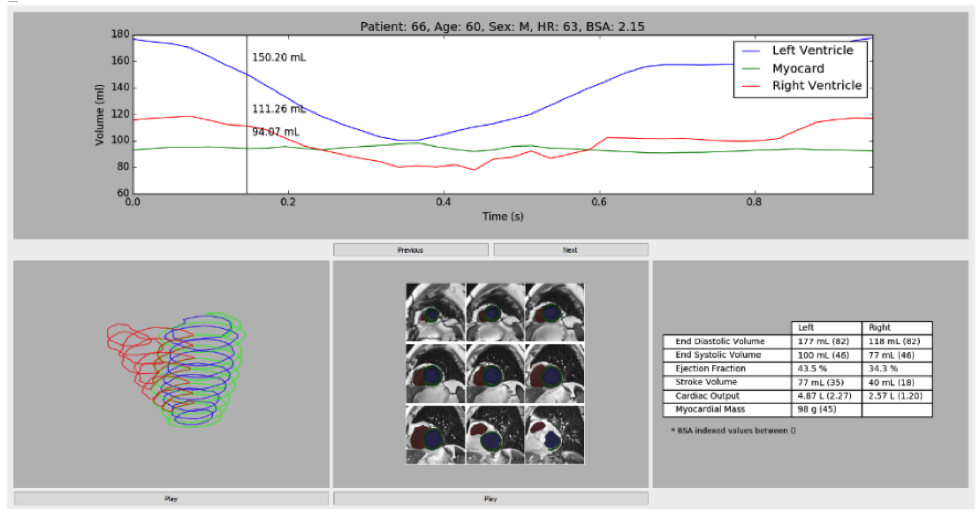
One of the project goals is to assist in the decision making regarding pacemakers and treatments. For example, it could take the heart cycle and volumes into consideration for prognosis and heart failure.
More than 400 images were taken per patient for different hearth depths across time. The team at GoDataDriven and Siemens developed multiple models, including binary and multi-class segmentation.
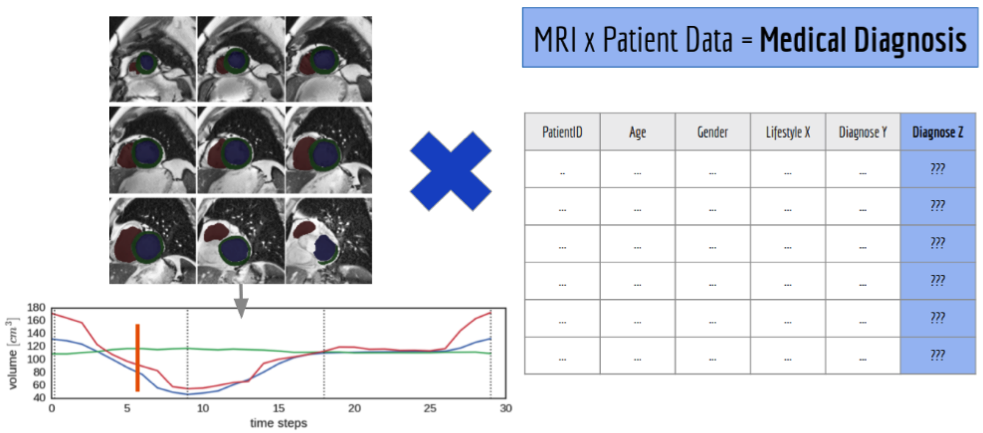
The model based on the U-Net deep learning architecture takes the MRI scan as input and outputs the corresponding volumes.
Traditionally, the process is done manually by looking at the scans and interpreting the results through hand-drawn diagrams.
Future of Deep Learning
Deep learning provides a way for companies to develop life-long learning modules. When more complex and richer algorithms are developed on top of pre-existing ones, companies will be able to achieve incremental growth.
Rodrigo believes that deep learning has a bright future because of its open source community and accessible platforms. Major corporations such as Apple which had built their systems on secrecy are finally coming around to the open-source model.
The main reason they are switching now is that they find deep learning talent acquisition more difficult in comparison with open source companies, such as Google’s Deep Mind for example. A company could have developed the most amazing and efficient deep learning system, but if they don’t publish their research and share the knowledge online, talented data scientists and deep learning practitioners will not apply to this companies.
Currently, deep learning teams like Google Brain, Google Deep Mind and companies like Facebook and Baidu find it much easier to hire talented, deep learning practitioners. They continuously publish research and open source the related implementations, such that the deep learning is reminded that these companies are at the cutting edge of these technologies.
Since the shift is towards open source and global adaptation of this technology, deep learning is likely to do well in the future and impact vast sectors of in our society. To learn more about Deep Learning and join the Dutch Data Science week click here.
About Dr. Rodrigo Agundez
