


Every marketer on this planet faces one common challenge ” lead generation. Getting a prospect to show some interest and sign up for your product or service is definitely an uphill task.
If you are taking the website route for lead generation you are in for a rude shock. No matter how much research you have done, how well written your website copy is, and how great your user experience is, you will struggle to generate leads. In fact, most customers leave the website abruptly if they are unable to find the information that they are looking for.
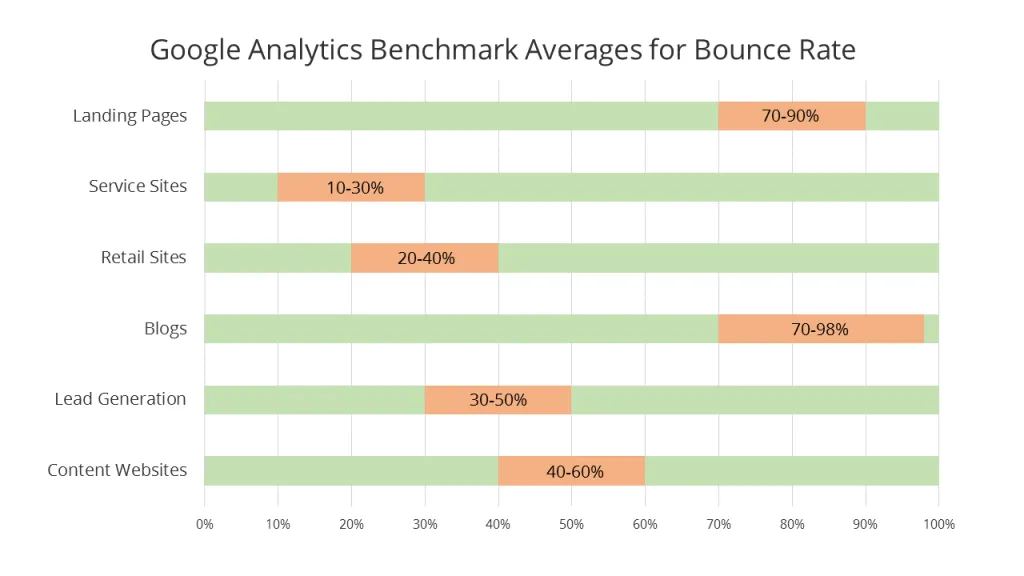
Websites, be it content websites or service websites have an insanely high bounce rate. Studies by Ezoic found that website bounce rates could range from 10% to as high as 98%.
 Source: ezoic
Anyway, don’t lose all hope. There is a surefire solution to this common challenge. A solution that is reliable, scalable, and the RoI of which can be measured with certainty.
Chatbots ” the computer programs that take the form of cute characters to real person impersonations. That can mimic human conversations by asking questions and responding with canned responses to users. They can solve the common challenge of marketers or anyone who is struggling with lead generation.
Chatbots are flexible, scalable, and customizable AI programs. They can be used on websites as virtual assistants that can serve your prospects even if a real person is not around to serve them.
Gartner reports a reduction of up to 70 percent in call, chat, and/or business email inquiries after implementing a VCA or chatbot technology.
Here is what you need to take note of: if chatbots can serve customers, they can win over prospects as well. They are an effective tool for lead generation as well.
The role of chatbots in your lead generation strategy
A lead generation strategy is not a single piece. It is a moving piece with multiple components. Each component has its own role to play. Let’s take forms as an example. They appear at the final leg of the lead generation activity. Forms are used to collect prospect information.
So far, marketers have relied rather excessively on forms for lead generations. Forms have worked well in the past and they continue to work well for a good share of marketers as well.
However, forms have several downsides that are causing more trouble than benefits for marketers. To begin with, forms do not give detailed insights into what a prospect is looking for. It acts as a tool to aimlessly collect the prospect’s contact information. If more fields are added to collect the prospect’s requirements, it inflates the bounce rate.
Chatbots, on the other hand, serve better than form collection. Here are some reasons that cement their usefulness:
- Chat helps segment prospect’s queries into multiple buckets. This helps the marketer and the salesperson to direct the future conversation in a strategic way.
- Chatbots help drive personalized conversations at scale. A single agent can engage with only one or max prospects at a time. A chatbot can handle a dozen or even more simultaneous conversations, which can lead to additional revenue for your blog and business as a whole
- Chatbots can render canned responses for frequently asked questions. They bring the power of automation to lead generation. This also helps spare a lot of effort for sales folks who otherwise have to repeat their answers to every single prospect.
Given these benefits, it is natural that chatbots can be considered as centrepieces in a lead generation strategy.
How can chatbots help improve your lead generation strategy?
Chatbots are new-gen technology. It is hardly five years or so since they have started appearing across websites. Although they are primarily used for customer support, do they have a sales use case?
Is it possible to use chatbots for lead-gen? If yes, how will they fit into the overall lead-gen strategy?
Given their multi-tasking ability, intelligence in dealing with repetitive queries, and also the ability to scale without bounds, chatbots are a natural fit for scaling your lead generation efforts.
Here are some possible use cases.
1. They can be programmed to ask the right question
Lead generation begins with understanding the prospect’s needs and immediate priorities. In sales parlance, this is referred to as the discovery phase. The discovery phase is critical since it determines whether the lead is a genuine one that needs active pursuit or one that needs to be set aside for the time being.
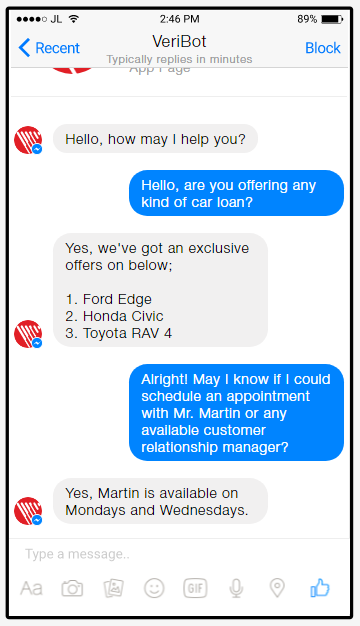
Chatbots can provide the prospectus landing on your website with a set of predetermined questions. The responses to these questions help in segmenting the prospect into the right product or service. This helps the sales teams in prioritizing the leads to pursue and plan for the sales conversations in advance.
Source: Chatbots Magazine
Do you see what the chatbot is doing in the above example? It is not spewing random responses to the user. Instead, it is providing contextual relevant responses. These responses provide value to the user.
In this specific case, the user is able to find the right model of car and also the days on which they can schedule an appointment with the Customer Relationship Manager. In an ordinary scenario, this is what a sales rep would normally do. A chatbot can do the same with not one but dozens of customers at the same time without missing a beat. It brings personalization at scale.
2. They can talk the customer’s language
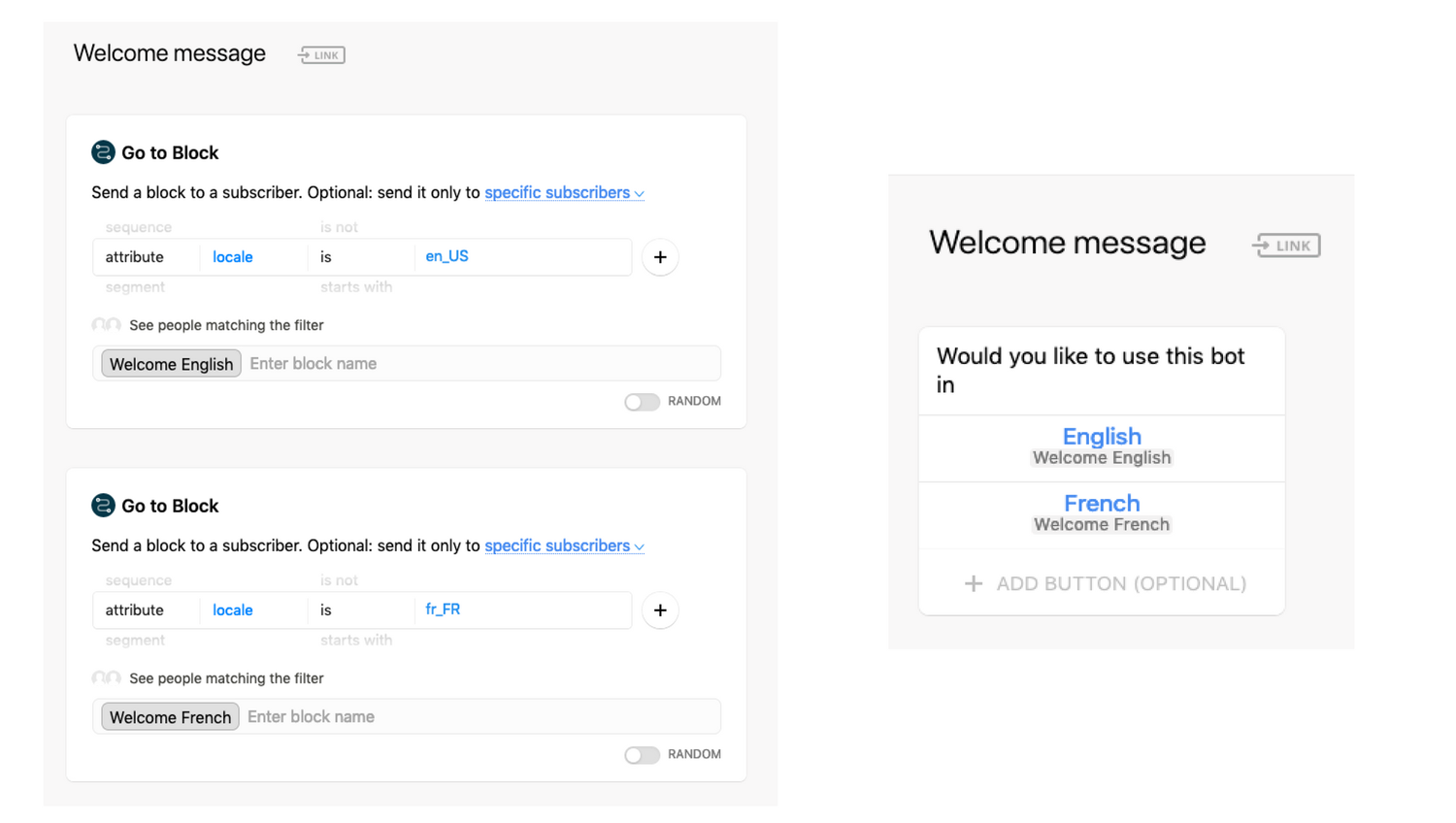
Chatbots can be customized to speak in any language. They can be built to have multilingual conversational capabilities. It is easy to configure the language pack in the backend and also customize the content. This enables them to converse with prospects in their native language.
Source: Chatfuel
Also, chatbots go one step ahead by conversing in colloquial conversations that rarely feel robotic. Thanks to Natural Language Processing (NLP), chatbots can pick up the style and tone of conversations and mimic them in forthcoming chats. This results in a better user experience for your website users.
The final outcome is that chatbots that can talk the customer’s language are able to convert them better as leads.
There is another advantage of using multi-lingual chatbots for lead generation. You can target specific geo’s with the regional language they use for communication. Spanish in Spain, French in France, and so on. Chatbots facilitate creating a connection with your prospects in the first conversation itself.
3. They aid in lead segmentation
When leads are handed over to the sales folks, there is one challenge that they face. What did these prospects sign up for and how to follow-up timely with all the prospects? Unless you are using an enterprise-grade CRM system with high-end features (and obviously an outrageous cost), you will not be able to segment leads properly. Another common solution is to have a virtual team to use a virtual phone system to call all the warm leads, but this might not backout.
But, chatbots can segment leads into appropriate buckets. Chatbots drive conversations with users by giving them questions and taking responses through options. These options are recorded in the form of canned responses. Based on the canned response provided by the user, the chatbot can label the prospect for a specific product or service.
The upside of this type of chatbot-based lead segmentation is that it helps effectively improve your conversion rate and simplifies the task of sales reps to converse with the prospect.
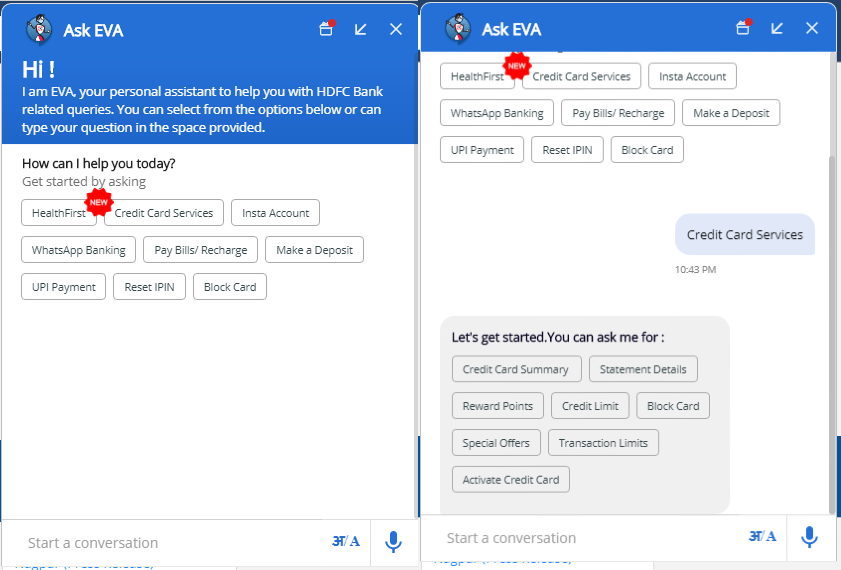
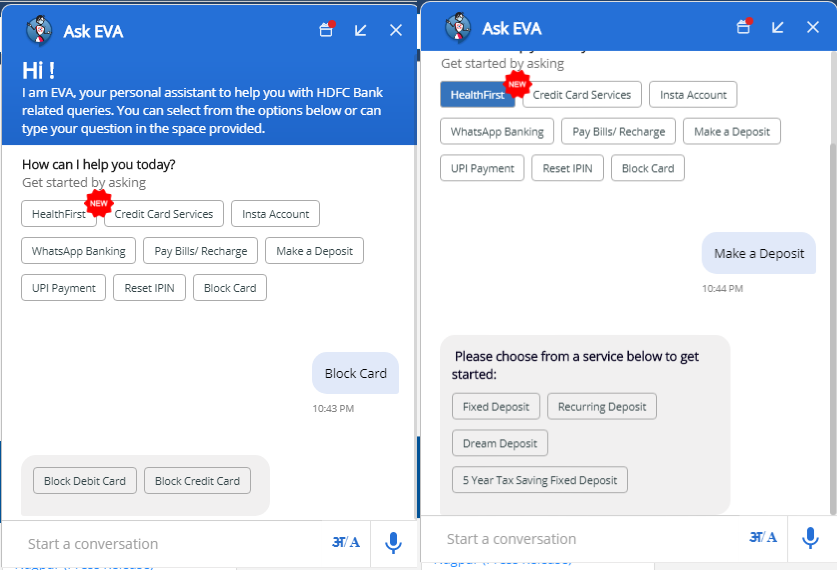
India’s leading bank HDFC has a chatbot named Eva which is designed to help users solve their banking issues with great ease.
From seeking health insurance services to blocking lost cards, Eva offers a sleuth of services with pace and convenience.
Source: HDFC bank
As shown in the screenshots above, Eva helps customers choose the sub-services under search banking service. It helps segment into specific customers based on the service that they are looking for. The sales teams can take over the lead and engage in conversations at a later stage when the user’s intent is clear.
In a nutshell
Chatbots are being hailed as harbingers of change in the customer service space. However, they have huge potential on the other side of the business spectrum as well. That is lead generation.
Chatbots can help solve a long list of problems that marketers face in their everyday life. Problems that are making them lose sleep or even burn dollars in marketing spend. From engaging with website visitors in an interactive manner to helping sales reps begin the conversation on the right foot, chatbots can help in several ways. They can help overcome the challenges in lead generation. Or even become a tool to simplify the existing processes.
