

Today’s technology has helped transform an array of industries and has helped give birth to new concepts such as digital currencies. In a world fully connected by technology and fully loaded with ideas and a need for quickness, consumers have grown an appetite for adaptive new technology and getting things done in real-time.
We have seen, systematically, how technology has changed our world and how we have been able to use technology like blockchain technology and AI to change and adapt our lives today.
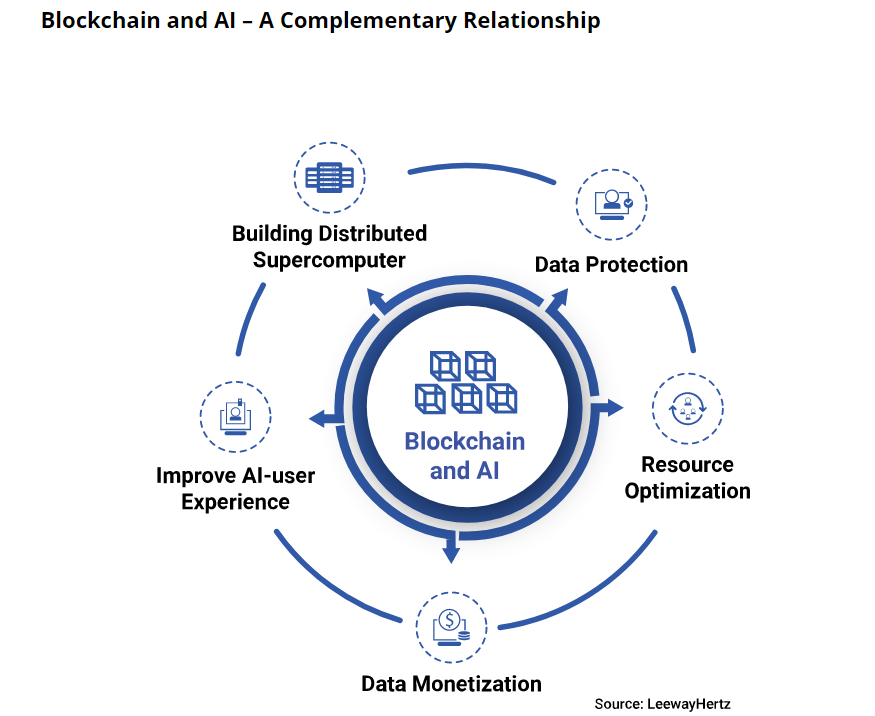
(Image Source: LeewayHertz)
The introduction of blockchain technology made the notion of cryptocurrencies, a digital form of money, possible in today’s day and age. Today, many have made mass amounts of money and gained incredible wealth by investing in cryptocurrencies that have gained much traction and popularity as the years have passed.
AI has revolutionised the way we use existing technology by providing it with the ability to be enhanced. AI makes it possible for machines to learn trends and mass amounts of data from experience and then apply new inputs to help them perform human tasks faster and more accurately. New concepts such as driverless cars can only be possible with the implementation of AI and rely heavily on the deep learning of algorithms and natural language processes that AI is capable of.
Combining the two technologies is proving to be a powerful force as they can improve the inner working of almost every industry thinkable where implemented. For example, they have upgraded the way the food industry works by helping to make the supply chain more linear with better insights and have been known to take heed in the health sector, especially concerning healthcare records. Adding an extra layer of security but with complete transparency for those authorised to access documents.
Blockchain brings trust to AI and IoT
Blockchain is the nexus of current tech and has the means to bring the missing link of trust that unfortunately clouds many of the other technologies, especially AI. Unlike other databases, which typically have a single administrator, a blockchain works differently and has a set of diverse administrators that referee the data.

(Image Source: Matt Turck)
The advantage this poses is that no single admin has the power to change, maliciously or accidentally, that data that is held on the blockchain. Furthermore, once the administrators reach consensus, the data is secured in blocks that are ‘chained’ and in a way attached to one another cryptographically, which in essence form an untamperable ledger.
When technologies like AI use blockchain to help track proofs, provenance, and permissions on certain types of data sets associated with the need for approvals, the trust in the data increases. Incorporating this level of confidence in the workings of agreements and contracts will allow technologies like AI and even IoT to be adopted and used in various industries without fear of them being compromised by unauthorised access personnel, giving birth to a new era of applications and adoption in tech.
Revolutionising agreements and contracts
Some organisations have taken the plunge into consideration of blockchain and AI contracts that help to take existing paper contracts between a business and their clients and place them on a shared blockchain database.
This means that businesses can see what the contact agreements are and that the clients and any revisions or changes that are made to it can be captured and seen on the ledger by both parties, creating a new level of transparency for better working relationships.
It works by taking the existing paper contract or agreement and placing it only in the shared ledger. The blockchain AI together can be programmed to record all movement in the contract and virtually resend all transitions shared with high levels of transparency. In addition, every step of the contrasting process will generate notifications that will alert all parties involved of the changes and activity of the ledger.
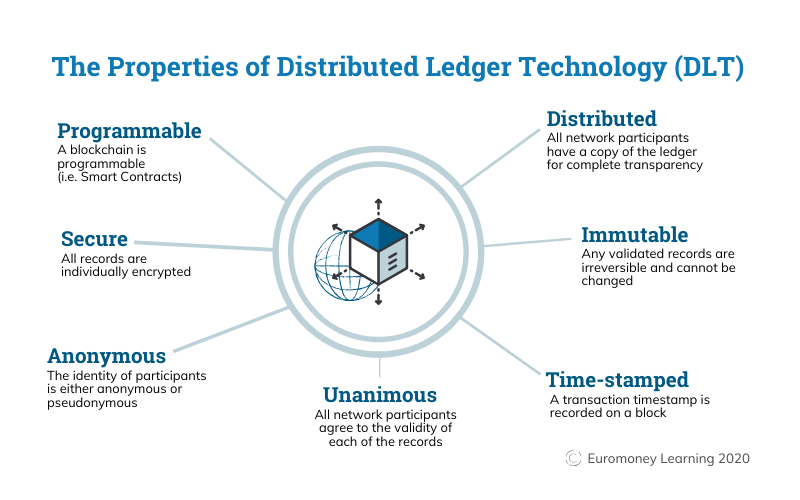
(Image Source: Euromoney)
Including blockchain and AI for contracts and agreements result in definitive agreements stored electronically in one precise location, which is assembled for all parties with access. Not only that but all activity is recorded clearly, with complete transparency. This is how trust is built.
The platforms have high levels of security through the use of encryption and restricted data sharing while offering complete transparency, which is quite unique. In addition, they can provide a tamper-evident audit trail with all contract revisions by using special hash codes of the agreement and transactions on the blockchain.
Using blockchain and AI for agreements means the process can be more streamlined as various tasks such as digital signatures, contract drafting, automatic remittance, entitlements, and rule-based agreements can all be executed via the blockchain platform. Furthermore, with AIs, machine learning capitalises it can sieve through that data to keep it relevant and updated.
The possibilities of blockchain are endless and can offer a wide variety of advantages. Still, the most significant benefit is the security that it can provide compared to other technology available today.
