



OVERVIEW
Lack of AI Governance leads to the following enterprise level issues,
- Siloed and ad-hoc AI software development driven by a tactical approach
- Enterprise cannot maintain proper alignment of business and IT
- Inability to rapidly respond to AI technology changes driven by business/technology challenges and no holistic enterprise AI view
- Data becomes stale or obsolete and hence becomes useless or less useful impairing strategic decision-making based on this stale/obsolete data thereby defeating the very purpose of AI
- Complex, fragile, and costly AI data interfaces between applications and data
- Incomplete future state of AI reference architecture leads to slow and ineffective decision-making
AI governance is defined as “A system of standards, guidelines, rules, practices, processes, and tools based on AI technologies aligns with the Enterprise’s strategies, objectives, and values”.
AI Governance is the responsibility of not only the IT executives (CXO and IT Directors) but also executives from Business organizations as well, along with critical participation from Enterprise Architects, Domain Architects, Subject Matter Experts, and other support staff throughout the enterprise. Successful AI enabled enterprise designing is not simply a function of the IT organization but needs total Enterprise participation.
ALIGNMENT WITH ENTERPRISE GOVERNANCE
The various governance systems across the enterprise and their alignment with the AI Governance are briefly described in this section. AI Governance does not exist in Isolation, it should be part of overall Governance system of the entire enterprise.
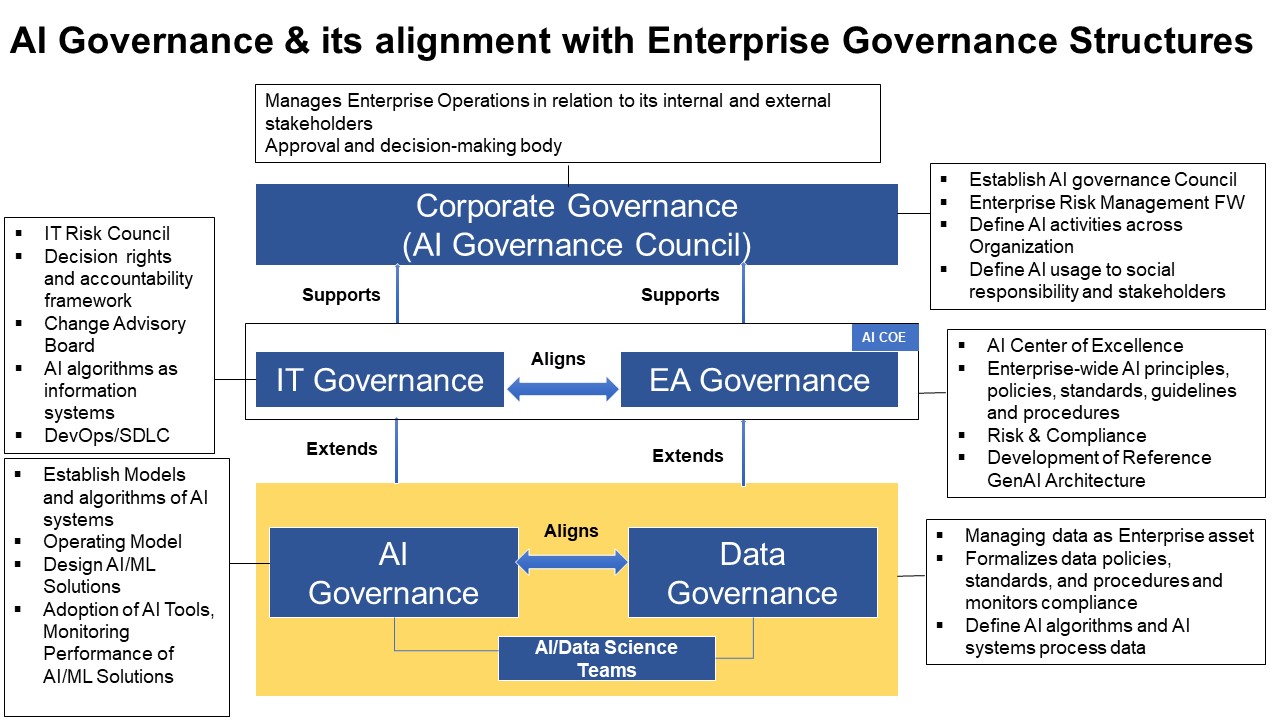
Corporate Governance is an overarching governance structure of an entire enterprise. It is a management body that manages Enterprise Operations in relation to its internal and external stakeholders. This body acts like an Approval authority and decision-making body. At the corporate level, AI Governance aligns with the enterprise objectives, rules, policies, and decision making.
EA Governance consists of Enterprise Leadership, Organizational structure, direction, and processes that ensure Information Technology (IT) sustains and extends the enterprise’s vision, mission, strategies, and goals in a planned manner. AI Governance leverages the guidelines, principles, standards, reference architectures defined at the enterprise level. In summary, AI Governance is in alignment with the EA Governance.
IT Governance executes corporate governance. It is defined as the processes that ensure the effective and efficient use of IT in enabling an enterprise to achieve its goals. AI functionalities are implemented using software code that is modeled as algorithms. These algorithms are standalone applications or integrated with the enterprise information systems to provide additional capabilities and better performance and automation. AI Governance enables IT principles, IT architecture, IT infrastructure and business needs across enterprise. AI governance at the enterprise level can be viewed as a subset of IT governance.
The following diagram depicts the indicative end to end governance of an Enterprise and their relationships. It depicts AI Governance and its alignment with Enterprise Governance Structures.

AI Governance is defined as a system of rules, practices, processes, and AI tools that are adopted to ensure enterprise use of AI solutions that aligns with the business strategies, objectives, and values.
Data Governance helps in managing the data across the enterprise. Helps in defining the AI algorithms and AI systems in processing the data. Data Governance team provides strategic direction, guidelines, policies, standards, and usage of procedures. It also helps in measuring and monitoring the effectiveness of data governance on a continuous basis. AI algorithms and AI systems process data. The business functionalities, outputs, and value depend on the data.
AI Governance overlaps with Data Governance. AI Governance is the subset of IT Governance. IT Governance and EA Governance overlap each other. IT Governance is the subset of Corporate Governance.
GUIDING PRINCIPLES OF AI GOVERNANCE
The Objectives of the AI Governance are,
- Ensure enterprise is adopted pre-trained foundation models and complied
- Guide the decision-making process to maintain AI Solution coherence
- Maintain the relevancy of the enterprise to meet changing requirements
Guiding Principles of AI Governance are,
- ccountable: Enterprise Users should be accountable for AI systems. Assess the impact of the system on employees and enterprises.
- Transparency: AI Systems should be transparent and understandable and allow users for easy decision making.
- Open: Build AI Open Systems, sharing source code, training data, and other relevant information, all while protecting personal information, system integration.
- Fairness: AI systems should treat all users fairly. AI systems are designed to provide a similar quality of service for identified demographic groups.
- Inclusive: AI systems should empower everyone and engage people. AI systems are designed to be inclusive in accordance with enterprise accessibility standards.
- Security: Provide enterprise data governance and security. AI platforms must provide robust encryption, multi-level user access authentication, and authorization controls.
- Governance: AI governance to be developed end to end, Governance, ethics, integrity, and security need to be built in from inception. Develop AI systems interact with entire enterprise providing integrity from the foundation level. Empower the individuals. Establish the process of continuous human learning and improved decision making.
- Skill Management: provide training so that employees developing and using AI solutions have the responsible design, function, and implementation skills needed to make AI-based services better.
AI GOVERNANCE BENEFITS
Significant cost savings are achieved with right AI governance model across enterprise, in addition to the following benefits:
- Enhance Customer Experience
- Improve Operational Efficiencies
- Automate Business Processes
- Identify new customer journeys and identify new audiences
- Enhance creativity and the ability to use create tools
- Transform campaigns, audiences, experiences, journeys and insights
- Create ideas for new Products
- Reinvent workflows
Acknowledgements
The author would like to thank Santosh Shinde of BTIS, Enterprise Architecture division of HCL Technologies Ltd for giving the required time and support in many ways in bringing this article as part of Architecture Practice efforts.
Disclaimer
The views expressed in this article/presentation are that of authors and HCL does not subscribe to the substance, veracity, or truthfulness of the said opinion.