

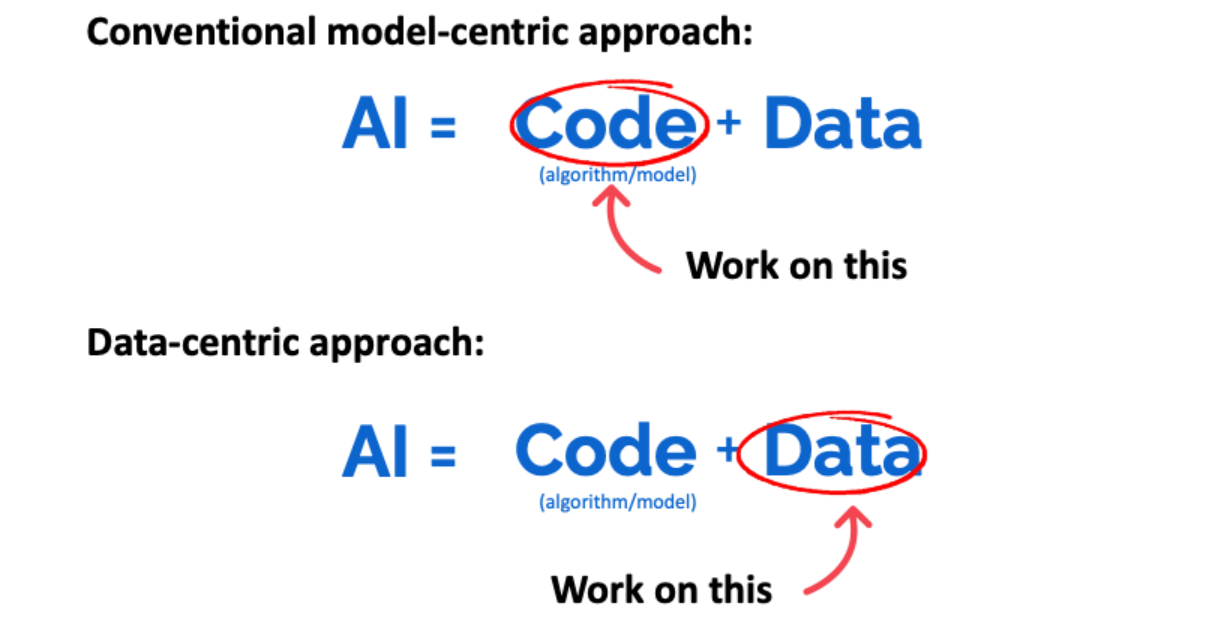
Data-centric artificial intelligence (DCAI) is a new approach to machine learning that relies on the data scientist to define the entire pipeline from data cleansing and ingestion through model training. In this approach, there is no need for deep knowledge about AI algorithms; rather, it’s all about the data. The idea behind DCAI is very simple: let’s start with clean data and train an algorithm on that dataset instead of training an algorithm first and then cleaning up the messy dataset afterward.
In this blog post, we will try to understand what is data-centric AI and why is it important in operationalizing & optimizing AIOps functionalities.
What is Data-Centric AI?
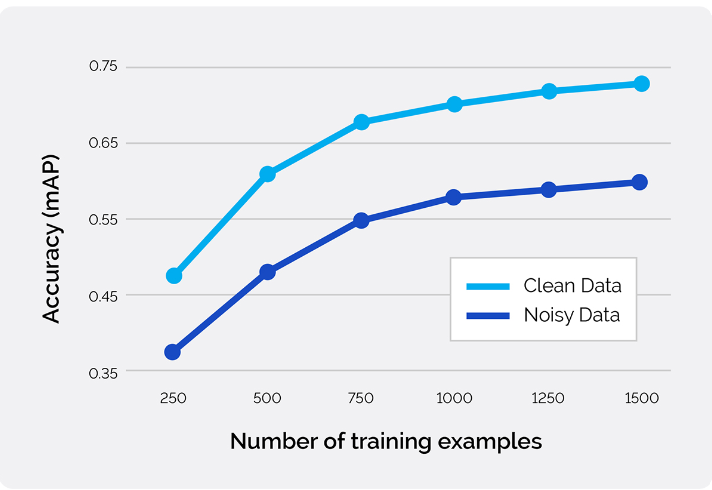
A data-centric AI approach involves building AI systems with quality data. In a world where quality data is often in short supply, AI-powered applications need to be developed based on this concept.
Data-driven AI systems are built with quality data because they can’t be accurate without it. Data is a central part of any AI system, and it’s the best way to teach an algorithm what to learn, as well as understand how it’s learning.
Leveraging a data-centric AI system in deployment reduces development time, and helps quality managers and developers to quickly reach a consensus on topics such as defects and labels, build and optimize models and quickly analyze the end result.
(Image Source: landing.ai)
Data-Centric AI vs AI-Centric Data Science
The difference is that the data-centric approach uses very large quantities of data to train and improve AI algorithms, while the AI-centric approach is more focused on the way data is used for learning.
AI-centric Data Science is more focused on the way data is used for learning and uses smaller quantities of data to train AI algorithms. Data-centric AI uses a large quantity of data to train and improve its AI algorithm while the AI-centric approach focuses on the use of data.
AI-centric data science can use the latest machine learning algorithms to predict the future and make decisions based on the information that is used. Whereas data-centric AI uses massive amounts of historical data to create predictive models that make sound decisions in real-time.
A major difference is that data-centric AI prioritizes data quality over quantity whereas the traditional model-based AI or AI-based data science is focused on doing the opposite i.e. taking the bulk data into consideration. Data-centric AI approach can smoothen your AIOps process as it can mitigate many of the challenges associated with deploying the traditional AI infrastructure.
How Does Data-Centric AI Work
Data-centric AI works to fit the needs of your business through data augmentation, interpolation, and extrapolation.
Data-centric AI doesn’t require that you train a model on a specific dataset. Instead, the algorithm uses the training data provided by your organization to predict something new from it. That means a model trained with your organization’s data is likely to perform well with other datasets, too.
Data-centric AI can benefit from data augmentation. By generating more instances of an existing instance through interpolation or extrapolation, you’ll be able to add a higher level of quality to your models. It also involves generating more data instances from existing ones. This task can be done through interpolation or extrapolation. Because it focuses on the quality of data rather than just quantity, data augmentation is often used to get you close to the right point and avoid overfitting the training set.
In general, a data-centric AI approach consists of the following steps:
- Appropriately labeling your datasets and correcting the errors if any
- Eliminating the data instances that are noisy
- Data Augmentation
- Feature Engineering
- Error Analysis
- Employing domain experts to detect the precision or inconsistency in data points can lead to better results
Why Do I Need to Centralize My Datasets?
A centralized data platform can be used to create a single source of truth, simplifying business processes and ensuring accuracy. When the team focuses on continuous improvement, it is able to minimize wasted time and resources.
By centralizing data, you can achieve better optimization. This is because your team will have more opportunities to improve processes and make better decisions. Centralizing data provides the ability to leverage a single platform that supports continuous improvement in processes, products, and operationalization models.
Data-Centric AI’s Application in Delivering the Best Customer Experience and Personalized Content
Data-centric AI is the link between your data and analytics. It’s used to identify typical behaviors and preferences, personalize marketing programs, generate better recommendations, and do much more.
Data-Centric AI is being used to analyze a range of data to help businesses make faster, more effective decisions. It’s helpful for analyzing customer behavior and patterns across many channels in order to deliver personalized experiences. It’s making it possible for apps and websites to actually tailor the content that people see to their tastes, and for marketers to target individual customers with personalized offers.
The Importance of Data-Centric AI
Data-centric AI prioritizes data quality over quantity by increasing the relevance and veracity of training data sets that are necessary to develop meaningful AI models. Through a combination of existing and new techniques, data-centric AI can help mitigate many of the challenges that can arise when deploying AI infrastructure.
Data-centric AI is a more focused approach to AI. It focuses on developing tools and systems that can help us better leverage the data we already have while ensuring that that data is of high enough quality to be useable in our machines.
What’s the Future of Data-Centric AI?
Data-centric AI aims to build a systematic approach across a variety of areas, including product design and user experience.
Data-centric AI is a systematic approach and tool to facilitate this process by making it easier for engineers and other data scientists to use machine learning models in their own data analyses. In addition, the goal of Data-Centric AI is to establish best practices that make data analysis techniques less costly and easier for companies to implement seamlessly.
The conventional architecture of data-centric AI looks like the following:
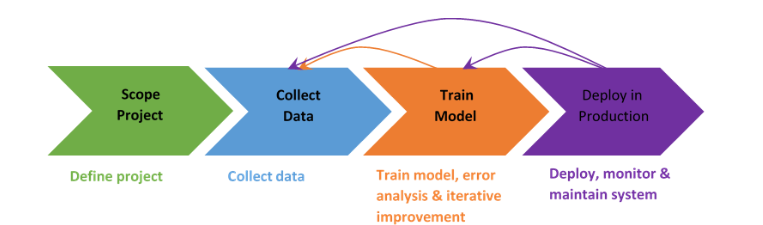
Image Source: technopedia.com
As illustrated it’s an iterative process where an iterative optimization is reinforced as the trained and deployed models can be subjected back to the data collection and/or model training process to bring to the surface and correct the inadequacies, inaccuracies, or insufficiencies in the training data set.
Tools to Encourage the Proliferation of Data-Centric AI
Adopting the data-centric AI model comes with its own set of challenges. Developing data-centric adaptable AI is one of the most important and challenging issues facing AI researchers today.
As applications require more data, the way we build and manage AI systems will be transformed.
To help proliferate the use of data-centric AI in several projects the AI community has come up with many exceptional tools. Some of the prominent ones are as under:
1) LandingLens
LandingLens is a machine learning product created by Landing AI, which helps AI engineers develop and deploy consistent and iterative inspection systems for a wide range of tasks in a production environment. The tool consists of data, model, and deployment modules to manage the data needed for troubleshooting and scale to deployment.
LandingLens helps you accelerate inspection time and drive cost savings by automating your AI-driven inspection processes. It provides a platform for building and deploying automated inspection solutions, allowing engineers to rapidly iterate from one solution to another, regardless of their prior experience level or toolkit.
A product developed by Landing AI helps AI engineers to develop and deploy consistent and iterative inspection systems for a wide range of tasks in a production environment.
2) Cleanlab
CleanLab is a data-centric AI package for model training. It helps you clean labels, perform error analysis, and learn to label errors in data sets. The overall goal of Cleanlab is to get the most possible accurate results from data analysis.
With Cleanlab, you can clean labels — helping you find errors in your data sets and learn from them.
Cleanlab helps automated data cleaning and analysis by automating the process of error-correcting. This means that any errors can be cleaned out so that you can use your data set without worrying about them. Cleanlab will also perform over-fitting, outlier detection, and time series analysis.
3) Snorkel
Snorkel helps you to automatically label and prepare data to accelerate the process of building, deploying, and scaling machine learning models. It’s a data-centric platform that makes the process of creating and labeling data for your model easy.
This revolutionary tool helps you to label data and prepare training data for machine learning models. It is also a platform to create advanced machine learning applications with ease. This revolutionary tool helps programmatically label and prepare data. The proprietary labeling technology of the tool optimizes the engineering resources (by cutting down the operational time from a few hours to seconds). The accuracy is 75%+. This tool can definitely help your teams save time, money, and resources.
4) AutoAugment
AutoAugment uses reinforcement learning to automatically generate new data in an existing training data set. This process is based on research that shows that reinforcement learning improves accuracy at a faster pace than machine learning alone.
Developed by Google Brain, this reinforcement learning algorithm helps increase both the amount and the diversity of the data set. It’s also available as a Python package. With this package, you can train your models without having to worry about the accuracy of your data anymore. AutoAugment helps scale up the training data and improve its diversity.
AutoAugment enables any ML model to efficiently learn from more data. AutoAugment is a reinforcement learning algorithm that learns from existing data by providing diverse examples and generating new ones (predicting the next image) while allowing the system to explore its possibilities.
5) Albumentations
Albumentations is a python library for fast and flexible image augmentation. It provides various methods for adding new features to the input image, such as blur, blurring, edges, and color modification. Taking care of the outputs through optional keyword arguments saves users from dealing with complicated conversion steps.
It uses the same approach as NumPy’s fast blurring function to generate more highly-resolved images. The results are fully compatible with neural networks.
6) HoloClean
HoloClean is designed to enable domain experts to communicate their domain knowledge in a declarative way. This helps produce accurate predictions, analytics, and insights from noisy, incomplete, and incorrect data. HoloClean platform also helps ensure all work is carried out according to real-world standards by using context and document lifecycle management (DLM) processes.
HoloClean is an automated domain knowledge generation platform, which enables domain experts to communicate their domain knowledge in a declarative way. This helps produce accurate predictions, analytics, and insights from noisy, incomplete, and incorrect data.
HoloClean uses domain knowledge to help produce accurate predictions, analytics, and insights from noisy, incomplete, and incorrect data.
Conclusion
With a data-centric approach, you can focus on the best data from your business, rather than having to produce an artificially large amount of certain content. This is because it allows you to avoid the risk that arises from overusing training models, which can be difficult to predict or measure.
Data-centric AI prioritizes data quality over quantity. This approach is more efficient and results in a better quality of intelligence because it draws from a smaller subset of data. Model-centric AI requires a large pool of training data to optimize algorithms, but the overall cost is high due to the considerable amount of computing resources required.
We know that it can be frustrating to not have a clear idea of what your business should be doing next, but we also know you’re in good company. The truth is that there are a lot of people who don’t know how to get started with their data or how best to use it at this moment in time. We want to help remove some of the fear around that by providing information on how AI can make sense out of any size dataset for any business type-and what better way than through examples? Data-centric AI works by creating an environment where humans and machines work together productively. Companies like Netflix and Amazon were able to create new products using machine learning algorithms which allowed them to access new customer segments based on previous purchases made online.
By prioritizing quality, data-centric AI helps to mitigate many of the challenges that can arise when deploying AI infrastructure.
We hope you have found this article helpful.
