


In the wake of the Covid-19 pandemic, countless industries have witnessed a profound shift in how employees operate within their roles at their respective companies. Whilst some still expected a mass migration to take place in which workers returned to their office desks, such a return to pre-pandemic ‘normality’ is yet to materialize on the same scale as before. As more employers begin to question whether their business will ever house the same volumes of office workers as before, big data is emerging as a key solution to build productivity among distributed workforces.
Whilst some employees welcome the notion of returning to the office, others outright reject the idea, citing the costs of commuting and the time consumed by lengthy journeys in the mornings and evenings to reach their company locations.
With sentiment towards in-house work reaching an unprecedented low in the wake of the Covid-19 pandemic, it’s clear that we’re unlikely to ever see employment in the same way as we did as recently as 2019. However, this poses new challenges for businesses in terms of managing employee engagement, satisfaction, and productivity.
(Image: Gallup)
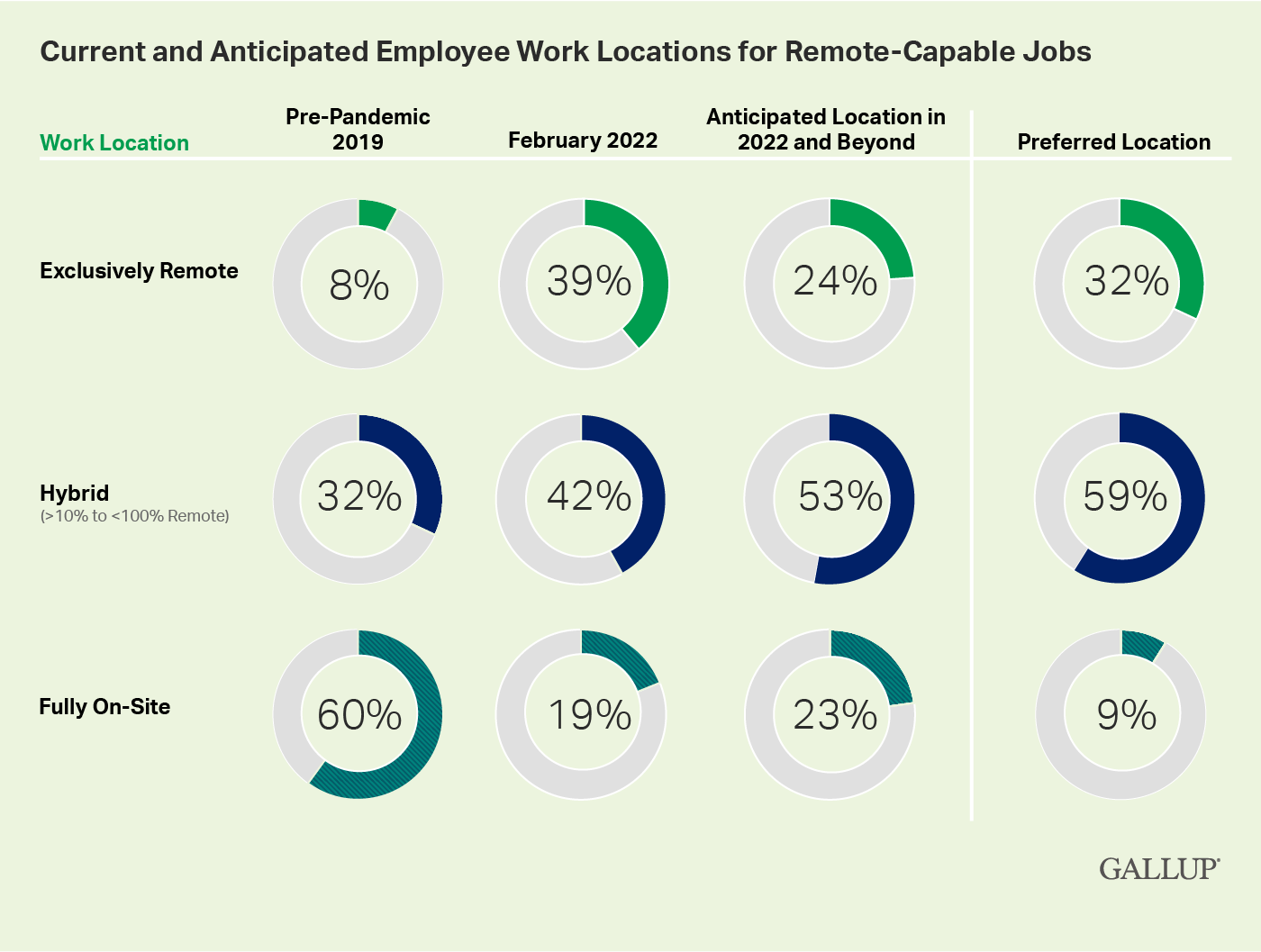
The chart above illustrates just how much of a significant shift has occurred in job location in recent years. In just three years, fully on-sight employment has fallen from 60% across remote-capable jobs to 19% in early 2022 – and tellingly, just 9% of employees cite fully in-house work as their preferred setup.
Whilst exclusively remote work has climbed from 9% to 39% between 2019 and 2022, most employees have indicated that their preferred form of work would be on a more hybrid basis – with 59% of workers stating that they would happily combine in-house and remote operations.
What this fundamental shift in employee sentiment means for businesses is only just starting to take shape, and decision makers will need to adapt in order to foster a healthy environment for both company and employee over the coming years.
However, evidence is already beginning to suggest that big data can pave the way for both a more productive and happier WFH environment for employees via better monitoring processes and actionable insights.
Managing productivity through data analytics
There’s little doubt that one of the primary concerns that employers would seek to address when establishing a WFH setup for their employees revolves around productivity. Through data analytics, this can be achieved through employee monitoring.
Nobody wants to be seen to micromanage their workers, but data analytics tools can provide useful insights into how well employees are tackling their workloads without having to intrude or check-in on them every 20 minutes.
Whilst offices can be optimized to become environments conducive to productivity and employee focus, there are few guarantees in place that remote employees are working in environments that are distraction free. Relaxing furniture and distracting technology like TVs and smartphones can all seep into WFH environments and eat away at productivity – but monitoring tools like Kickidler, Workpuls, and MyAnalytics are all examples of data-driven platforms that can help employees to notice any dips in productivity that can be addressed quickly.
When it comes to big data technology, monitoring productivity can be made far more straightforward through the use of embedded apps and AI-driven management tools. These platforms can offer bespoke features that make it easier for managers to keep track of employee performance in WFH scenarios. They can also offer reporting features that can drive company-wide decision making.
Because employers will be reaching their staff remotely, these tools can also help to drive actionable insights into how employees engage best within their teams. This paves the way for the adoption of the right presentation software that can help to ensure all workers are well equipped to understand their workloads and tasks.
Platforms like Powered Template offer access to nearly 100,000 premium resources through dynamic subscription packages that allow businesses to trial, test, and revise their presentation engagement strategies and how to deliver data to their audience online.
With a wide selection of presentation graphics, infographics, and data presentation templates, Powered Template empowers employers to fine tune their approach to reaching out to their employees and helps them to discover the best possible ways of communicating complex information and insights to them.
Data-driven HR processes
Remote work will transform the recruitment process over the coming years. Whilst a potentially unlimited talent pool with no geographical requirements carries great potential for businesses, it also poses a number of challenges, too.
Paradoxically, despite HR experts often having to sift through mountains of applications for employee vacancies, today’s companies can generally feel as though they struggle to recruit the right talent.
Recruiting the wrong candidate can cost a company a small fortune. Statistically, the cost of a bad hire can equate to around 30% of the employee’s annual earnings. However, with big data, analytics and AI-based algorithms can forge a more comprehensive vetting process for applicants.
In the future, the necessity of utilizing data technology to make the right hire will be essential. After all, many interviews will be conducted on an entirely remote basis – meaning that employers will struggle to gain a comprehensive impression of their chosen candidates before they start their job.
One of the emerging stars of big data HR is the development of applicant tracking software, which can accurately comb the performance of candidates beyond the confines of their CV and even score them effectively before the process of shortlisting and interviewing can take place.
Whilst the prospect of an entirely remote future can still be a daunting one for employers, big data is on hand to make the process a largely frictionless one. With more refined recruitment and productivity management, the transition into WFH operating models can be a prosperous move – helping to fine-tune your teams and ensure the best possible chance of quicker future growth.
