


In recent years, we have been hearing a lot about the potential of digital doctors and nurses: the example of AI becoming directly in charge of our welfare. Being a logical step after AI assisting in diagnostics and treatment path evaluation, digitalisation of medical professionals is something that the broad public still isn’t completely comfortable with.
But what if the technology turns to the mental health and digitalises, not physicians, but psychologists? The implications all favour to the introduction of AI into the sphere: one-fourth of the adult population is estimated to be affected by mental disorders. According to the World Health Organization, depression alone afflicts roughly 300 million people around the globe. The sad truth is that not all of them can reach out for help. The obstacles are related to the still existing stigma in the society, the lack of therapists, the price of the therapy, and Š ” Šin some countries Š ” Šthe qualification of the specialists.
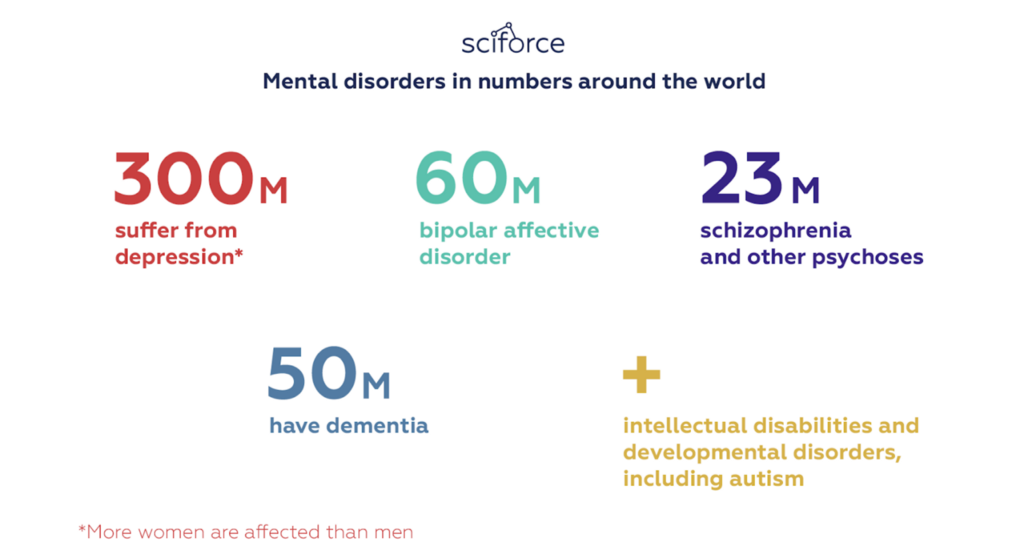 It looks as if AI offers multiple opportunities to help people maintain and improve their mental health. At present, the two domains AI is expected to yield the biggest benefit are the emerging field of computational psychiatry and development of specialised chatbots that could render counselling and therapeutic services
Computational psychiatry
Broadly defined, computational psychiatry encompasses two approaches: data-driven and theory-driven. Data-driven approaches apply machine-learning methods to high-dimensional data to improve classification of disease, predict treatment outcomes or improve treatment selection. Theory-driven approaches use models that instantiate prior knowledge of such mechanisms at multiple levels of analysis and abstraction. Computational psychiatry combines multiple levels and types of computation with multiple types of data to improve understanding, diagnostics, prediction and treatment of mental disorders.
 Image credit: shutterstock.com
Diagnostics
It is known that mental disorders are difficult to diagnose. At present, diagnosis is based on the display of symptoms categorised into mental health disorders by professionals and collected in the Diagnostic and Statistical Manual of Mental Disorders (the DSM). However, in many cases, with the current lack of biomarkers, and symptoms gathered through observations, such symptoms overlap among different diagnoses. Besides, humans are prone to inaccuracy and subjectivity: what is three in one person’s scale of anxiety might be seven for another.
One possible way for AI to assist or even replace human experts, as offered by the Virginia Tech group, is to combine the neuroimaging of fMRI with a trove of data, including survey responses, functional and structural MRIs, behavioural data, speech data from interviews, and psychological assessments. Another example is s Quartet Health, which screens patient medical histories and behavioural patterns to uncover undiagnosed mental health problems. To illustrate the concept, Quartet can flag possible anxiety based on whether someone has been repeatedly tested for a non-existent cardiac problem.
AI can help researchers discover physical symptoms of mental disorders and track within the body the effectiveness of various interventions. Besides, it might find new patterns in our social behaviours, or see where and when a certain therapeutic intervention is effective, providing a template for preventative mental health treatment.
Treatment assistance
Similar to somatic diseases, AI algorithms can be used to evaluate the treatment of mental disorders, predict the course of the disease and help select the optimal treatment path. Building statistical models by mining existing clinical trial data can enable prospective identification of patients who are likely to respond to a specific medicine of line of treatment.
On example of using machine learning is the application of algorithms to predict the specific antidepressant with the best chance of success. While clinicians have no empirically validated mechanisms to assess whether a patient with depression will respond to a specific antidepressant, the treatment efficacy can be improved by matching patients to interventions.
Beyond analyzing fMRI images, computational psychiatry faces, ethical, spiritual, practical, and technological issues. For instance, the huge stores of intensely personal data necessary for the algorithms, immediately raise the issue of cybersecurity. At the same time, however, it is a barrier between the individual, the personal data, and the counsellor that can help overcome patients’ fear of stigmatising and the reluctance to turn to help.
Chatbot development
The idea of creating chatbots that would provide immediate counselling services was born as a response to the lack of therapists and the embarrassment of patients. It is believed that patients, who are often reluctant to reveal problems to a therapist they’ve never met before, let down their guard with AI-powered tools. Besides, the lower cost of AI treatments versus seeing a psychiatrist or psychologist let expand the coverage to a broader circle of people who require treatment.
 Image credit: shutterstock.com
Virtual Counseling
The idea to use programs to simulate conversations between a therapist and a patient dates back to the 1960s when the MIT Artificial Intelligence Laboratory designed ELIZA Š ” Šthe grandparent of modern chatbots. The present-day advances in natural language processing and the popularity of smartphones have to the foreground of mental health care.
For instance, Ginger.io’s app has video and text-based therapy and coaching sessions. Through analysing past assessments and real-time data collected using mobile devices, the Ginger.io app can help specialists track patients’ progress, identify times of crisis, and develop individualized care plans.
Another example is Woebot, a Facebook-integrated computer program that aims to replicate conversations between a patient and a therapist. The digital health technology asks about your mood and thoughts, listens to how you are feeling, learns about you and offers evidence-based cognitive behaviour therapy (CBT) tools. The first randomized control trial with Woebot showed that after just two weeks, participants experienced a significant reduction in depression and anxiety.
The next generation of chatbots will feature avatars who would be able to detect nonverbal cues and respond accordingly. Such a virtual therapist named Ellie was launched by the University of Southern California’s Institute for Creative Technologies (ICT) to treat veterans experiencing depression and post-traumatic stress syndrome. Ellie functions using different algorithms that determine her questions, motions, and gestures. The program observes 66 points on the patient’s face and notes the patient’s rate of speech and the length of pauses. Ellie’s actions, motions, and speech mimic those of a real therapist just to the extent it does not feel too humanlike.
Preventing Social Isolation
Another problem that can be addressed by AI-driven chatbots is the extreme social isolation and difficulties building close relationships of people suffering from mental illnesses. Combined with social networks on the Internet, such chatbots can foster a sense of belonging and encourage positive communication. The National Center of Excellence in Youth Mental Health in Melbourne, Australia, has launched the Moderate Online Social Therapy (MOST) project to help young people recovering from psychosis and depression. The technology creates a therapeutic environment where young people learn and interact, as well as serves as a platform to practice therapeutic techniques.
The recent developments hint that we will soon be facing the AI revolution in mental health Š ” Špromising better access and better care at a cost that won’t break the bank. However, if AI builds models for mental health disorders, are we not also building a model for normality? And if so, who gets to define what normal is and will it be used as a tool or a cudgel? What we should remember when applying artificial intelligence to study our brains, is that we should be careful not to reduce personality to a combination of quantifiable factors and to demystify mental disorders without finding problems in every idiosyncrasy.
