


“The Metaverse is here, and it’s not only transforming how we see the world but how we participate in it- from the factory floor to the meeting room.”
Satya Nadella, CEO of Microsoft
A lot of learned people, huge corporate giants, and a sea of the population across the globe are keen on exploring the world of the metaverse. Satya Nadella and many other eminent people aren’t talking all doubt; when they say that ‘the metaverse has arrived and is experiencing booming popularity’, which is reflected in its market size. A recent report targets an expected market growth of the metaverse from $100.27 billion to $1527.55 billion between 2022-2029.
New projects are being launched all the time, but how many of these are worthy of achieving the larger vision of the metaverse?
Neal Stephenson coined the term ‘Metaverse in his popular science fiction in 1992; where humans as programmable avatars interact with one another and software agents, in a 3D virtual space that consumes the metaphor of the world. As per its definition, the metaverse is a virtual-reality space in which users can interact with a computer-generated environment and other users. Isn’t that fascinating? Being an integrated network of 3D virtual worlds, Metaverse is accepted across industries. Facebook Horizon, Fortnite (the popular online game), and many other such applications are commonplace in the world of the metaverse.
It is quite evident that AI is sure to shape the future of the metaverse. The latest inventions in AI technology have made the metaverse a hot technology to vouch for. Many companies are streamed toward making big advancements in service creation for this new digital world order. The metaverse is the future of the internet. Bringing the virtual worlds together to interact, work, transact, play or even create. It is all set to be a technological genie, for sure. Artificial intelligence is likely to play a critical role in the inclusivity and accessibility of the metaverse. This is going to enhance its functionality; thereby making it user-friendly.
The metaverse uses a variety of technologies- Artificial Intelligence, Virtual reality, Augmented reality, 3D animation, and Blockchain. The different layers of the metaverse are:
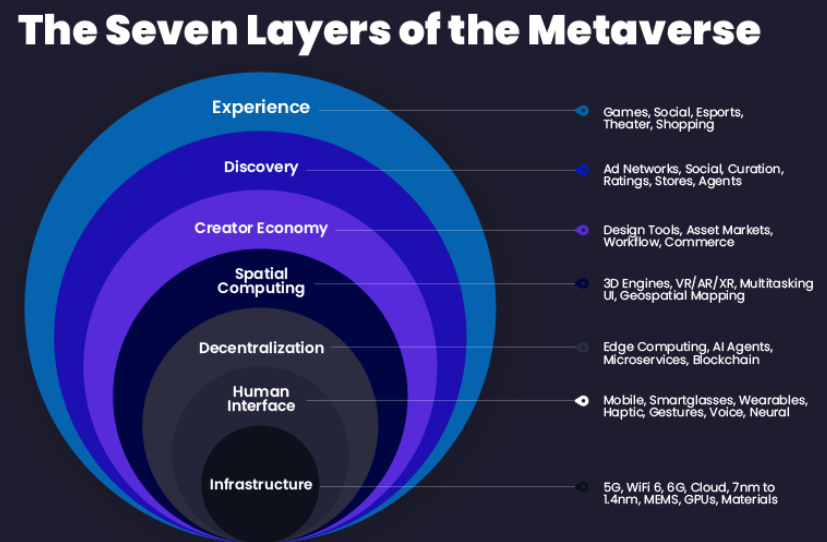
Source: Article by Jon Radoff
The key characteristics that the metaverse platform should comprise include:
- Virtual Worlds
- Massive Scalability
- Persistency
- Synchronicity
- Sturdy Platform to build on
- Fully functioning economy
- Openness and Decentralization
- Interoperability
Why AI is the key to unravelling the metaverse?
The following use cases are sure to reveal the real AI role in the multitudinous development of the metaverse:
Digital Humans and Non-player characters
Entering the metaverse for the first time is always going to be an exciting experience. But users won’t stick around if there’s nobody else there to interact with. AI-driven non-player characters and AI-powered content creation tools developed by certified AI professionals can help resolve this issue. This will turn the secluded metaverse space into an adventurous platform for digital activity. This will induce life for the existing spectators to become metaverse users.
Multilingual Accessibility
AI for accessibility is set to play a fundamental role in guaranteeing everyone’s access to the metaverse. Recent developments expected in this stream of affairs include:
- Image recognition for visually impaired individuals
- Automated Translations
- Exoskeletons interacting with the digital world
- Brain-computer interfaces
AI-driven tour guides
With 25% of people expected to be using the metaverse daily by the year 2026, this is not a task that humans can achieve alone. AI will be used to create digital tour guides, offering a one-to-one introduction to each user; providing all the requisite information about each world.
Education and Training
AI in the metaverse provides the opportunity for users to learn in a real-time virtual environment, without the risk of facing repercussions. It will also equip teachers with virtual assistants.
AIOps
AI-powered operations will allow businesses to handle IT infrastructure. They can be used in the metaverse to predict outages and identify problems as they occur.
Smart Contracts and Digital Assets
Users and companies will be allowed to easily store and exchange assets in the metaverse. They would be using Cryptocurrency called ETP in exchange for goods in the metaverse. Enhanced smart contracts incorporating AI, could help identify key trends.
Unique Immersive Content
As more and more users generate experiences, AI technology will improve upon itself, autonomously generating new scenarios outside of developer creation. Eventually, AI will be directed by an interactive storytelling interface, generating unique scenarios from each input (an immersive content creation tool).
AI as a creative partner
The latest NLP models have opened the door to the use of AI as a creative partner, generating creative writing based on user inputs. Not only can AI generate creative writing, but also realistic images from text descriptions or even from very simple drawings. Technologies such as OpenAI’s DALL-E OR NVIDIA’s GauGAN2.
These use cases require AI to work in tandem with VR and blockchain, and while AI is still in development, hope lies in the masses of funding that is entering the metaverse space. It is finally time to believe that AI is sure to help the metaverse achieve its true vision in no time.
