


There’s no denying that Artificial Intelligence (AI) and blockchain can both be difficult to understand, as promising as they are. But what if there was a way for the two technologies to work together in harmony? AI and blockchain could potentially complement each other by combining the best of both worlds.
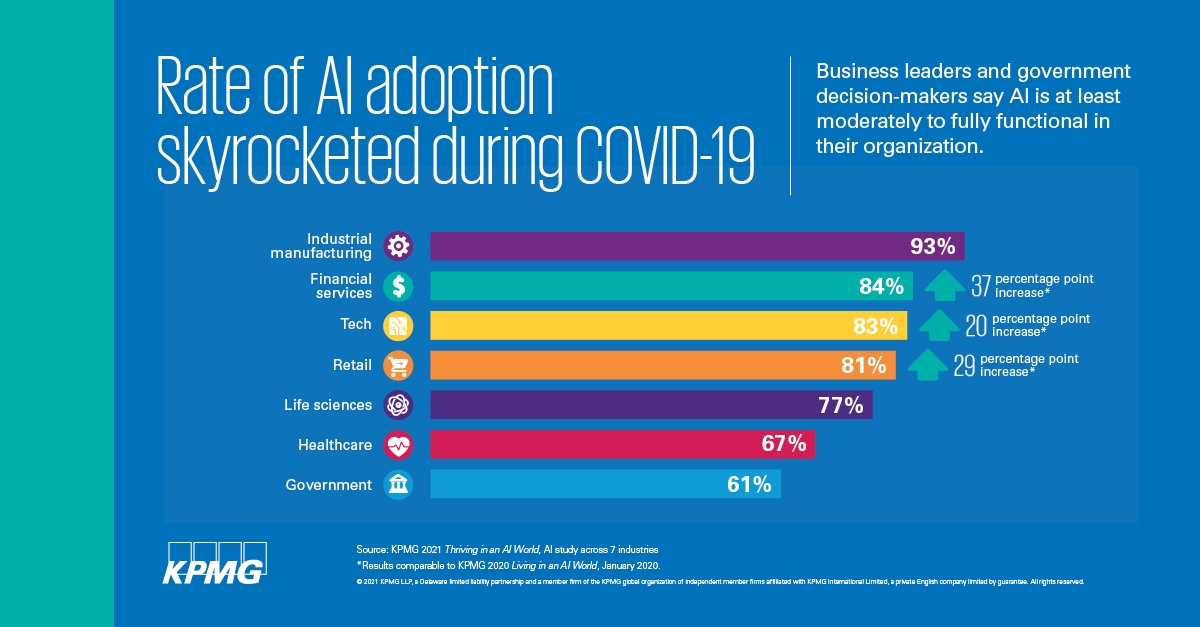
For those unfamiliar with the term, AI is an umbrella term that refers to machine learning that enables software applications to learn without being explicitly programmed. This sounds like science fiction, but this technology already exists, and it‘s not too difficult to imagine how it could be applied in our daily lives. Throughout the pandemic, many businesses have seen the opportunities of AI technology, which has increased its adoption.
(Image Source: KPMG)
A number of AI projects are already underway within various industries – from retail to logistics to healthcare. However, it’s challenging to share the full scope of the potential use cases for AI in blockchain because much remains uncertain at this stage.
AI could help businesses become more efficient by analysing large amounts of data to generate new insights. For example, It could be used to build more secure smart contracts, thereby increasing transparency for both parties. And it could even help identify fraudulent transactions.
As mentioned earlier, there are many different applications that AI can potentially apply to besides blockchain. However, AI technology is still in its infancy – the technology has only been around for a decade or so. Thus, there is huge potential waiting to be unlocked – but it may take some time before AI is able to make the most of blockchain’s advantages and help make this revolutionary technology even better.
What is AI?
To understand AI, you need to understand machine learning. It’s actually possible to have technology that can learn without being programmed. You don’t necessarily have to program your AI with very little instruction it will ever need, but you do need to know how its learning process works.
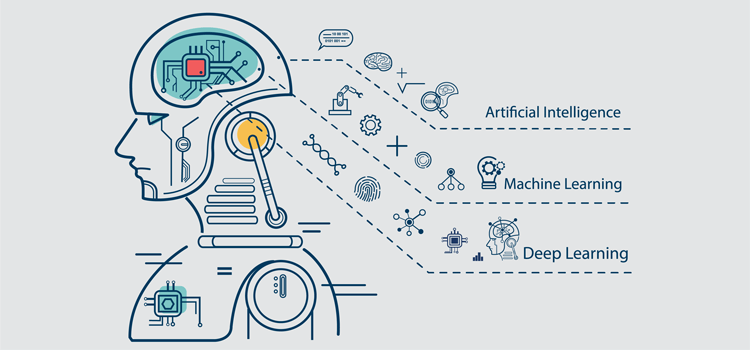
This is where the concept of neural networks comes in – they are algorithms that are based on the human brain, but they can be developed in a computer. These neural networks mimic the human brain so well that scientists believe it would be possible for AI to one day copy the human mind with this type of network.
(Image Source: JalelTounsi)
Let me give you an example of how neural networks could be used. Say you want to teach AI how to tell cats apart from dogs or alligators. You show the AI thousands upon thousands of images on the internet of these different animals. It gradually learns on its own how to identify what makes a cat a cat and what makes a gator an alligator – using nothing but raw images.
Machine learning works by finding patterns in vast amounts of data, so it can help find new insights or correlations that would be hard for humans to notice with their own eyes. What’s exciting about AI technology is that it can handle high volumes of data. As a result, it can perform tasks that are often extremely complicated to us humans but are easy for AI to carry out.
What is Blockchain?
Let’s talk about blockchain now. Blockchain is an underlying structure that manages how data is shared among multiple parties. It allows people to make transactions without the need for a trusted party, which makes fraud virtually impossible.
Blockchain has already gone through its first wave of disruption – popularised by Bitcoin – and it could be considered the first stage of blockchain evolution. It used to be just a way for banks and financial institutions to record transactions between themselves, but it’s now used in quite another way.

(Image Source: Block Geeks)
As mentioned earlier, there are many use cases where AI can contribute to blockchain technology. For example, when AI can analyse large amounts of data to make better decisions, it could make blockchain technology better – especially in its transactions. So, for example, AI could be used to program more secure smart contracts.
Banks and financial institutions are currently working on blockchain applications that allow trade in foreign currencies, securities transactions, and even payment settlements. In addition, AI could be used to make transactions more effective. An example is financial institutions developing artificial intelligence applications to make it easier for investors, regulators, and other parties to find information on transactions.
How can AI and blockchain work together on smartphones?
The markets for AI and blockchain are expanding rapidly. But it is not possible to share everything about AI’s potential use cases that work with blockchain because many applications are still developing. This is why it will be helpful to take a look at some of the more popular areas using AI and blockchain by some of the major players in these industries.
For AI, one of the most popular areas of application is facial recognition technology. As you may know, your smartphone uses face recognition technology to identify you when you unlock your phone. Many companies are currently developing even more advanced facial recognition technology or like the technology used in the X-Rays device. The same tech has been tested on Samsung’s latest Galaxy Z Fold 3.
For blockchain, one of the most prominent applications in supply chain management. Blockchain’s ability to create an immutable digital ledger that can’t be tampered with seems like it would be helpful for many smartphone applications, which allows retailers and suppliers to monitor their own products throughout the supply chain ecosystem.
This is just an example of how blockchain and AI technologies can work together to provide real-time data about transactions between different organisations involved in a product’s shipment.
The future for both AI and blockchain will increasingly become intertwined. Some may even say they are complementary technologies. AI’s ability to analyse large volumes of data could help blockchain technology to even better protect information about transactions between different parties, for example. And blockchain’s transparency makes it secure for AI technology since AI could use blockchain to help confirm that what is stored on a computer or mobile device is indeed true.
In a nutshell, it’s impossible to predict whether or not AI and blockchain technologies will work together. But we can say with a high degree of certainty that they have incredible potential to be used in tandem.
