


There is no doubt Artificial Intelligence has already transformed and will continue to change most of the industries: Healthcare, oil & gas, banking, insurance, customer service, retail, government, education, automotive, aerospace, consumer products, telecommunications & media, sports, energy & utilities, hospitality, travel and transportation, among many others.
Use cases based on artificial intelligence have already demonstrated its value to the enterprises and its industry, and new use cases with high potential are being developed based on AI technologies: natural language processing, image recognition, machine learning, speech recognition and deep learning.
AI is enhancing human potential and is transforming our jobs, not only by generating new ones but also focusing humans on more relevant activities, while AI assumes on repetitive and monotonous tasks that add little value to our jobs.
In general terms, and this applies to most industries, I have identified five ways in which AI brings value to enterprises and humans:
- Engaging with customers, employees and suppliers by enhancing experience and relationships.
- Discovering unknown behaviours & patterns hidden in massive data sources, turning them into insights, recommendations and actions.
- Enabling humans to better learn, develop and perform, AI learns from internal & external data, documents, audios and images and from the expertise of your best employees, making this knowledge available to everyone.
- Predicting business outcomes by augmenting traditional analytical models with machine learning and deep learning.
- Optimizing maintenance and predicting failures in complex machinery/equipment, processes and systems, when AI gets integrated with data coming from IoT devices and sensors.
But, how enterprises should start AI adoption? this does not pretend to be a methodology but only six useful hints that I recommend considering by any enterprise initiating on AI:
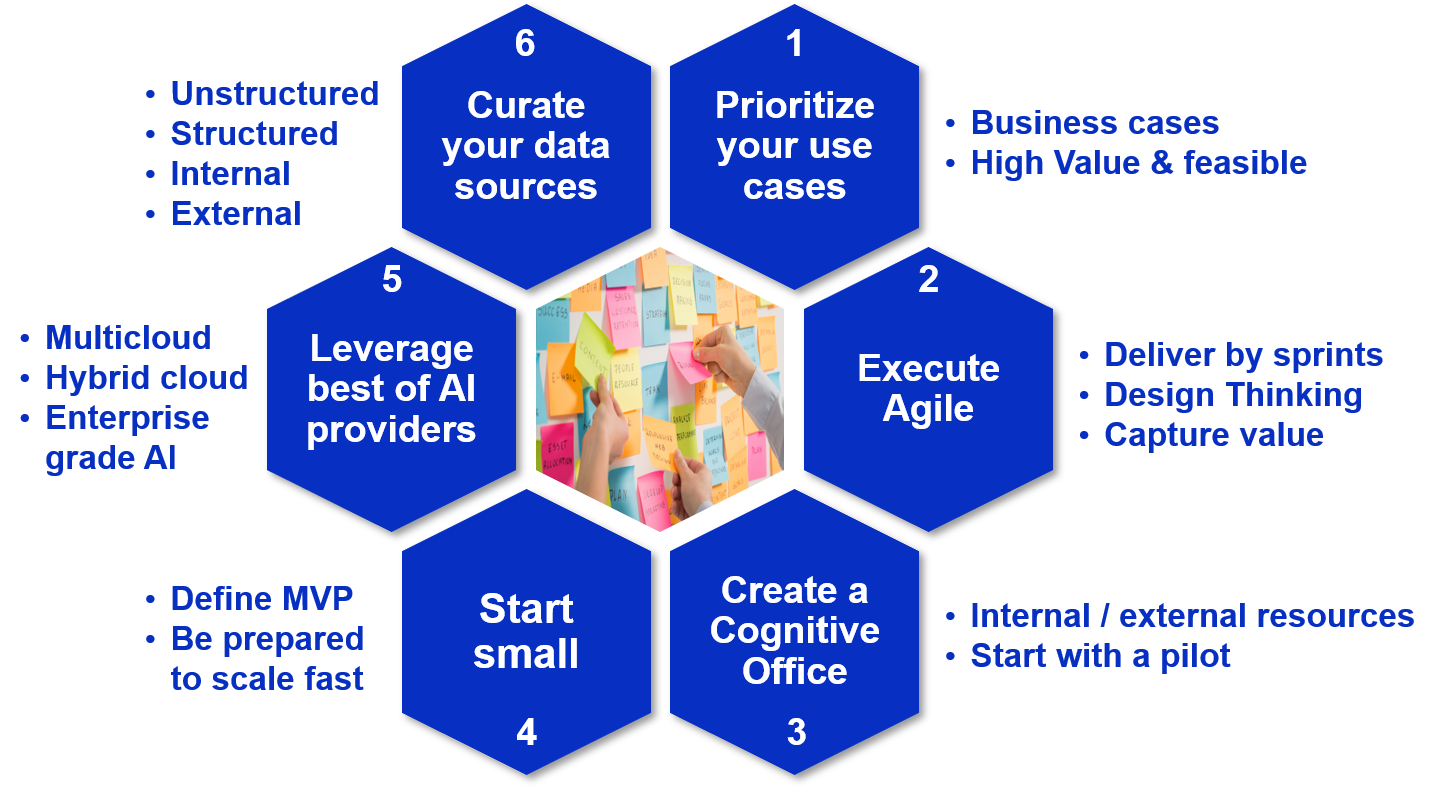
- Prioritize your use cases: Identify and select those use cases that may bring the highest business value, that are feasible and that requires moderate effort.
- Execute agile: Use agile methodologies to define, design and execute short sprints and capture value on each one. Be ready to try, fail and succeed. Conduct design thinking sessions to capture bold ideas but make sure not to oversimplify your design process.
- Create a cognitive office: Start with a team of 4 to 6 persons, make sure you include data scientists, developers and subject matter experts for the area you are starting with. I recommend using a mix of internal and external resources, identify internal talent and complement with external experts.
- Start small: Define an MVP (Minimum Value Product) with a limited amount of data per source but include as many sources as possible and be ready to scale quickly! Do not wait for all data sources to be completely and fully ready, they never will.
- Leverage the best of AI providers: Explore different AI offerings and use the best of each vendor, make sure to use enterprise-grade AI, especially if you are using sensitive data and large amounts of information and documents. Don’t limit yourself to one AI provider, explore multi-cloud and hybrid environments (cloud & on-prem).
- Curate your data sources: when identifying and selecting your use cases, you need to define what information is critical, necessary and desirable for each use case, make sure that your critical data is reliable and accessible. If possible combine structured and unstructured data and internal and external data sources.
Finally, and most importantly, enjoy your AI!
