


When I first heard the term Big Data a few years ago, I didnt think much of it. Soon after, Big Data started appearing in many of my conversations with many of my tech friends. So I started asking a very simple question ‘What is Big Data?’. I kept asking that question to various folks and I did not get the same answer twice from any number of people. Oh, its a lot of data. Its variety of data. Its how fast the data is piling up. Really? I thought to myself but was afraid to ask more questions. As none of it made much sense to me, I decided to dig into it myself. Obviously, my first stop was Google.
When I typed Big Data at that time, this showed up.
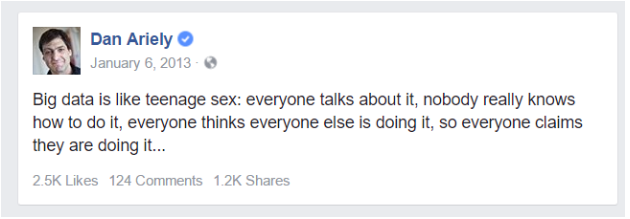
Ahh, It all made sense right away. None of the people I was talking to really knew much about Big Data but were talking about it anyway as everyone else was talking about it.
In this series of articles, I am planning to write on Big Data, my target audience is those people who come across the term Big Data but dont live and breathe Big Data on a daily basis for their regular jobs. If you are one of those practitioners making a living off of Big Data, these articles may be rudimentary for you. Decide whether you are on that spectrum and decide to either continue reading or leave now. Ill not be offended.
So what Really is Big Data?
I turned to my trusted old friend Wikipedia and it said:
Big Data is a collection of data sets so large and complex that it becomes difficult to process using on-hand database management tools or traditional data processing application.
So Wikipedias definition is focusing on volume of data and complexity of processing that data. Good start but doesnt clearly answer the question of what is the volume threshold of data that makes it Big Data. Is it 100 GB? A Peta Byte? What are the on-hand database management tools? Are they referring to Relational Database Systems from Oracle and IBM etc? Most likely but not answered in this definition.
Then I turned to OReilly Media who everyone told me that they are the ones who made Big Data popular. As per OReilly media:
Big data is data that exceeds the processing capacity of conventional database systems. The data is too big, moves too fast, or doesnt fit the structures of your database architectures. To gain value from this data, you must choose an alternative way to process it.
To some extent, Wikipedia and OReillys definitions are similar in that both refer to processing capacity and conventional database systems but OReilly media adds a new twist by mentioning too big and moves fast. Hmm, animals like elephants and cheetahs started running through my head.
My next stop was Doug Laney from Gartner who was credited with the 3 Vs of Big Data. Gartners Big Data is:
High-volume, high-velocity and/or high-variety information assets that demand cost-effective, innovative forms of information processing that enable enhanced insight, decision making, and process automation.
Gartner is referring to the size of data (large volume), speed with which the data is being generated (velocity), and the different types of data (variety) and this seemed to align with the combined definition of Wikipedia and OReilly media.
I thought I was getting somewhere.
Not so fast said Mike Gualtieri of Forrester, who said that the 3 Vs mentioned by Gartner are just measures of data and Mike insisted that Forresters definition is more actionable. And that definition is:
Big Data is the frontier of a firms ability to store, process, and access (SPA) all the data it needs to operate effectively, make decisions, reduce risks, and serve customers.
Let us try to digest this together. Forrester seems to be saying that any data that is beyond the current reach (i.e. frontier) of that firm to store (i.e. large volumes of data), process (i.e. needs innovative processing), and access (new ways of accessing that data) is the Big Data. So the question is: What is the frontier? Who defines the frontier?
I kept searching for those answers. I looked at McKinseys definition:
Datasets whose size is beyond the ability of typical database software tools to capture, store, manage, and analyze.
Well, similar to all the above but still not specific for me to decide when the data becomes Big Data.
Then I came across this article from University of Wisconsin which gave some specificity to the Volume. The article said some have defined big data as an amount that exceeds a petabyte – one million gigabytes. Thank you Wisconsin for clearing that up. But the same article mentioned the numerous Vs that are being added to the 3 Vs that Gartner originally came up with.
IBM added Veracity referring to the quality of data. See the picture below with 4 Vs.

And other Vs kept getting added to Big Data definition by other people
Variability is referring to the changing nature of data.
Visualization refers to the art of turning data science into visual stories via graphs and other charts to transform data into information, into insight, into knowledge etc.
Value refers to the fact that businesses need to take advantage of all this data into some valuable decisions.
So what did I learn?
Even though there is no single definition for Big Data that is universally accepted, there are some common concepts that almost all seem to converge on. And they are:
- Big Data is data that is of large volume (> 1 Petabytes)
- Big Data is data that is not a single type i.e. structured and a variety of structured, unstructured etc.
- Big Data is data that is being generated at a much faster rate than data in the past from all kinds of sources including social media.
- Big Data is data that requires newer ways to store, process, analyze, visualize, and integrate.
Hope this article was helpful. If it was, please Like it here, Share it with your network, and feel free to Follow me. If you want to stay in touch, please Connect here on LinkedIn or follow on twitter @rkdontha1.
So what other Big Data questions you have but are afraid to ask? Go ahead and comment below OR send me a note. Look forward to hearing from you!!!
Sources (Please click on the link for article):
