


What do I do with all this data?!? Time and again, we hear this from marketers across all industries. While there is plenty of content and How-To Guides published about Big Data, digital marketing, and social media, just grappling with the data you already have at hand continues to be a challenge for many companies.
Before you can even begin thinking about implementing a Big Data solution what do you do with the data you already have? Or maybe you are dabbling in digital marketing and social media on some level, but meanwhile, your data continues to pile up without any real insights into what it is telling you. If any of this sounds familiar, read on as we share some practical tips on how to better manage all that data.
1. Getting Started – Establish an ROI
Establishing a strong return on investment (ROI) will help get new data projects off the ground. Begin by outlining problems caused by dirty data, documenting the costs, and showing the benefits that can be achieved by improving data. By directly aligning data improvement projects with business goals, data management solutions can more quickly be justified.
In the following two examples, each company establishes a strong ROI by documenting costs caused by dirty data, as well as the benefits gained by improving data quality.
- Mid-Sized Retailer – Increase revenue by improving operational efficiency.
Numerous errors in billing and shipping are causing frequent product returns, inaccurate deliveries and queried invoices. The problem is tied back to inaccurate customer addresses. If the customer database for the retailer contains 100,000 customers, and addresses were improved by 5% or 5,000 customers, costs and benefits of improving data can be quantified. Product redelivery costs are reduced, cash flow is increased when invoices are paid in a timely manner, and customer service representatives become more productive when they no longer need to spend time resolving customer invoicing issues.
- National Financial Institution – Increase revenue by identifying up-sell and cross-sell opportunities.
Customer data silos are hindering the marketing departments ability to identify new revenue opportunities. By integrating disparate data sources, unified household views can be established and analyzed to make informed marketing offers. For example, using common identifiers, the Smith household is linked together. By discovering that the Smiths have a college-age son, an offer can be made for a student savings account.
2. Perform a Business Needs Analysis
As part of any new data initiative, a business needs analysis should also be performed to understand what is required of data moving forward. A business needs analysis focuses on understanding business objectives, strategic goals and business drivers.
For example, what information is required to meet these objectives and how accessible is it to end users? Are data gaps occurring, limiting the availability of required information to support decision-making? What data issues may be impacting revenue, increasing costs, or causing inefficiencies in operations?
Documenting business objectives helps determine what data should be captured, how the data is related, and how data should be structured to create value.
3. High Quality Data for Smarter Decisions
Once a data management project is approved, data must be properly cleansed and integrated to ensure information is of the highest quality to drive smarter decision-making across departments.
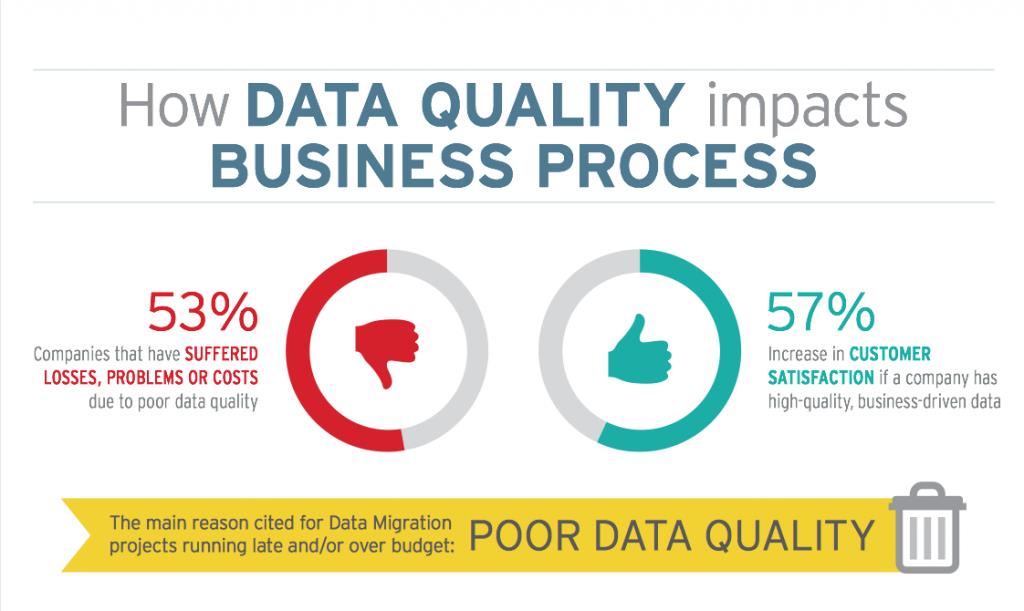 Begin by evaluating the quality of your data with a data assessment. DataMentors provides a complimentary assessment to help identify areas where data quality can be improved, what types of data may be missing, and other problems that may be affecting optimal data performance.
Data must also be integrated and placed into a central repository for a complete, 360-degree view of the customer or other business area. Data quality software automates integration processes and improves data quality by performing the following functions:
- Parsing and standardization
- Matching and linking data
- Monitoring to ensure data continues to align with business rules
- Enrichment through data appending
Business processes should also be established to ensure data manually entered into systems is of the highest quality possible. Many organizations experience data errors when information is manually entered, at a rate of 2% and 8%. Even one wrong number entered incorrectly can cause a payment to fail, a wrong part number to be shipped, or apparently a man to become pregnant.
Data validation controls can be integrated into on-line forms, using rules to check the validity of data sets. For example, an online website form may require a visitor to enter data in specified formats. Or an IRS form may utilize controls to check that positive numbers are being entered into fields. Training employees to be more aware of the importance of data quality is also a crucial step to achieve a company-wide awareness of maintaining high quality information.
While companies have long understood the value of investing in human capital, managing data for smarter decision-making requires a similar level of commitment and investment. People, processes and technology must all be aligned to successfully derive value from data.
However, successful data management programs are not developed overnight. Establishing short-term and long-term goals is key, as is working with a data management vendor who can provide guidance throughout the process. Once the foundation has been established, data management programs can grow over time. Companies that embrace a data-driven mindset can be confident that data is of the highest quality to support Business Intelligence, increase revenue and grow the business. And of course to answer the question of what to do with all that data.
