


The working world has been turned upside down by the emergence of the COVID-19 pandemic. Businesses are facing unprecedented levels of uncertainty for the future and many operations have been forced into going remote to protect the welfare of employees. Amidst the chaos, we’ve also seen a significant rise in digital transformation, with more companies than ever embracing change. Could this lead to a fundamental shift in how we protect the morale of our workers?
The pandemic has progressed the movement towards digital transformation at a much faster pace than ever before, and this, in turn, is leading decision-makers to new ways of keeping their employees happy in brand new working environments.
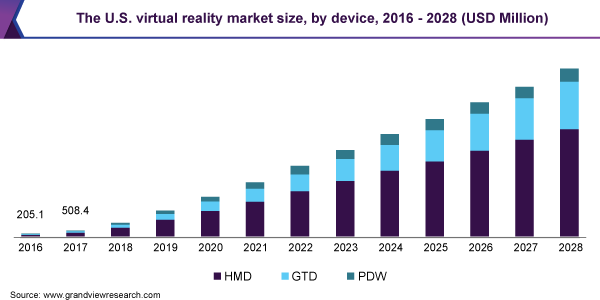
(Image: Grand View Research)
As the chart above shows, one of the industries that’s set to experience significant growth alongside digital transformation is that of the US virtual reality market. Use cases of VR within internal business structures are growing, but can the technology become a leading way of boosting employee morale and motivation as we emerge from the pandemic and into a more remote era of the new normal?
Encouraging Remote Team Building
One company that moved quickly in the pandemic to use virtual reality technology to keep employees happy and functional as a team was BrightCarbon, a UK design agency that specialises in eLearning content.
During the lockdown, BrightCarbon sent out regular surveys to monitor the wellness of their employees. One survey asked whether employees had an interest in virtual reality, and all respondents who claimed to be interested in VR were sent an Oculus Quest 2 headset to enjoy at home. Subsequently, almost all 80 employees at the company received a headset.
BrightCarbon’s adoption of VR headsets for remote employees has paved the way for a number of VR-based team building events in which employees don’t even need to leave the house. Workers get to bond over virtual rock climbing, archery, fishing and dancing classes.
Speaking to the BBC, John Bevan, a BrightCarbon employee explained that “It‘s absolutely boosted my morale and my family’s and all of my team’s as well. It really has connected people with others in the business they don’t talk to.”
The beauty of BrightCarbon’s approach to adopting VR activities for employees is that remote workers who may have never met other employees can engage in team-building exercises that place individuals in close contact with one another in an entirely virtual environment. This can help to make communication much more seamless between workers while maintaining a strong level of company culture even despite employees operating entirely remotely.
Enhancing Collaboration
Employee collaboration is essential to the functioning of a business and the motivation of employees. If a worker is confident in approaching colleagues, they can undertake their tasks with a greater level of comfort and efficiency.
As the world moves more towards the realm of remote work, bosses have spent recent months looking for ways to ensure that seamless collaboration can still take place among distributed teams. While platforms like Zoom, Skype and Slack are making strides in bringing remote employees closer together, the ability for more comprehensive communication like in office environments is still largely lost.
Virtual reality applications help collaborators to freely gesture and move around meeting environments, all without the need of spending time and travel costs on face-to-face meetings.
In a remote world, distributed workforces can emerge to become a driving force for VR adoption among workforces to better improve employee collaboration, interaction and, subsequently, motivation. This represents a significant step towards recapturing the essence of traditional office environments and interactions in a digital world.
Eliminating Uncertainty Within Roles
One of the biggest causes of frustration among new recruits is a feeling that they may not be adequately prepared in their job role. Regardless of whether they’re engaging in remote or in-house employment, there can be many flaws to the onboarding process of employees such as individual variations in learning styles, the lack of relevant mock training scenarios and the inability to gauge whether employees are retaining the information they’re learning. If businesses don’t give enough attention to their training processes it could lead to more uncertainty and a higher turnover rate.
To counter this, Walmart has begun issuing VR headsets within its stores with a growing virtual reality training library. Some of the topics covered range from Black Friday scenarios to a Pickup Tower simulation. Andy Trainor, Walmart US Academies senior director, noted to eLearning Industry that the VR program has helped employees to gain confidence, helping the company to retain staff more efficiently.
Virtual reality helps businesses to generate immersive virtual environments that help employees to learn in an engaging way without the fear of costly errors during the process. As virtual reality adoption continues to increase, we’re likely to see more businesses utilise the technology as the most immersive way of helping new recruits to better understand their job roles, helping them to settle faster and find comfort in their environment – whether it’s at home or in the office.
The use cases of virtual reality within the business landscape are growing. As we continue to emerge from the pandemic and operate in a new normal’ environment, it will be VR and augmented reality that will drive innovation, paving the way for greater levels of employee morale, motivation, and, in turn, productivity.Â
