


The architecture, design, or pattern of any application decides the foundation of how that software is going to look like. Every business application’s architecture depends on its needs, customer’s demands, and more on the availability of tools, resources, and talent. Design models differ from business to business and therefore it becomes important to analyze which one would make yours profitable. MVC or Machine View Controller has been in the picture for quite a long time, Flux and Redux architectures are new in the development field. To choose the best, you need to know about them better.
What is MVC?
MVC architecture was first introduced in 1976 by Trygve Reenskaug. Gradually, it gained importance, was upgraded and used by various development companies. MVC is a three-layer development architecture. The three components of the application developed using MVC are:
· Model: Maintains the data and behavior of an application
· View: Displays the model in the UI
· Controller: Serves as an interface between view & model components
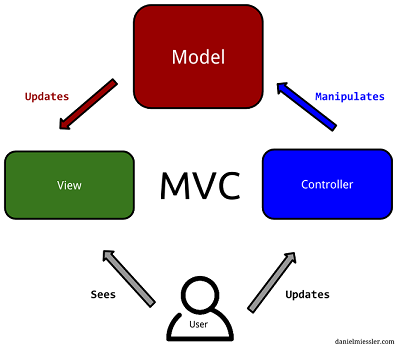
This figure makes it clear that how an MVC architecture works. The controller takes the user’s input and passes that to the model and view to update accordingly.
MVC is liked by developers and is counted among the favorite architectures because it allows the separation between the three layers. This separation helps in improving testing capabilities and web interfaces. It works well in JS frameworks like Ember and many others.
Why other architectures?
This question makes sense, if MVC is so favored by the developers then what is the need for Flux?
MVC is considered good when it is about server-side development, but on the client-side in many JS frameworks, MVC allows the view to communicate with the model directly which leads to complex changes in properties. This makes it difficult to debug anything.
So, Facebook came up with Flux when it saw problems in scaling its own MVC applications.
Flux Architecture
MVC has a bidirectional flow and Facebook stated it as a problem because this architecture messes up for client-side applications as shown in the figure.

The Flux architecture has the following components:
Stores: A storage for the app state & logic
Action: Triggers data transfer to the dispatcher
Dispatcher “ Coordinates actions & updates to stores

This figure simply states that in Flux architecture, when a user clicks on something, the view creates actions. Action can create new data and send it to the dispatcher which dispatches the action result to the appropriate store. The store updates the state based on the result and sends an update to the view.
Flux based implementation of JS Framework-Redux
Eventually, after Flux ventured into the market, its workflow suited many client applications and therefore led to the development of other similar frameworks such as Redux. Redux is not considered as an actual framework but a library that is based on the idea of Flux. Redux has flowing new components:
Reducer: Logic that decides how your data changes exist in pure functions
Centralized store: Holds a state object that denotes the state of the entire app. The Redux architecture denotes an event to an action that is dispatched to the reducer. As Redux has a centralized store, the Reducer updates that store according to the action. Store creates a new state and sends an update to view, it reflects the update.
Features of MVC, Flux, and Redux
The above information clarifies a basic understanding and working of the three architectures in an application. Below are the features that differentiate these three architectures:
Debugging
· The major feature that led to the development of Flux and Redux was their capability of simplifying the debugging process in any application. MVC has a bidirectional data flow that makes it difficult for the developers to identify the issue and debug it.
· In Flux the data flow is unidirectional. The Flux architecture encourages making the code clearer, updating other views, and debugging by new developers. It has a dispatcher and all actions are passing through that dispatcher that make debugging easier.
· In Redux, debugging is way easier because the state of your entire app is maintained within a single Store. It is possible to log all the actions that have been performed to get to a certain point that helps in debugging the application in one go. Redux also offers a Live Code-Editing option with a time-traveling debugging feature. This feature enables you to rewind and replay your debugging action.
Business logic
· Business logic defines real-time business rules into data management, control, storage, and changes. In MVC the controller takes the responsibility of handling both the data and state of the application.
· Whereas in the case of Flux, the logic of changes in the data based upon the actions is mentioned in its appropriate Store.
· In Redux the logic is stored in the Reducer, which receives the previous state & one action, then returns the new state.
The Store Concept
· MVC does not use the store concept instead it has a model that contains the state of numerous objects.
· Flux uses multiple stores to cache any single application associated with data or state.
· Redux includes a single Store per application and keeps everything in one region of the app.
Front end back end support
· Talking about MVC, albeit, its complex debugging feature it is recommended for both server-side and client-side development. Front-end frameworks supported are AngularJS, Ember, Backbone, Sprout, and Knockout. Back-end frameworks supported are Spring, Ruby on Rails, Django, Meteor, and more.
· Flux is mostly recommended for client-side development. Front-end Frameworks supported are React, AngularJS, Vue.js, and Polymer.
· Redux also supports client-side development but it is more than just a library. It serves other advantages for your front-end apps such as ensuring data consistency, sharing data between components, and providing templates for code organization.
Conclusion
Every architecture has advantages of its own. It entirely depends on the needs of the business, your idea of the application, and the customer’s demands that which one should be brought into use. The type of application plays a major role in choosing the type of architecture. If the application is complex and has a complicated data model it’s better to go with Flux or Redux or if data binding is fine for you then nothing is better than MVC. To clarify better, Flux and Redux are just an improved MVC approach for client-side applications because MVC in itself is not that much good for client-side applications.
Want to know which architecture will suit your project better? Get in touch with us.
