


5G means blazing speed, and many believe it to be the next big thing in internet connectivity. The current generation of internet connectivity like 4G LTE (Long Term Evolution) has been around for quite some time and offers 1GB per second; at the same time, 5G technology can deliver speeds up to 20 GB per second. The 5G technology has been deployed in some nations, while others are still developing infrastructure for the deployment.
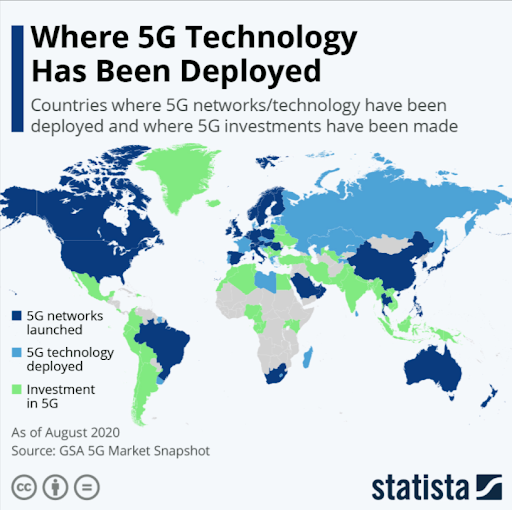
Source: https://www.statista.com/chart/23194/5g-networks-deployment-world-map/
Countries like the US, Canada, South Africa, Australia, New Zealand, and many others have launched full-fledged 5G services. At the same time, there are countries like India, Mexico, and others that are yet to deploy 5G technology but have substantial investments.
Apart from the faster internet and better connectivity, 5G is an excellent upgrade for IoT adoption(IoT). Many IoT intelligent devices like wearables, smart speakers, and others need rapid data exchange. Here, 5G technology can help boost data exchange, enhancing IoT device connectivity, especially for industrial purposes.
But, is the 5G technology worldwide ready for IoT? Let’s discover.
5G & IoT: Need For Speed
Not just the data transfers, but enabling innovations like Augmented Reality/Virtual Reality(AR/VR) needs lower latencies. Internet of Things or IoT-based devices connects wirelessly with systems for interaction and data exchange.
Take an instance of a smart wearable like a fitness center that detects your vitals‘ real-time data like heart-rate, or even SPO2(Oximeter). Checking on the go’s oxygen levels can be great, especially when dealing with a respiratory-related pandemic like COVID19.
Now, every data detected by wearables is exchanged over a cloud network to be stored in local data centers or even virtual machines. Here, the speed of data transmission takes centerstage. 5G technologies can enable a higher speed of transmission for data between data centers and IoT devices.
Apart from the cloud-based data exchange, and interactions 5G can enable intelligent technologies like Artificial Intelligence. With more IoT devices in the market, BigData management for businesses is prevalent, and smart technologies like AI can help. But to leverage Machine Learning or AI algorithms, you need low latency networks.
5G Networks and Latency
Network latency relates to the delay between sending data and receiving it. Take, for example, the difference you feel while watching a Youtube video from your Bluetooth earphones. The latency lag can place the audio out of sync. Similarly, network connectivity can be an issue for enterprise-grade applications due to the high volume of data exchange.
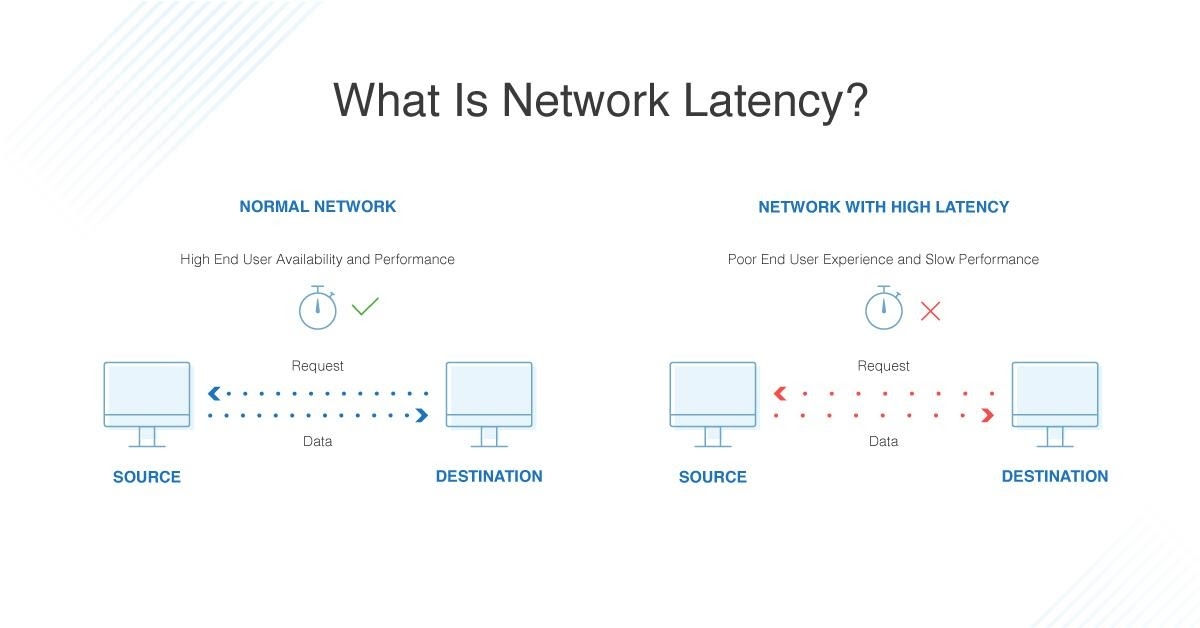
Source: Network Latency Guide: How to Check, Test, & Reduce – DNSstuff
With 5G, experts expect latencies to be as low as 1ms, which is quite fast compared to the current ecosystem. 4G LTE bands offer a latency of about 50ms(milliseconds) which is much more than what 5G can offer. Such lower latencies can be excellent for cloud-based application and software development. Now that we have an idea around 5G technology and its significance in IoT technology let’s understand the present challenges that businesses face while implementing a full-fledge 5G service.
5G: Infrastructure Challenge
Most of the countries that are seeing significant investments in 5G services have existing 4G infrastructure. So, it might seem that implementing 5G may not seem to be a problem on the hardware side which is not the case.
On the hardware front, the existing 4G infrastructure can only facilitate the execution of sub-6gigahertz bands for 5G services which are not that comprehensive in terms of speed.
The millimeter-wave (MMWave) technology in 5G can offer the kind of speed and latency that most businesses expect. While on the software front, you can create distribution functions by leveraging development companies. But, on the hardware front, you need substantial investment to have a mesh network of MMWave receivers.
For MMWave, you will need nodes/receivers close to the service area, as shown in the above video for Verizon. At the same time, sub-6gigahertz can be executed on the current 4G infrastructure with slight tweaks.
5G: Data Security Challenge
5G technology will enhance the data exchange, and at the same time, security is an essential factor. Data security is a massive issue with the recent leakage of 533 million user’s personal information, including their cellphone numbers.
However, there have been attempts by many businesses to adopt innovative technologies like Blockchain for data security; with higher speed transmissions offered by 5G, security will take center stage.
Data security needs an extra authentication layer over the standard encryption to ensure protection. What 5G can do is improve the user experience during the data transmission from an extra layer of encryption. Even the UI can be made more compatible with smooth navigational capabilities to leverage lower latencies through mobile app development. Lower latencies can also improve the fluidity of the display in apps that usually can be achieved by higher refresh rate screens.
5G: The BigData Challenge
An enormous amount of data that will be exchanged over 5G networks need traffic routing and overhauling to control the network flow. Here, mobile operators can leverage virtualization approaches like software-defined networking (SDN) and network functions virtualization (NFV). For network operators to leverage SDN, a reliable software development approach becomes vital.
Apart from virtualization, the nodal approach can be a great way to counter short-distance connectivity that can come with MMWave technology that has a shorter wavelength than the current 4G LTE. Here, businesses can leverage a nodal approach to collaborate with mobile operators and create local data centers to accommodate BigData in small packets.
Distribution of data and duplication is not new for cloud-based services that leverage it to ensure higher availability. Similar strategies can be deployed in tandem with the 5G technologies to aid real-time data processing and exchange. Adding AI and ML to this mix will make autonomous BigData management a reality.
Conclusion
With more IoT devices getting attention and data resources growing exponentially, the need for better connectivity is evident. 5G will help achieve better data transmission speeds and reduce the latency of interaction between IoT devices and machine interface.
Even though countries like the US and Canada have been offering a full-fledged 5G service, there have been instances of inconsistency in speeds. At the same time, many countries are yet to even start a 5G trial. The heterogeneity in adopting 5G is due to different challenges that these countries need to overcome before leveraging it.
