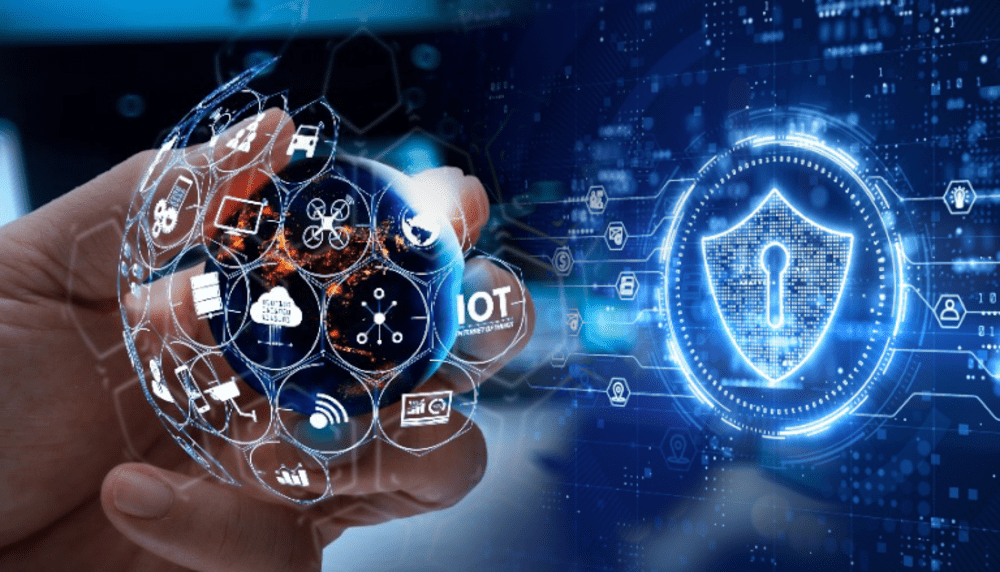
Cyber security protects internet-connected devices such as software, hardware, and data from various online threats. Cyber security ensures that the public relies on services and government organizations. Business requires cyber security to safeguard intellectual property, data, and money. The global cybersecurity market size in 2021 was $216.10 billion and is predicted to increase to $478.68 billion by 2030, representing a CAGR of 9.5% during 2021-2030.
The Internet of Things is a network of physical objects that can identify themselves to other devices and use integrated technology to interact with internal or external states. In the Internet of Things (IoT), an object representing itself can grow by connecting to nearby objects and the vast amounts of data constantly flowing past it. The IoT aims to improve quality of life and enable new business models by turning the physical world into one large information system.
One single failure in the security chain could provide hackers with nearly limitless access points that could be unlocked and lead them to data.
Cybersecurity Landscape for the Internet of Things
Privacy is a major concern in the Internet of Things and in all applications, devices, and systems where we share information. Even when users take preventive measures to protect their data, there are some factors that they cannot control. Hackers can now create attacks with unexpected sophistication and correlate data from public networks and various private sources such as automobiles, smartphones, home automation systems, and even refrigerators.
In the quickly evolving world, everything connected to the Internet is expanding the attack surface for hackers and enemies. According to a recent study, about 70% of IoT devices contain serious risks.
As new devices are built that are interconnected with the Internet, best security practices should also be implemented. Many best security practices can be used, such as hardening systems, using secure communication protocols, and installing the most recent updates, fixes, and patches. Innovators must consider that future security will be managed automatically by the system rather than by users, and developing secure technology will necessitate a new approach.
Most common Internet of Things Security Challenges
- Software and firmware vulnerabilities
It is tough to ensure the security of IoT systems, owing to the fact that many smart devices are resource-constrained and have limited computing power. As a result, they are not able to run powerful, resource-intensive security functions and are more vulnerable than non-IoT devices.
- Insecure communications
The majority of existing security mechanisms were developed for desktop computers and are difficult to implement on resource-constrained IoT devices. As a result, traditional security measures are ineffective in protecting IoT device communication.
The possibility of a man-in-the-middle (MitM) attack is one of the most dangerous threats caused by insecure communications. If the device does not use secure encryption and authentication mechanisms, hackers can easily perform MitM attacks to compromise an update procedure and take control of your device. Attackers can even install malware or change the functionality of a device.
- Data leaks from IoT systems
Hackers can access sensitive information such as location, bank account information, and health records. However, exploiting insecure communications isn’t the only way for attackers to obtain valuable information.
All data is transmitted and stored in the cloud, and cloud-hosted services are vulnerable to external attacks. As a result, data leaks are possible from both devices and the cloud environments to which they are connected.
Third-party services in IoT systems could also be a source of data leakage. Ring smart doorbells, for example, were discovered to be sending customer data to companies such as Facebook and Google without proper customer consent. It occurred as a result of the Ring mobile app’s use of third-party tracking services
- Malware risks
According to a recent Zscaler study, set-top boxes, smart TVs, and smartwatches are the devices most vulnerable to malware attacks.
If attackers are successful in injecting malware into an IoT system, they may alter its functionality, collect personal data, and launch other attacks. Furthermore, some devices can come pre-infected with viruses if manufacturers do not provide adequate software security.
- Cyberattacks
IoT systems are also vulnerable to a variety of cyberattacks. The most common types of IoT device attacks are device spoofing, physical intrusion, denial of service, application-based attacks, and denial of sleep attacks.
Soon, IoT devices will play an essential part in our lives. It is the responsibility of cybersecurity experts to ensure that these devices continue to assist in conducting business rather than creating problems.