

We all aspire to grow old someday and we often wonder how life will be for us at that stage. As we move towards this phase, our needs evolve. This is because our body cells change and in response, it affects our feeding, medications, treatment plans, activities, and even the choice of goods and services we go for. Many senior citizens need support and assisted care to enjoy life at this stage hence, it will always remain a sensitive phase of life. Today, there are many services that tend to the needs of senior citizens at different phases of their lives. Examples of such services are nursing homes, assisted living, and hospice care.
According to the World Population Prospect, the number of persons aged 65 and above exceeded children below 5 years of age and this is estimated to triple by 2050. An aging population reduces the labor force which in turn slows down economic growth. This also means more senior citizens will need care. While this is a good reason for the eldercare industry to expand, there aren’t enough hands to meet up with emerging demands. To solve this problem, healthcare providers are beginning to transfer certain areas of the eldercare pathways to artificial intelligence.
With major AI transformations in diverse areas, it is no doubt that AI will keep senior citizens healthy and social while updating family members on the quality of care received which will in turn increase ratings and income for senior care health workers and facilities.
Let’s look at the impacts of AI on the state of senior care:
1. New Technology Adoption
New technologies to cater to every area of elderly care is now available, many thanks to AI. These technologies are increasing by numbers ranging from at-home-health-monitoring-wearable to smart-device-assisted-daily-living. As these technologies revolve around the older generation, more senior citizens continue to adopt them as they don’t want to miss out. Healthcare professionals use data generated from these devices to make an accurate diagnosis. Once the diagnosis is accurate, coming up with an effective treatment plan is easy.

2. More Social Engagement for Senior Citizens
Lack of social engagement is one of the reasons why older residents who live alone experience dementia and cognitive decline. This happens because they do not enjoy the interesting companionship that comes from social engagements. This can be more heartbreaking if they also need daily support as difficulty in carrying out tasks can cause both physical and mental distress. To make old age a beautiful experience, we now have social robots that double as companions and virtual home assistants for elders who live alone and need an assistant. For example:
Catalia Health’s Mabu
Mabu is a companion robot that has intelligent conversations with seniors. It gives information and advice on their health while also providing data to their healthcare professionals.
3. Keeping Family Members Updated
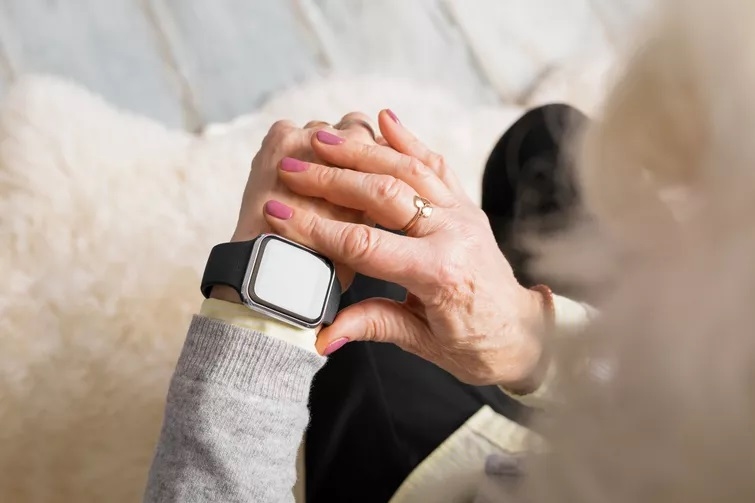
Work and other responsibilities make it difficult for family members to be present with older citizens at all times. But with AI-powered systems through wearable devices and accompanying apps, they can stay up to date with first-hand information on the state of health of their elderly ones. A good example is apple smartwatch.
Apple’s Series 6 Smartwatch
Ranked by safewise.com as the best personal check for seniors, Apple’s smartwatch comes with a biometric tracking system that monitors sleep rate, heart rate, and oxygen levels. These types of devices and apps notify family members of emergencies like a fall. It can also detect potential medical problems.
4. Good Quality Elderly Care
The ability of AI to perform real-time analysis, detection, and monitoring allow for immediate updates to be sent to physicians and family if changes or risks are detected. Old residents get timely help and care from their healthcare providers before risks advance into serious issues. According to Stanley healthcare, seniors living with an AI health monitoring platform lived 1.72 years longer. Such AI-themed elderly care platforms help residents stay healthy, live longer, and out of hospitals.

5. Anti-aging Research
Helping anti-aging researchers understand the aging process and come up with better methods to delay the process is one of the significant effects of AI in elderly care. With this research, more people will live longer. To this effect, Calico labs a bioscience company uses deep learning to understand the biology of aging. Calico labs use the information from this to come up with solutions so that people can live longer and healthier.
The Future of AI in Elderly Care
There are indications that AI systems and robots will be connected with home appliances in the future. Senior residents who need assisted living will get every help they need without missing out on anything. Future robots will obey commands and help with every form of task like cooking, weather forecasting, retrieving missing items around the house, shopping, and even driving. Family members will also be able to check-in anywhere their loved one is from any part of the world.
Future robots will make use of facial recognition algorithms to determine how a senior citizen is feeling. In the case of any emergency, they will be able to alert healthcare providers of any impending doom and even rush the resident to the nearest hospital. With all these, AI guarantees an exciting future for the elderly care industry.
Conclusion
There is no doubt that AI technologies are rapidly disrupting the senior care pathways to ensure that seniors get the best possible care as they move towards the end of their life cycle. While this happens, the eldercare industry will continue to expand to accommodate trends and demands.
