


More than half of the world are now living in a digital life that is full of augmented technologies disrupting human activities. Some experts have stated that the monumental rise of artificial intelligence will, in the next decade, make people better off.
Many experts, for and against AI technology have predicted that AI will amplify human effectiveness. However, this does come at a cost as it threatens human capabilities and autonomy. The prospect of a more customised experience in all aspects of our lives can help save time and money, but there are wider implications that need to be thought about, including environment and mental health.
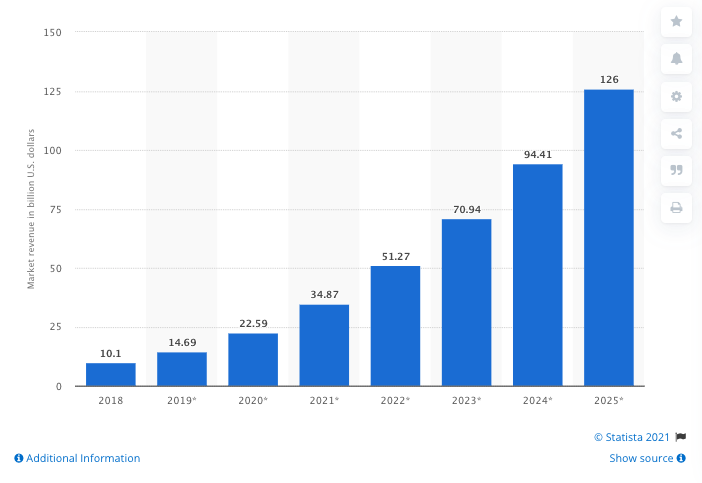
(Graph showing revenues from AI software market. Source: Statista)
These new technologies, such as artificial intelligence have offered unimagined opportunities. As many code-driven systems and algorithm-driven artificial intelligence emerge, it has opened the scope of opportunity and brought to today’s world software and technologies that are able to outperform humans.
DeepMind
The latest AI program from DeepMind has the bailey to attain performance that outshines standard human capabilities, in conducting tasks without needing to be given rules to follow. This level of technology will outperform humans with powers and abilities that have not been found until now.
The software is named MuZero and has had the bailey to achieve and successfully win old Atari video games by working out the rules for itself, unlike its predecessors who have had to be given the rules.
The software has hit the ground running and has already been put to practical use by finding a new avenue of encoding videos which could potentially help YouTube slash its costs.
What is Encoding?
Video encoding is the process of compressing video files so that they are recognised and saved as fluid videos and not individual images. Typically, YouTube has 4 container formats that are used to encode and it determines which by assessing the video itself.
Although the results of their work are astonishing, like much of today’s technology. Some have argued that in the process of improving and streamlining, adding new algorithms and applying new performance measures, there will be an environmental impact and cost that needs to be addressed now and considered when going forward.
The London-based firm first published details about their software MuZero in 2019. The software reflects the firm’s latest success in deep reinforcement learning, which is a technique that uses layered networks that are all neutral, allowing machines to teach themselves new skills through trial and error. Machines receive rewards for success instead of being told what to do, which is what helps them understand rules rather than be instructed to behave in certain ways.
More recently, DeepMind made a breakthrough in protein folding by adding and adapting an array of techniques. These, in the future, could pave the way for new drug developments to help fight diseases.
MuZero could be used to try and invest in a new kind of video compression which could potentially save YouTube and other streaming and social media platforms a lot of time and money. When considering the level of data and traffic thrown out form the internet – most of it due to video. Therefore, using MuZero, if compressing can be made effective, there is huge potential for savings.
Another aspect of video encoding arises due to an increase in the use of smartphones to record and upload videos. As phone cameras become better and better, so does the video quality. However, with better quality, there rises a question of video size. For example, according to Smartphone Checker, a new Samsung Galaxy S20 Ultra has an astonishing 108 Megapixels rear camera, which is incredible in any stretch of the imagination. The question is, how big will the size of the file be if you record a 40-minute video?
How much is YouTube costing YouTube?
Google acquired YouTube almost a decade ago and recent information has shown that in advertising alone, YouTube makes an astonishing $15 billion, which is paid out to its creators. Over the past few years, YouTube has suffered through some turbulent times which has pushed them backwards slightly.
Some of their biggest complaints come from content seen as unsuitable for advertisers, which prevents YouTube from making money as they have so little control over what can be uploaded on the platform and what advertisements deem fit as content. Due to this, new advertising-friendly policies that have been put in place by Youtube has made content creators less favourable of the service.
The amount of ad revenue YouTube gains is just a small indication of how big video platforms have become. The platform that is owned by Google has more than 20 million subscribers across its premium services. Creators who upload to the platform are the beating heart of the service and without them, there would be no content to share.
However, advertising is the blood which makes running the platform possible. Although YouTube gives its creators a portion of its advertising revenue, it only seems to favour those at the top and does very little for middle-level creators, let alone those that are just starting out. Software like MuZero has the potential to help YouTube save money. This will give YouTube the opportunity to share more of its profit with their creators.
