


Last month, I had the incredible opportunity through my current employer to attend Gartner Data & Analytics summit in London, one of the top conferences around emerging trends in Data and Analytics. This year about 1600 people attended the event, expecting to get invaluable information on applying the latest data and analytics technologies to generate new revenue. Most attendees were C-level executives such as CIOs, CTOs or Head of Analytics from top companies globally.
Top trends in the IT sector
This year, the conference had a lot of buzz and sessions around Artificial Intelligence, Augmented Analytics and Machine Learning. Maybe it is just a hype as it appears that still, a number of companies have been able to launch AI models in production.
Yet, this hype is real, and Gartner already predicts that the use of AI and Machine Learning in the enterprise will enable a new efficiency wave that will empower the Business and reduce the need for IT.
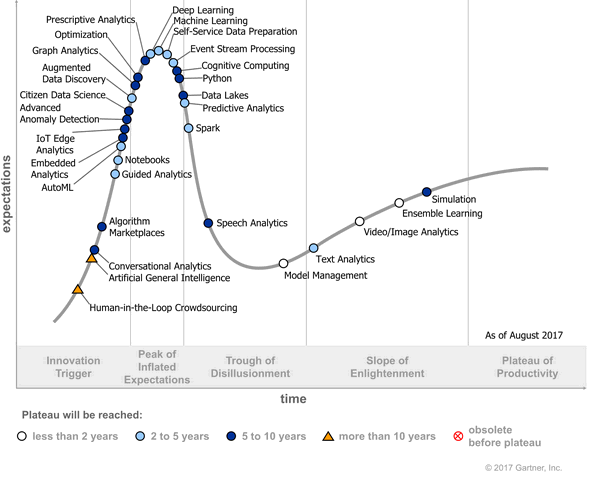
Source: Hype Cycle for Data Science & Machine Learning ” 2017 Gartner
Technologies such as Augmented Data Discovery, Advanced Anomaly Detection, AutoML and Predictive Analytics can provide to the Business the answers they have been looking for regarding business outcomes while reducing the need to have IT spending time and resources on analysis, coding and data discovery. In a way, IT will slowly die and be replaced by AI and Machine Learning..?
Confidence from a Gartner Analyst
As an attendee at Gartner Data & Analytics, one can spend 30 minutes in an interview-style session with a Gartner Analyst. I took this opportunity to discuss some of the key Strategic Technology Trends they identified for 2018. Speaking about the need for vendors to be discussing with IT into the selection process of different Analytics tools, the analyst I was talking too shared this interesting thought:
In 5 years, IT is to disappear as tools are now enabling the Business to do what IT was doing before.
I almost choked on my coffee when he announced this to me. After the end of the session, I assumed it was a joke: after all, what would Gartner be without IT?
Yet, this comment has been stuck in my head since then, like a resilient smirking thought. You see, I am working in IT so if the sector is due to die in 5 years, my career is doomed to fail ¦ I also always been a defender of the thought that AI will replace jobs as I believe that AI will actually enable people to be more efficient and will generate new jobs. So what was this comment about?
AI, Creativity & IT
The issue with Artificial Intelligence is that it doesn’t exist as such: it is not Intelligence .
Intelligence: the capacity for learning, reasoning, understanding, and similar forms of mental activity; aptitude in grasping truths, relationships, facts, meanings, etc.
Artificial Intelligence is the application of rules ” a.k.a. Machine Learning algorithms ” some data. Although the algorithms allow for some sort of learning and aptitude of grasping relationships or meanings, this reasoning is only based on the rules and code defined by the Data Scientist who wrote the algorithm. As such, AI is often biased and limited in terms of creativity and innovation. Some tasks cannot easily be replaced by automation.
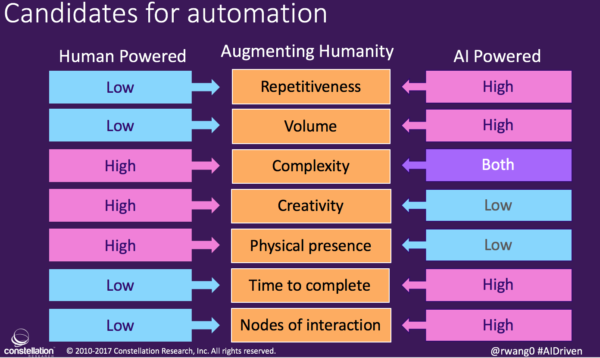
Source: Constellation Research
As a result, AI will make common IT tasks to disappear, and IT as we have known it since the rise of the Internet will indeed die. What will survive is an IT with more interaction with automation and Business, with more creativity and complexity. IT shall no longer be focused on repetitive tasks but more on ad-hoc issues, the creation of innovative and complex systems or models, the maintenance and support of growing automation systems. IT will work more closely with AI and as such will be more effective and efficient. The future is not the doom of IT but a place where IT is working hands-in-hands with the Machine Learning mechanisms it created, thus coping for AI’s lack of creativity, judgement and context.
If you enjoyed this article, feel free to also check my thoughts from the Gartner Data & Analytics summit for Mid-sized companies.
