


Implementing a Conversational AI solution is integral for businesses that want to improve their Customer Experience. With the right strategy, you can engage with customers in human-like conversations while being cost-effective. However, with a plethora of solutions available, most CX and Digital Transformation professionals get confused between chatbots’ and intelligent virtual assistants’.
The principal question being – can chatbot’ and Intelligent Virtual Assistant’ be used interchangeably? Or does their scope, complexity, and capabilities vary?
Simply put, Intelligent Virtual Assistants (IVA) are evolved chatbot solutions to serve the needs of a modern-day enterprise customer. Chatbots are simple rule-based systems that can only handle simple, routine FAQs. On the other hand, IVAs are advanced AI solutions “ equipped with NLU (Natural Language Understanding). NLU helps them understand and retain context for smoother conversations while carrying out a wide variety of tasks to fulfill a user’s requirements.
Let’s drill down deeper to understand the key areas where IVAs bypass the capabilities of a Chatbot:
#1 IVAs can understand user queries better
When it comes to understanding queries, chatbots have a very limited scope as they respond from pre-defined scripts. IVAs possess the ability to learn over time and adapt to context for free-flowing chats. Moreover, chatbots use open-source NLP that are not trained to understand complex sentences with any industry or brand-specific queries. This leads to further bot breaks and heavier load on Live Agents creating a vicious cycle of poor Customer Experience.
Haptik leverages our own proprietary NLP engine to cater to domain-specific intents and trained on 4 billion+ conversations. As recognized globally at EMNLP 2020, Haptik NLP wins in terms of accuracy against multiple open-NLP libraries like Dialogflow, Rasa, LUIS.
Here are some proven use-cases where Haptik IVAs outperform any regular chatbot in the market:
1. Maintaining conversation context
In the journey of having contextual conversations, chatbots can only identify return users. However, IVAs go much further by remembering information derived from past user behavior and actions. It then uses this information for more context in future conversations.
2. Understanding complex sentence structures
In free-flowing conversations spelling errors, slangs, negative sentences or negations are very common. However, chatbots do not have the AI models that IVAs have, to understand specific intents and answer user queries with precision.
For example,
.png?width=600&name=Chatbot%20vs%20IVA%20(2).png)
3. Gauging Sentiments
IVAs are equipped with simulated emotional intelligence’ to analyze user sentiments by assessing the customer mood based on speech patterns and sentence structures. Most chatbots aren’t advanced enough to decode sentiments as they lack AI.
4. Handling user intents like a Pro
Humans talk in natural language wherein often the intents are vague. In such cases, a chatbot is unable to handle user queries. IVAs are capable of handling such issues by prompting the user for more clarification.
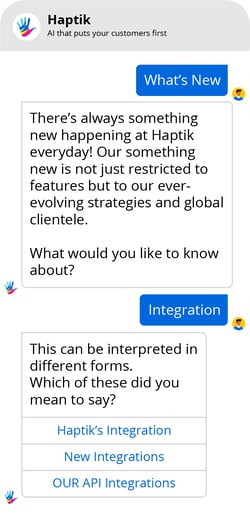
Eg: Haptik’s IVA in the screenshot is using a feature called Did you mean?/Disambiguation to prompt the user with possible interpretations of the query received for delivering a quick resolution. This reduces the chances of bot breaks and unnecessary overload on the agents.
#2 IVAs are technically advanced
Apart from the core capability of powering conversations, IVAs possess a wide variety of features to meet the complex requirements of any enterprise. These capabilities result in increased ROI over time and justify why IVAs are better for the future of CX. Let’s take a look at few instances validating the same:
1. Contextual AI to Agent handoffs
Unlike other chatbots, which use auto-assign routing logic based on query queue to pass chats, Haptik IVAs take into account the agents’ availability and capabilities to provide the best support experience. Furthermore, Haptik NLP auto-suggests answers for queries to assist agents in responding to incoming user messages.
2. Leveraging Voice for enhanced CX
Given the growing use of voice as a medium for customer communication, IVA’s enable users to interact with businesses as if they were speaking to a person. An IVA like the ones we build at Haptik can accomplish this by using custom NLU models to understand customer speech and underlying messages to respond through text or speech. On the contrary, Chatbots are not prepared for phonetic errors, background noise, or differences in accent, making them unreliable for providing customers assistance via voice.
3. Chat interface & user experience
While chatbots come with static buttons or text as responses after a user initiates a conversation, IVAs uses interactive prompts to get the user’s attention based on pre-defined triggers. When the user begins texting, the IVA can further autosuggest responses. The chat interface can also be configured dynamically to fit the brand’s design needs.
Summing it up!
When in a fix between Chatbots and IVAs, the latter will help you ensure customer’s delight! We hope this article helped explain how IVAs stand out in a sea of chatbots. The IVAs implemented by Haptik have been assisting brands to have more thoughtful and customer-focused conversations to inform, assist, convince, or to sell. And it would be fitting to say that the next generation of Conversational AI is at your doorstep and it’s time to embrace IVAs.
