Big Data is affecting every industry and especially the manufacturing industry. The manufacturing industry offers so much potential of including all kinds of sensors in the equipment used during the manufacturing product, that it will result in massive amounts of structured sensor data. These vast amounts of sensor data will result that within a few years, the distribution between structured and unstructured data will move from 10-90 to 40-60 again. The sensors in the manufacturing equipment are capable of monitoring every aspect of the production process, resulting in the next generation of manufacturing.
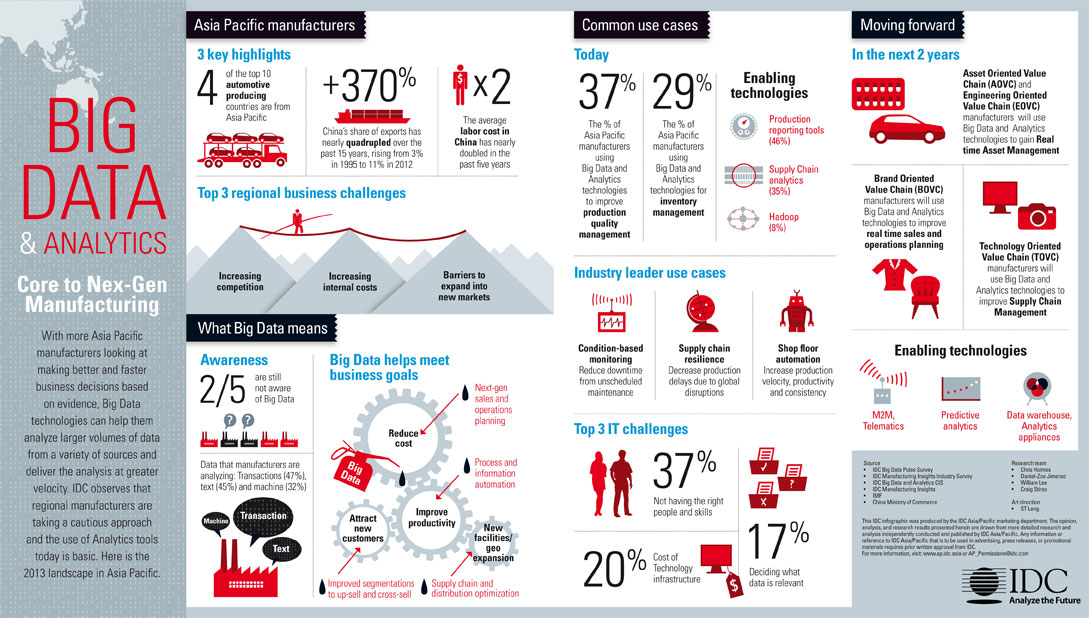
IDC released an infographic some time ago, that gives insights in how the Asian markets, and especially the manufacturing industry, approach Big Data. It seems that they are taken a even more cautious approach than European companies, who are slowly moving to more data-centric organisations. As per the infographic, only 60% of the Asian manufacturers are aware of the possibilities of Big Data and from those organisations using Big Data they focus on transaction data and text data. Only 32% is using sensor data in the machinery, while in fact these data sources will provide the most benefits for organisation. And only 8% of the Asian companies are using technologies like Hadoop to gain those insights.
Those companies that have moved into the Big Data era see the most advantage in reduced downtime thanks to predictive maintenance. After all, the data from the sensors in the machinery can tell exactly when service or maintenance is required and when it can be skipped. Downtime of machinery normally also causes delays in the production process and could therefore affect the entire supply chain. With knowing which machinery to service when and what is required, these global disruptions can be minimized.
Luckily, there is a bright future ahead of the manufacturing industry thanks to Big Data. Using technologies such as Asset Oriented Value Chain or Engineering Oriented Value Chain, companies can achieve real-time asset management and thereby saving precious time and money. Thanks to Mixed Data, manufacturers will also be able to combine different data sources and thus improve their sales and operations planning.
Of course, these examples are just the tip of the iceberg. Once manufacturers start using sensors and Big Data on a global scale, a lot more benefits will be achieved. The production process will become more efficient and effective, the costs will be reduced and even the environment can be saved. Big Data will therefore definitely enable the next generation of manufacturing.