


ITIL 4: An Important Guide
ITIL is the most widely used IT service management framework which provides a systematic approach to businesses for managing risks, strengthening customer relationships, establishing cost-efficient practices and building stable IT environments that provide scale, growth, and change.
It is used globally by many organizations of various sizes as the processes of ITIL can bring value to all. Smaller businesses usually implement only a subset of these processes that are observed to contribute the most vital or actual return on effort.
The ITIL framework went through many changes in history. Originally, ITIL consisted of 30 volumes which were later reduced to 7 when ITIL v2 was launched in the year 2000. Each of these 7 volumes covered a phase of ITIL management. In 2007, ITIL v3 commonly known as ITIL 2007 edition, broke through the covers to unveil a small and tightly regulated framework consisting of 26 processes and functions that were adapted into five volumes. This version, also known as the ITIL Refresh Project while it was launched, was developed around the idea of service lifecycle structure.
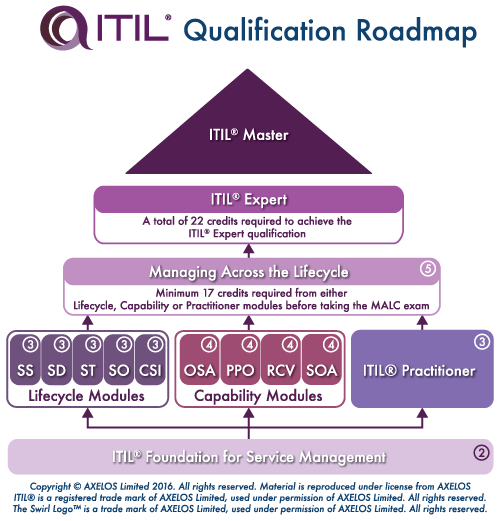
As an update to the 2007 version, the next iteration of ITIL was launched in the year 2011. The five volumes remained the same namely
- ITIL Service Strategy
- ITIL Service Design
- ITIL Service Transition
- ITIL Service Operation
- ITIL Continual Service Improvement.
Now, ITIL 4 is the latest standard in the IT best practice atmosphere, revised to meet the complicated, interconnected world of a globalized market and demands IT professionals who play a significant role in the success of various organizations.
The most recent version is ITIL 4. Its purpose is to present a realistic and adaptable foundation to help organizations on their digital transformation journey. The framework is updated to support and acknowledge to present technology, tools, and software. Following ITIL’s latest update, the IT field has evolved to become fundamental to every company and the current framework supports this by being more flexible, agile, and collaborative.
It focuses on business culture and blending IT into the overall structure of the organization. It promotes the association within IT and other fields, particularly as other business factors increasingly depend on technology to get the job done. ITIL 4 also highlights consumer feedback, as it’s simpler than ever for companies to know their public opinion, consumer satisfaction, and dissatisfaction.
ITIL 4 Components
ITIL 4 is composed of two principal components:
- The four dimensions model
- The service value system (SVS).
The four dimensions model
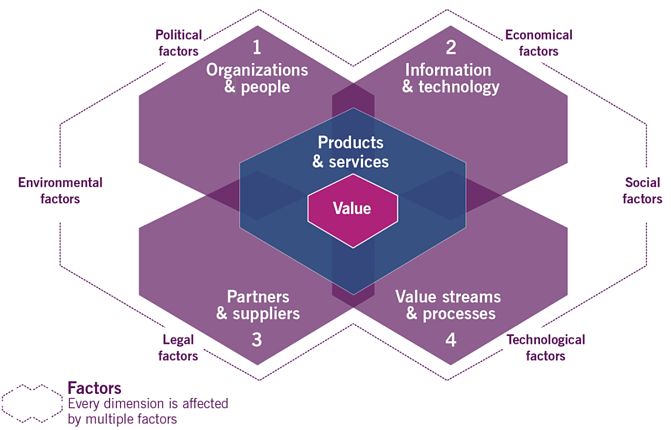
As ITIL 4 is about an integrated path to service management., the framework describes four dimensions that are important to generating value for stakeholders including customers.
Source: AXELOS, ITIL Foundation, ITIL 4 Edition (2019)
These four dimensions are
- Organizations and people “ The corporate society requires to establish an organization’s goals, and the correct level of team potential and competency.
- Information and technology “ Within the SVS, this refers to the knowledge, information, and technologies that are required for managing the services.
- Partners and suppliers “ The suppliers that are included in the design, deployment, performance, assistance, and continual development of services and their connection to the company.
- Value streams and processes “This is necessary to create value with products and services.
The service value system (SVS)
 .
.
Source: AXELOS, ITIL Foundation, ITIL 4 Edition (2019)
The service value system (SVS) is an essential component of ITIL 4 and it promotes value co-creation. It explains how all the components and movements of a business operate collectively to create value.
The service value chain is the core of the Service Value System. It is a flexible working model for designing, producing, and continuously developing services. There are six essential activities within the service value chain:
- Design
- Enhance
- Engage
- Develop
- Obtain/build
- Deliver and support.
These activities can be linked in various sequences.
Since the service value chain is adjustable, it indicates that a business can efficiently and effectively respond to varying needs from stakeholders.
ITIL 4 will help IT, experts, to compete in a developing market and guarantee that they stay consistent. Start developing your career with ITIL or get reaccredited from ITIL v3 to exhibit your digital talents and reach your career objectives.
