


Everyone in today’s world, directly or indirectly, can touch the Intelligent Automation “sprouts”: for instance, when launching a smart conditioning system that continuously controls the fresh air inside, or when buying vegetables from a smart farm. For the end-users, such cases are the one more digital catch that simplifies everyday life, while businesses, that implement these technologies within large-scale digital strategies, in fact, define the kind of world we will continue to live in.
Smart Automation, enterprise IoT solutions, and Digital Transformation now are the basis of “intelligence” for the business that directly affects products, service level, business processes, and profit naturally. We hear these “fine words” so often that the implementation of any digital solution in the enterprise might seem like a panacea from defects in production or extra expenses. However, it is not the case, and the benefits brought by every digital solution must be clearly understood by the enterprise. In spite of this, we consider the reasoning behind the fact that IoT and Intelligent Automation are “birds of a feather”, and the keys to successful implementation in various cases.
What is Intelligent Automation?
Business automation (BA) – a precursor of Intelligent Automation (IA) – is not a new thing that is universally utilized to replace monotonous and redundant operations. The thing is robotized software that replaces simple human-executed operations, for instance, structuring the data in a table or counting products on the conveyor belt. “Intelligence” comes through Artificial Intelligence (AI), which enables the performance of an action as well as decision-making within a complicated process. This significantly widens the areas in need of automation.
Thus, Intelligent Automation can be described through the simple equation:

Standard automation within both manufacturing and management processes is not adapted to the content of the work or to business events. Bots don’t care which parameters you fill in tables, and, therefore, apply the same rules to calculate every case. They don’t care about the contents of the box moving from one belt to another. On the contrary, smart robots in warehouses can “read” RFID tags of the boxes to get info about their contents and move them to the appropriate place depending on what’s in the box. It turns out that the main distinguishing factor of ordinary automation from intelligent systems is that the latter is based on data, can take data-based decisions, and, therefore, manage business processes. Enterprise IoT solutions, equipment, products, and people can be involved in these processes which makes the main task for the IA apps – to operate with the specific motley datasets. That’s why intelligent automation solutions are mainly customized.
The Place of IA within Enterprise IoT Solutions
To execute intelligent reaction, the IA-based system has to retrieve the data, not simply get it and store it. The very convenient way to do it is to utilize low-level mechanisms of the IoT ecosystem which imply “taking” the data from “Things” mainly through sensors. For instance, we can track the temperature, humidity, distance, and other parameters to automatically send to processing and analysis. That’s why IoT enterprises where the collection of information is automated are the most suitable for the automation of various business processes.
Essentially, a full-fledged IoT ecosystem involves intelligent automation to execute its processes, and stitch them together. On the example of QA processes that are at every production, let’s map the following scheme illustrating the integration of enterprise IoT solutions and IA:
- At the conveyor outlet, a robot collects product data through machine vision – an automatic process executed through IoT-specific technologies
- The video stream is analyzed to detect defective production – artificial intelligent analysis
- Defective items are sent to the specific department – data-based industrial automation
- Custom software analyzes the defect data and generates reports – EIoT analytics
Humans might participate at any of these stages. The “intelligence” of such automation is through the “intellectual” analysis it performs first, and the second – through the intelligent connection between stages which creates a cross-cutting flow. Also, the decision on where to send the product after its assurance is intelligence-motivated, that means they are data-based. The reports that contain data on the defective details that appear more frequently show how to improve manufacturing process. Thus, the IoT ecosystem creates a cycle: the IoT reports are used for management decision-making which causes improvements in the manufacturing process, and everything starts all over again.
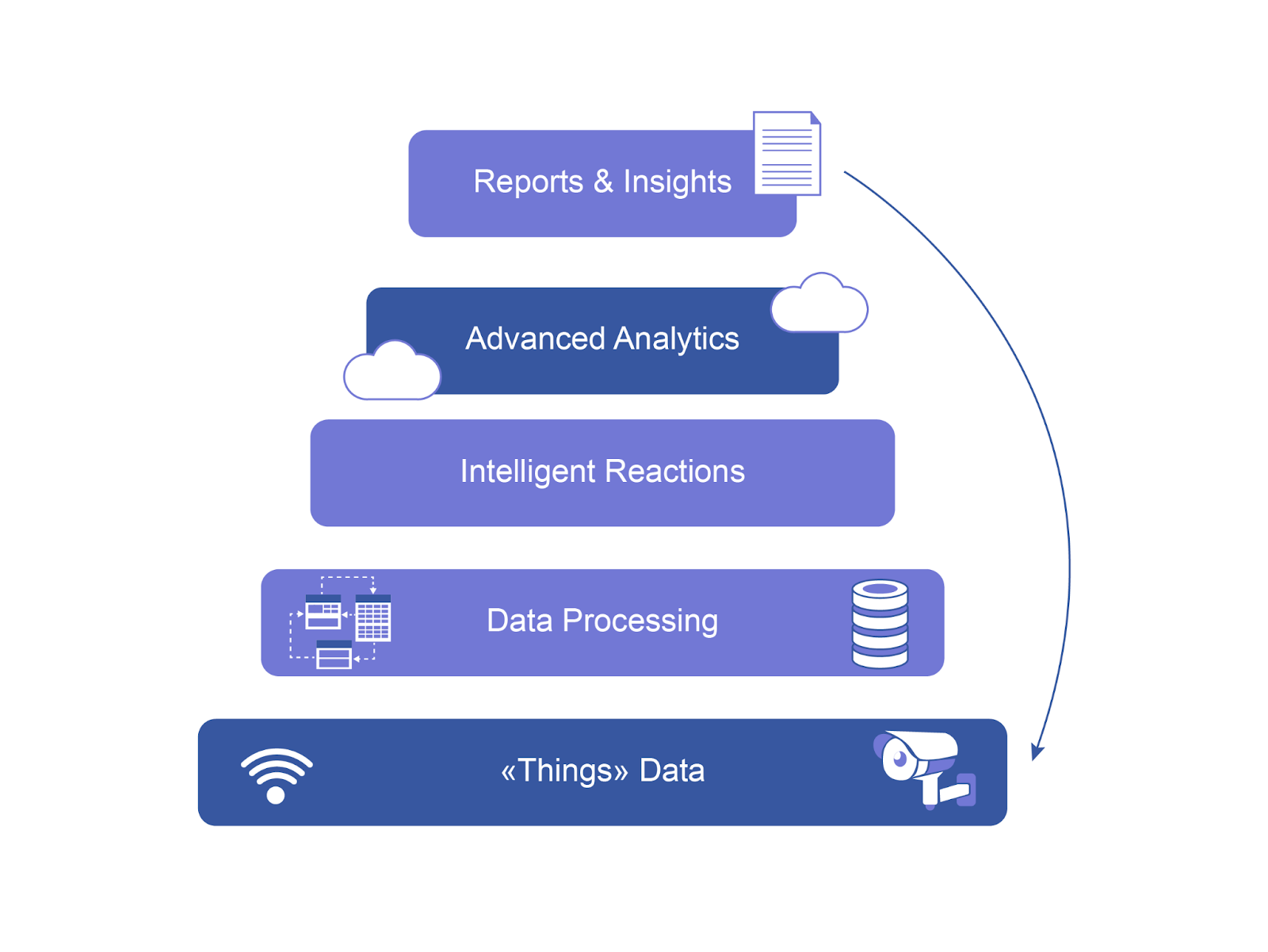
It turns out that one of the main purposes of IoT ecosystem implementation is impossible without intelligent automation – namely, to provide management, and executive support, as well as other high-level business tasks.
How to Upgrade Enterprise IoT Solutions Through Intelligent Automation?
According to statistics, about 31% of organizations have automated some of their processes globally, while only 5% of them are satisfied with the result. It happens through the unclear identification of business needs and the abundance of IA solutions on the market which usually leads to the wrong choices.
To avoid unmet business expectations, you should clearly understand the goals of intelligent automation for your enterprise and strictly follow the implementation strategy. As described above, Intelligent Automation is the “glue” that connects disparate stages into a solid business process, so theimplementation is more effective within enterprise IoT solutions, or within large-scale digital transformation strategy. This allows for identification of high-level needs first and then coordinating processes, people, and partners. Another reason is that IA is now the main driving force for digital transformation processes that simplifies companies’ digital transition. Thus, by defining IA tools within digital transformation strategy, companies make a contribution to their future.
Well, we’ve outlined how important is to comply with the integrity of IA integration, so the other main questions are how to automate processes, where to start, and where to move. It’s advisable to adhere to the following sequence of actions:
- Identify enterprise bottlenecks. The enterprise audit, which can also be executed automatically, shows all the processes and their components to identify which of them can be optimized through intelligent automation. For instance, if the operators still need to open the window in the greenhouse when the sensor detects anomalous high temperatures and sends a signal to the control pad. Such a “half-automated” process might be time-wasting and induce human mistakes. In the same way, all the enterprise’s weak points have to be identified.
- Identify business value. Calculate how profitable a particular process is to eliminate identified bottlenecks. Reducing maintenance costs, reducing time spent on manufacturing, increasing production performance, or reducing human labor are the most demanded goals set within IA and IoT implementation strategies.
- Assess resources. Estimate the existing technical and digital resources, and how they can be integrated with future enterprise IoT solutions. The other point is to define human resources that can manage future intelligent automation solutions.
- Create an optimization strategy. A significant document should contain all the points described above and have clear business goals, ways of their achievement, financial justification, and steps to be done for the successful implementation of intelligent automation for EIoT solutions in detail.
If business goals and technical needs are identified correctly while the IoT ecosystem is perfectly performed, all the parties win since the product is improving, the clients’ service as well, and the costs are reduced. The more highly-structured the company is, the harder it becomes to subordinate the existing business processes to the new digital reality. Thus, when you’ve clearly identified how it can be performed, you can move gradually from the less susceptible systems to the digitalization of processes for most.
Use Cases of IA for Enterprise IoT Solutions
Now take a look at how the harmonious interaction of the Internet of Things and Intelligent Automation can improve the processes which are essential for any business. Here are the processes that can be significantly improved through competent data management.
Task Management. The setting of tasks can be “intelligently” generated. This way, the technical staff is immediately informed that the bulb has to be replaced; or the medical staff sees a new dosage of the drug which is automatically updated for the patient by the system, that detected their health changes. The quickest way to get tasks this way is direct to their smartphones.
Technical Support / Predictive Maintenance. Any support is provided better when you know which equipment might fail soon and plan for preventative maintenance. When sensors installed on equipment detect anomalies, such as strange vibrations or noise, it sends this data to the server software that analyzes it, sends a notification, puts the maintenance of the specific equipment to the short-term plan, or generates tasks for the technical team to perform service soon.
Material & Technical Supply. The improvements within this process logically follow the previous one. Since the reports generated via custom IoT software show not only the current status but the expected breakdown, the company can prepare for it. For instance, if it predicts that 30 components will have deteriorated within 3 months, they can be automatically added to the procurement plan. Thus, the enterprise avoids downtime through the equipment that’s broken.
Supply Chain Management. Enterprise IoT solutions for SCM allow full visibility of the cargo location and status. This process is implied to be automated for the client to see their products at every delivery stage and be sure of their optimal conditions. They can automatically connect to the platform, and send notifications if something went wrong. At the same time, it is easy to identify the responsible party if cargo gets spoiled, or is delayed.
Corporate Management. Basically, the advanced high-level control provided by the IoT ecosystem summarizes all preceding paragraphs. Automatically generated reports give a comprehensive view of what’s going on in the enterprise to continuously optimize processes. Having all the enterprise data, a custom Enterprise IoT application not only simply shows the bottlenecks but also offers specific solutions on how they can be fixed through existing resources.
Conclusions
The time of common automation has long passed – now it’s time for intelligent automation based on deep analytics which helps reach extraordinary business results and transform the way we live. The wide adoption is caused by the fact that it significantly improves business processes and facilitates digital transformation.
- The business value of IA is that it manages processes within the enterprise while standard automation manages only tasks.
- The most competent way of IA adoption is to implement it during implementation of Enterprise IoT Solutions or digital transformation strategy.
- Intellectual automation is for strengthening the capacity of the Internet of Things ecosystems – it’s a glue for every component, such as people, devices, and partners, which allows them to be easily coordinated.
- The perfect ecosystem is an integrated ecosystem where robots are responsible for the scalability of repetitive operations, AI – for process automation, and IoT for automated data collection and further analysis.
- The majority of business processes can be improved through intelligent automation tools – from task management to technical support and high-level management.
