


One of the most mature professions in the world is undergoing a technological revolution. Architecture and construction once relied upon the mind and body power of man. From idea-conception to design modelling and building; the industry has been spun on its head and its future even more so. The global market size of VR is rapidly expanding and is showing no signs of slowing down.
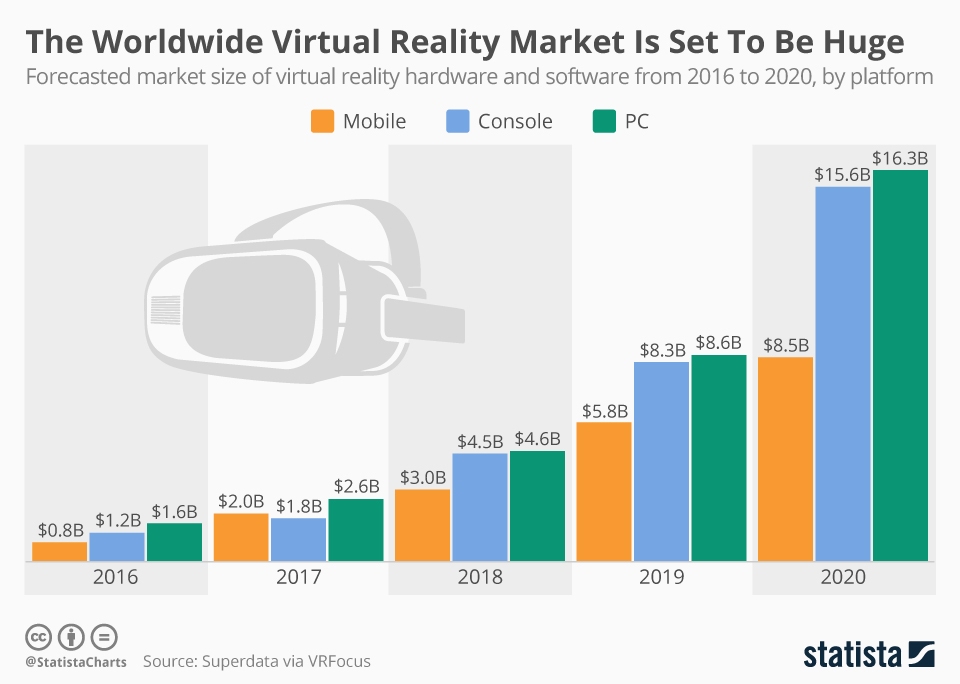 Source: Growth in global VR
 As technologies such as telephone, internet, and even 3D printing have already reached their colossal potential in the industry, improving communication and distribution efficiencies, there is now a new technological player in the game. Virtual Reality – although nowhere near its peak in potential, has already made an impact in the construction industry.
Virtual Reality (VR) essentially creates a completely new and independent environment from the real world. It enables users to immerse themselves in, and interact with a new digital environment. Early-stage virtual reality appliances require a headset to interact with the computer-simulated environment. Within this digital world, users can walk around and manipulate objects through telepresence.
How is VR used in Architecture and Construction?
Virtual Reality technology has so much potential for architects and designers. Consider the fact that the very nature of the profession is to design and construct buildings, often on a grand scale, for the convenience, comfort and lifestyles of its inhabitants. There’s a lot at stake, and a lot can go wrong. VR as an immersive technology gives designers, clients and residents access into and around a virtual representation of a room, flat, space or office before its construction.
Saving Costs
VR can generate representations of objects, fixtures and fittings in conditions as close as possible to reality. As a result, enables architects, designers and builders to spot design problems and avoid costly mistakes.
Far more effective than 3D ground modelling; which only goes as far as the human eye will take it; virtual reality enables users to actually walk around the rooms, of which can be manipulated to provide an incredibly rich and accurate sense of presence in a space that can be changed a hundred times over before it is built.
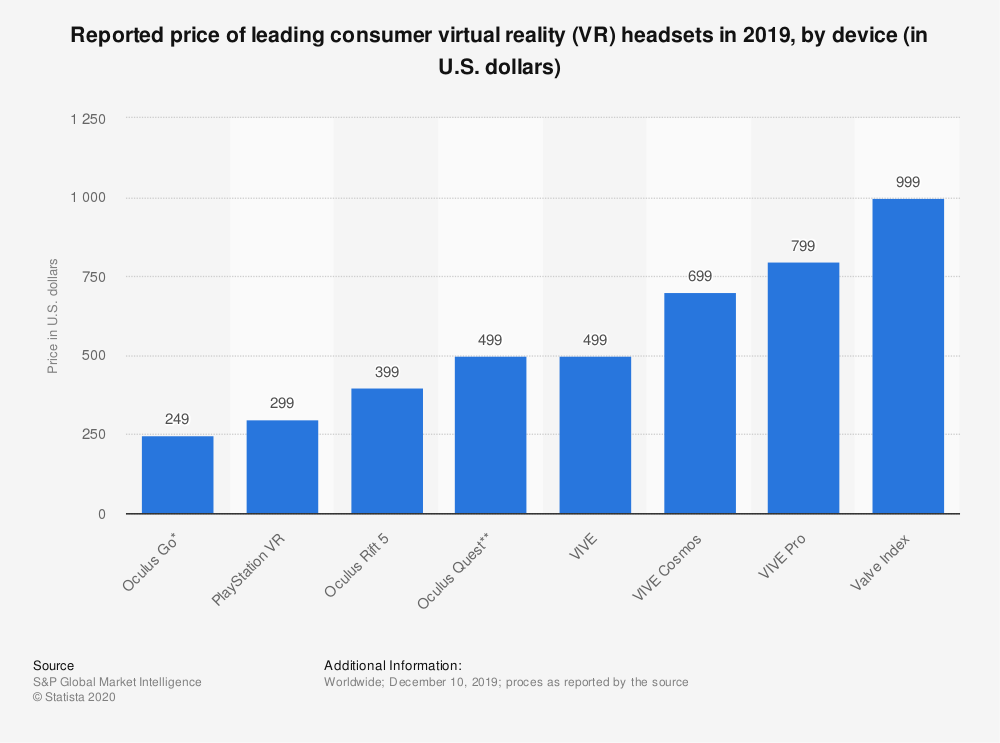 Source: Prices of leading consumer VR headsets 2019: (Statista)
The chart above indicates the stark differences in the prices of VR headsets. Oculus and VIVE dominate the consumer market. But VR becomes increasingly more accessible as costs come down and the technology evolves. The return on investing in VR in this area will almost certainly outweigh the costs of making mistakes in construction. This is in terms of both monetary and human value.
Holistic planning
Virtual Reality lets users bring to life some of the environmental factors that will inevitably impact the whole building. This revolutionary capacity has changed the way the construction of buildings and town planning is conducted.
For example, our access to widespread environmental data can be incorporated into virtual reality. Architects can test safety elements, sunlight, heat exposure and so on by overlaying VR environmental data within the project. For example, it’s now possible to see how the sunlight looks in a specific room. Accuracy in this space was never possible prior to VR technology.
The visual feedback can be recorded and incorporated into the final design, approved by all stakeholders; once again, all before the construction process begins.
Collaboration
One of the biggest challenges architects face is to convince a client that the design works. The bigger the project, the more stakeholders it will likely have. Meaning more decisions are to be made, communication to be had and inevitable disputes to resolve. The chances are, there will be more than one single decision-maker, rather multiple participants will have a role to play in various aspects of the design and construction of a building.
Getting all stakeholders into a room to collaborate on a design can be time consuming and inefficient. That’s why floor plans, 3D renderings, and models emerged to convey an idea to a wider group of decision-makers. This core approach of architectural design can still fail to effectively communicate the project idea to so many people.
That’s where VR comes into play. What was once the relied upon method of sharing design ideas across departments, individuals and stakeholders has been pushed aside, in favour of the immersive and interactive technology. Transporting a number of users simultaneously into a fully interactive 3D environment gives them all the opportunity to view, feel and manipulate the digital environment – allowing for more meaningful conversations and collaboration.
What’s the difference between AR and VR?
Although virtual reality and augmented reality are the terms that are often used in the same sentence – VR and AR are quite different from each other.
Before we jump into how VR can revolutionise the architecture and construction industries, it’s important to establish the main difference between augmented reality and virtual reality.
Augmented reality (AR) adds elements and to a live view by using a smartphone camera. A great example of AR is Pokemon Go – a game that adds digital elements to the real world when looking at it through a smartphone camera.
Virtual reality (VR), on the other hand, is a completely immersive experience when the reality is replaced by virtual reality. With a VR headset, users can be transported into multiple real-worlds, be it space or the bottom of the mariana trench.
The future of a VR enhanced Architecture and Construction industry
Thus far, VR will and has undeniably worked as a presentation tool, allowing clients and future residents to gain a deeper insight into how a design will look to scale. But will the application of virtual reality in architecture go further than this?
To truly change the game, virtual reality technology will need to evolve in a way that allows clients to fully interact with a proposed model. There have been reports that it will go as far as enabling users to open and close doors and windows, turn lights on and off and move objects around the room themselves.
This level of interaction is equally important to the architects, builders, developers and designers in their workflow. The extent to which VR can aid the design process is boundless. But how far can it go for the physical construction of a building?
Well, flight simulations and virtual medical surgeries have both proven to be successful applications of VR in high-risk industries. Unsurprisingly, the technology is making its way into construction to reduce risk, enhance training and provide on-site assistance.
Since HTC Vive and the Oculus Rift headset brought VR technology to the consumer’s doorstep, it has become widely accessible. As it stands, however, not nearly enough construction firms have begun to exploit the full potential of VR. This could be down to public perception and an unwillingness to incorporate what is known to be a gaming fad into the profession.
Virtual reality and augmented reality still have a long way to come in order to revolutionise entire industries, especially those that have existed for decades and aren’t susceptible to quick change.
However, with greater development and as customers in the real estate market become more willing to try a VR headset to visualise a final project, there is scope for VR technology to entirely recreate the industry.
