

VPNs, or Virtual Private Networks, are typically known for their ability to keep the sensitive information of users safe from hackers and cyber attacks. But what many users are yet to realise is that VPNs can also make for an excellent way of making browsing faster online.
There are plenty of arguments for the use of a VPN, whether it’s to safeguard your PC browsing or to protect your smartphone from prying eyes whenever you access online banking, but one of the lesser-known facets of Virtual Private Networks is that they can provide significant boosts to the performance of your internet.
How is this possible? And could utilising VPNs make for a privacy-infused alternative to paying more for faster internet access? Let’s take a deeper look at the links between VPNs and internet performance to address these questions:
How do VPNs Work?
Fundamentally, a VPN connects your PC, smartphone or tablet to another server that allows you to browse the internet using the connection of the external server. Depending on the location of the server, this means that you can theoretically browse the internet as if you were from a neighbouring country, a different continent, or the other side of the world.
This means that VPNs offer a range of benefits for users. Their primary use revolves around offering protection in hiding your real IP address from other users, and to stop prying eyes from accessing your personal information when using WiFi hotspots. The fact that you’re hopping onto a server elsewhere means that your information is better encrypted – allowing you to access financial information and personal data with more confidence than before. However, there are plenty of other uses for VPNs that are gaining popularity over time.
Significantly, by changing your location using a VPN, it means that you can potentially access audio and video streaming sites that are limited to certain countries. Some users buy into VPNs solely to access the various different catalogues of platforms like Netflix and Hulu that are region-locked.
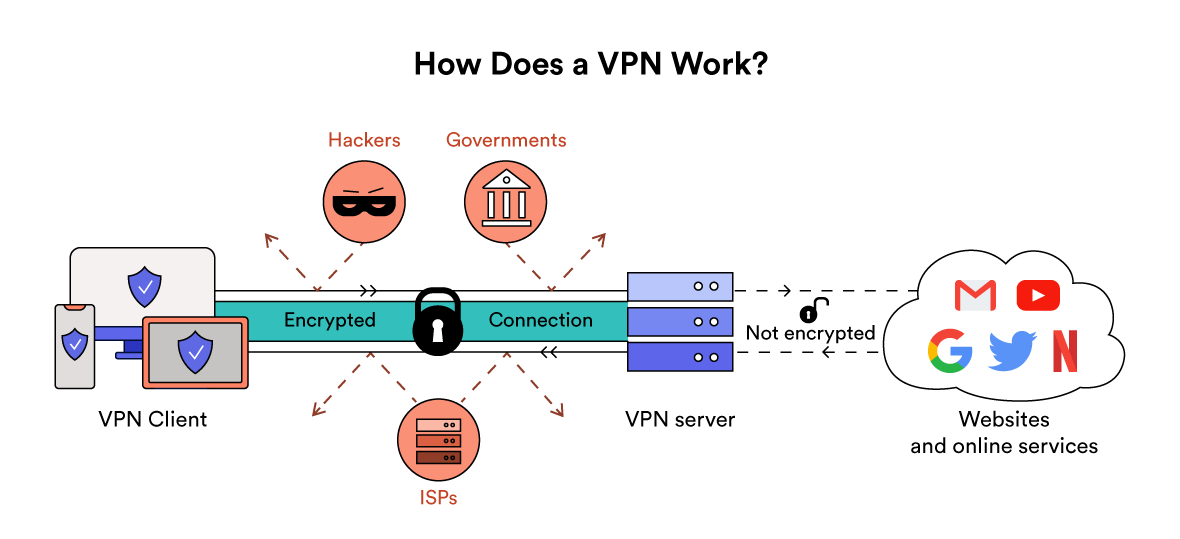
(Image: Top10 VPN)
The diagram above illustrates how VPNs work. The path from the VPN server towards online services behaves as though it’s a typical internet connection, while the secure encryptions come into action on the user’s path to the distributed VPN server – helping to promote better privacy while actively changing your region, should you desire.
The various uses for VPNs have meant that many users buy into services in order to bypass geographical restrictions for watching content in different countries – however, they’re still highly useful for keeping protected, especially when spending prolonged periods using public WiFi spots.
When it comes to the best paid VPN services, there are plenty of idiosyncratic functions and features that could benefit users in more ways thanks to international roaming and heightened levels of security. If you’re interested in utilising a VPN to use on your PC or smartphone, it’s certainly worth exploring the market and the wider applications of the VPNs available.
Driving Performance
Firstly, let’s address the caveats. The reality is that a lot of VPNs will actually slow your internet down. If you already have a strong internet connection in place, logically adding encryption and proxy servers will cause your speeds to decrease, rather than increase.
However, many users have experienced significantly better internet browsing speeds while using VPN services. Although said users may not be in the majority, their cases paint an interesting picture of how internet service providers work – and how using a VPN can carry a whole host of benefits.
Before the repeal of net neutrality, internet service providers (ISPs) around the world often practised bandwidth throttling and shaping. This would be done by selectively slowing certain types of traffic in order to ensure that all users receive a consistent and positive experience of their service.
However, in recent years, ISPs have been found to seek out profit from this practice by creating fast lanes for higher-paying users. These ISPs throttle and shape your internet experience by inspecting your traffic and deciding on whether to slow it down based on certain conditions. This could result in slower internet streaming, longer downloads and sluggish peer-to-peer file transfers – it can even involve external websites that haven’t paid more for their ISP.
When a VPN comes into the equation and encrypts your traffic, it hides what you’re doing from even your ISP. Because of this, your service provider has no way of telling what you’re up to so can’t selectively throttle or shape your traffic depending on your actions.
If a user happens to use an ISP that regularly performs these restrictive actions, utilising a VPN to mask their activities will result in a relative increase in internet speeds.
Another way that a VPN may improve internet speeds is by undoing the inefficient routing conducted by internet service providers. Lower quality services or more cost-efficient ISPs may offer cheaper access to the internet for users, but they may direct your traffic through more inefficient paths than other providers – leading to slower loading times. Because a VPN bypasses this by running through a completely different, a user’s route to a specific website won’t be liable to take so many unexpected turns.
VPN Solutions For Gaming?
The prospect of more consistency within internet speeds has made the use of VPNs an unlikely saviour to gamers around the world.
With many online video games gobbling up 100s of megabytes of data per hour, some titles are liable to suffer more from bandwidth throttling more so than others.
The factors of privacy and encrypted data also help to make players within multiplayer games feel safer from the actions of their opponents. In some extreme cases, when some players become worked up during the playing of a game, they can swat’ their opponents by retrieving their IP address and gaining access to their personal data and location.
Furthermore, it’s also possible for some players to run DDoS attacks on their opponents – sometimes in a bid to achieve a cheap win. But because VPNs mask your IP address, anybody attempting to run a DDoS wouldn’t be capable of finding a location to flood with useless data.
The uses of VPN services extend way beyond the realm of online privacy. One of the lesser-known applications of VPNs is that they can help users to free themselves from the shackles of underperforming or restrictive internet service providers. By bypassing your ISP and trusting a fresh server elsewhere, you’ll not only be able to rest easy knowing your personal information is more secure, but you may even find that your browsing has become faster as a result.
