


Augmented reality is an emerging technology that’s set to challenge traditional approaches towards collaboration across multiple fields.
The world’s continually getting smaller, with businesses making use of recruiting staff globally as well as embracing the emerging gig economy. But while the recruitment of remote workers carries a wealth of benefits in guaranteeing a deeper pool of talent to operate with, many organisations suffer from poor communication and collaboration as a result.
Remote meetings featuring shared screens capable of being broadcast instantly to any recipient’s computer worldwide helps to provide some visual cues when discussing principals and practices, but a lack of face-to-face and dynamic communication makes for something of a stumbling block when it comes to ensuring a team is fluent in their understanding of the latest protocols within a business.
Luckily, as the world becomes more local, the technology capable of facilitating efficient remote work gets more powerful. Today, many developers are turning their attention to the potential of augmented reality, and its ability to transport staff across the world into a visually stimulating and more engaging space. Here, I take a look at the role AR can play in revolutionising how we collaborate with each other across the world.
Remote augmentation
The augmented reality market is growing at a rapid rate. IDC anticipates that AR and virtual reality headset sales will 8.9 million units sold in 2018 to 65.9 million by 2022.

Such a seismic boost will be leveraged by rising corporate usage as well as recreation. This rise in sales will also be complemented by further developments in a fledgeling technology.
Remote AR is an extremely fresh iteration of augmented reality, but its implications for collaboration in the world of business, healthcare and engineering are building excitement among industry professionals.
Significantly, remote augmented reality has the power to enable users to both see and interact with each other from far away locations, all through the use of a digital visualisation layered over a real-life backdrop.
Organisations like Watty and Magic Leap have both worked tirelessly to make Remote AR a reality within the field of entertainment, with the respective companies creating social collaborative software in the form of AR Racoon and Avatar Chat.
Both AR Racoon and Avatar Chat operate by rendering meeting rooms within the user’s eye line and allows each participant to interact with each other visually – either through the use of expressive emojis or gestures.
Industry defying collaboration
Remote AR has the power to really excel within business, healthcare and engineering, thanks to the unprecedented ability for participants to interact with real-world environments and provide visual cues to users.
One such company that’s set on delivering a level of Remote AR collaboration that could potentially be lifesaving is Proximie. It’s Proximie’s belief that AR is already having a profound impact on medical training, and can help bring 3D anatomical learning to life.
Services like AccuVein helps practitioners to locate a patient’s veins by embedding a visualisation on top of their skin, and it’s not too difficult to see a future where Remote AR eyewear can transport mentors into the eyes of their pupils when conducting surgery. The layer of augmentation enables visual indicators to be embedded within a surgeon’s line of sight, ensuring unprecedented levels of accuracy.
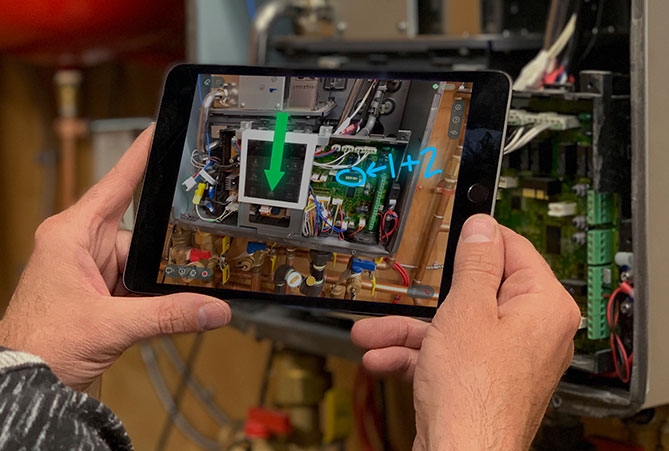
Scope AR similarly believes that such levels of collaboration can be of use to engineers.
(Source: ScopeAR)
Through the use of compatible eyewear, workers can attain visual help when operating complex machinery in remote locations with the use of a tablet. Experts can draw directions that are instantly visible to the worker as a means of dramatically aiding in the meeting of deadlines and ensuring accuracy on the job – all from the screen of a tablet.
Who would have thought that tablets, originally designed for taking notes, playing games and reading books would have the ability to accommodate complex engineering work.
There could be question marks over the safety of using such interconnected tools in industries that relies on keeping sensitive information confidential. Fortunately, companies like Bubbletone are already pioneering ways to ensure that data usage on both smartphones and mobile data devices remain confidential – meaning that in industries like healthcare, patient information will remain secure.
Boosting delegation
Tel Aviv is a hotbed for innovation, and this has certainly extended into the world of augmented reality.
Infinity AR is a driving force in producing discreet eyewear to provide a seamless augmented reality experience for multiple participants, wherever they may be. Infinity AR‘s virtual meeting place will tirelessly recreate complex 3D constructs that can be witnessed and manipulated by everyone involved – paving the way for dynamic collaborative materials for all.
Another company heavily invested in developing augmented reality landscape is Spatial.

Spatial’s collaborative tools have led the technology to be dubbed FaceTime in 3D’ by Endgadget – and for good reason, too. Through compatible eyewear like Microsoft’s Hololens and Magic Leap, participants have the ability to hold the type of engaging meetings as if all members were present within the room.
Spacial’s collaboration program has the ability to render highly detailed 3D centrepieces along with super-imposed visualisations and graphics for reference.
