


MLPs (Multi-Layer Perceptrons) are great for many classification and regression tasks, but it is hard for MLPs to do classification and regression on sequences. In this code tutorial, a GRU is implemented in TensorFlow.
 Introduction
A sequence is an ordered set of items and sequences appear everywhere. In the stock market, the closing price is a sequence. Here, time is the ordering. In sentences, words follow a certain ordering. Therefore, sentences can be viewed as sequences. A gigantic MLP could learn parameters based on sequences, but this would be infeasible in terms of computation time. The family of Recurrent Neural Networks (RNNs) solve this by specifying hidden states which do not only depend on the input, but also on the previous hidden state. GRUs are one of the simplest RNNs. Vanilla RNNs are even simpler, but these models suffer from the Vanishing Gradient problem.
GRU Model
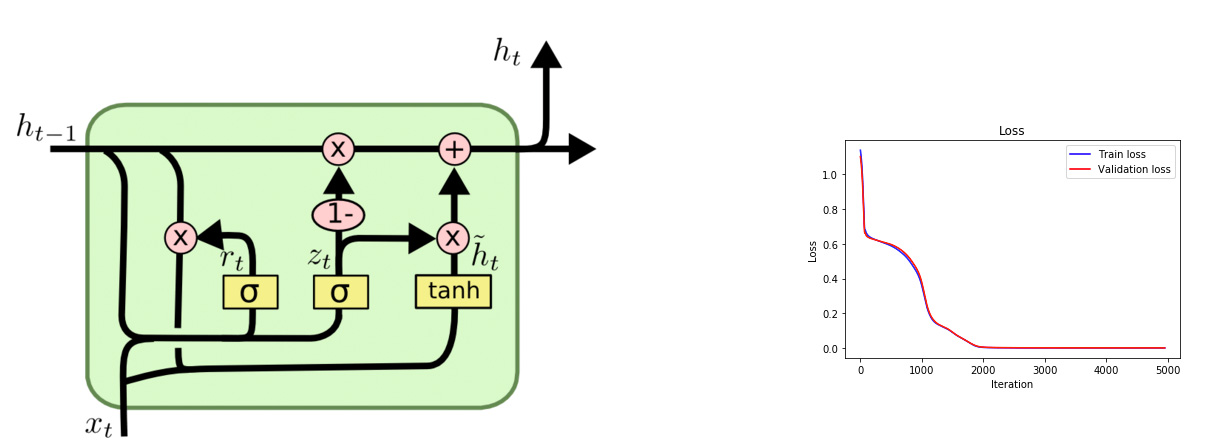
The key idea of GRUs is that the gradient chains do not vanish due to the length of sequences and this is done by allowing the model to pass values completely through the cells. The model is defined as the following [1]:




I had a hard time understanding this model, but it turns out that it is not too hard to understand. In the definitions, 


The Task
In the code example, a simple task is used for testing the GRU. Given two numbers 


![a = [0, 1, 1]](https://s0.wp.com/latex.php?latex=a+%3D+%5B0%2C+1%2C+1%5D&bg=ffffff&fg=000000&s=0)
![b = [0, 0, 1]](https://s0.wp.com/latex.php?latex=b+%3D+%5B0%2C+0%2C+1%5D&bg=ffffff&fg=000000&s=0)
![a = [1, 1, 0]](https://s0.wp.com/latex.php?latex=a+%3D+%5B1%2C+1%2C+0%5D&bg=ffffff&fg=000000&s=0)
![b = [1, 0, 0]](https://s0.wp.com/latex.php?latex=b+%3D+%5B1%2C+0%2C+0%5D&bg=ffffff&fg=000000&s=0)
![c = [0, 0, 1]](https://s0.wp.com/latex.php?latex=c+%3D+%5B0%2C+0%2C+1%5D&bg=ffffff&fg=000000&s=0)
![[1, 0, 0]](https://s0.wp.com/latex.php?latex=%5B1%2C+0%2C+0%5D&bg=ffffff&fg=000000&s=0)

The Code
The code, which is published on GitHub, is self-explaining. If you have any questions, feel free to ask! Sharing (or Starring) is Caring :-)!
Results
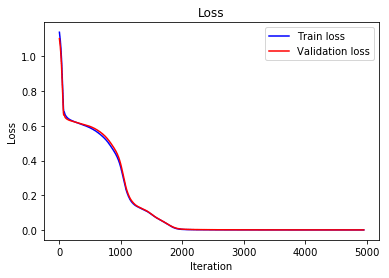
After ~2000 iterations, the model has fully learned how to add 2 integer numbers!
Conclusion (TL;DR)
The implementation of the GRU in TensorFlow takes only ~30 lines of code! There are some issues with respect to parallelization, but these issues can be resolved using the TensorFlow API efficiently. In this tutorial, the model is capable of learning how to add two integer numbers (of any length).
References
[1] Chung, J., Gulcehre, C., Cho, K., & Bengio, Y. (2014). Empirical evaluation of gated recurrent neural networks on sequence modeling. arXiv preprint arXiv:1412.3555.
The original blog post can be found on Data Blogger where you can find more technical articles and tutorials on Data Science. ‹
