
Venture capitalists are placing bets that GameFi will become the next hot Web3 sector. Grayscale estimates that revenue from virtual gaming worlds could grow to $400 billion in 2025, up from about $180 billion in 2020. GameFi is a blockchain gaming ecosystem that encompasses the virtual gaming environments which enable owning, creating, earning and selling in-game assets. The term GameFi is a blend of decentralized finance (DeFi) and gaming, and it is meant to represent the emerging decentralized metaverse gaming model.
GameFi changes the way that players interact with online games rather than paying to play online games that earn virtual rewards with no value, players can own digital assets in their games. The ownership incentivizes greater loyalty, engagement, and positive stewardship of gaming communities. GameFi is unique to blockchain applications, and it makes use of NFTs and cryptocurrencies to incentivize gamers to play. In-game assets including the characters, land, weapons, and more can be bought and sold for cryptocurrencies on NFT marketplaces.
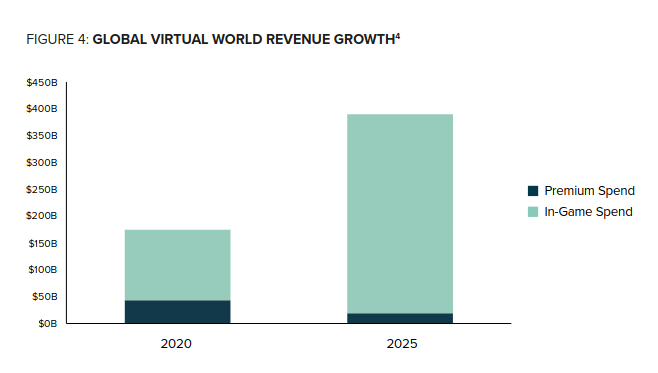
Source: Grayscale
GameFi NFT projects mint own tokens and construct virtual game economies. Usually the tokens function as both a utility and governance token. Utility tokens are used for in-game activities, like buying game characters, clothing, and other items. They’re also used for distributing rewards to the community of players. Governance tokens give voting rights to their holders in the decentralized autonomous organization (DAO).
One popular example of how gaming is changing the world is virtual land. Decentraland and The Sandbox enable on virtual land ownership, which is very similar to physical land. Players can rent their land to other players, build on the land, or simply speculate on its value. Also, digital asset owners in Decentraland can vote on in-game organizational policies based on the total number of MANA assets they own. The more MANA the player owns, the the greater voting power the player controls in the DAO. The decentralized self-governance structure of Decentraland is starkly different than centralized games today. Players have the ability to govern and influence the project roadmap. Also, players are not subject to censorship or unjust bans.
“If they help create part of the value of the gaming universe, maybe they should have a piece of it. I think this is just a next chapter in what our relationship is with our digital lives and the digital items that we accumulate. The idea of giving true ownership of these assets so that these assets are not siloed to one game environment or one server, and actually have real liquidity and value and can be traded, allows these players to actually earn and buy their way to the top. It’s pretty exciting. It’s kind of incredible how big this market is already,” said Yash Patel of Telstra Ventures.
Gaming Is Attracting Venture Capital
Solana Ventures, Forte, and Griffin Gaming Partners announced a $150 million investment in blockchain gaming in December 2021. Their goal is to invest in Web3 game developers who are building decentralized games on the Solana blockchain. Griffin Gaming Partners manages one of the largest gaming investment funds, and Forte is leader in gaming infrastructure and regulatory compliance. Griffin has invested over $400 million into gaming and Web3 gaming-related companies over the past two years. Griffin is backed by over a dozen of the world’s premier gaming, media, and technology companies across Europe, the U.S., Asia, and the Middle East.
“Blockchain is enabling publishers to engage with their player bases in innovative ways. Where game developers once had to continuously create new content for players to consume as one-time purchases, with the advent of NFTs and other blockchain technologies, game developers can now offer their audiences real property rights and create self-sustaining and thriving economies within their games,’ said Forte CEO Josh Williams. “Solana further pulls the future of blockchain gaming forward, as its ultra-fast and low-cost solutions ensure scalability, even at tens of thousands of transactions per second, making building games on Forte with Solana feasible and cost-effective for both developers and players. We are also honored to partner with Griffin Gaming Partners, which has an exemplary reputation in working with publishers to build the most forward-looking titles in the games industry”
In November 2021, Solana Ventures, FTX and Lightspeed announced a $100 million blockchain gaming fund. The fund will invest in Solana gaming projects. The fund has already made its first investment in Faraway, a Solana gaming company.
Gaming Requires Fast And Cheap Blockchains
GameFi requires fast transaction processing and low network fees. According to GameFi.to, Binance Smart Chain (BSC) has the most on-chain games, followed by Ethereum and Solana. Axie Infinity launched on Ethereum in late 2021 and led to very strong growth of almost 10 million new users in one month. The game became so popular that it caused network congestion issues across all of Ethereum (the Ethereum network is capable of handling about 15 transactions per second – this compares to Solana at 60,000 transactions per second).
Ethereum will be the universal settlement layer, but it’s not a place where you can run highly-performant applications,’ said Jeff Zirlin, Sky Mavis co-founder and Growth Lead.
In 2022, gaming developers accelerated their pivot to lower cost blockchains with higher throughput such as Solana and BSC. Currently the Solana Ecosystem lists about 280 games. This number number has grown from single digits in one year. Solana and BSC are much cheaper than Ethereum, where an average transaction currently costs a few dollars vs BSC and Solana at less than a penny. Ethereum fees reached several hundred dollars per transaction in late 2021 during the cryptocurrency peak. The high fees and congestion issues led more developers to move to BSC and Solana.
Outlook
The rapid success of Axie Infinity in 2021 caught the attention of venture capital and game developers. We will see a continued influx of games over coming years as gamers demand Web3 blockchain applications.