



Blockchain technology is here, and it promises to fundamentally change a wide range of industries – including healthcare – in the coming years. In the private healthcare landscape, change could come sooner rather than later.
If you’ve not heard of Bitcoin, or the blockchain framework that powers the cryptocurrency, it might be time to take note. The world of digital finance is exploding with entrepreneurs and investors looking for ways to maximise the potential of this relatively new development in technology and its various applications.

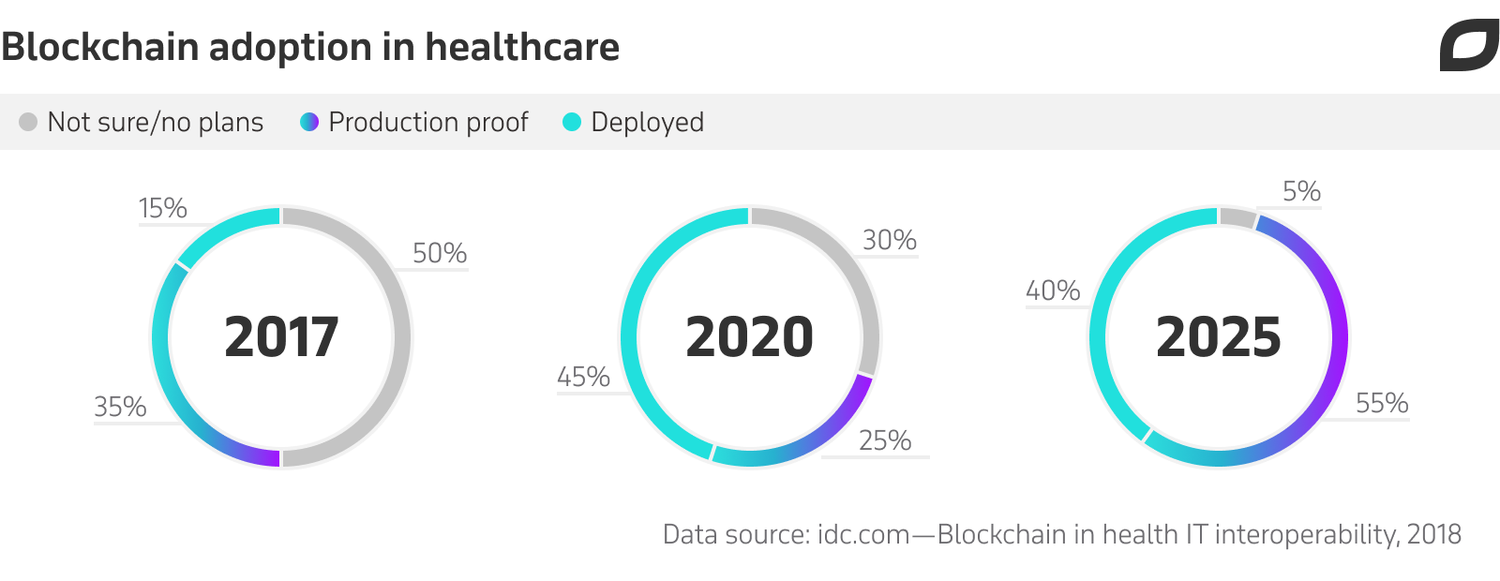
(Image: Itransition)
As we can see from the chart above, many healthcare endeavours are already at work on producing solutions that have been optimised through the use of blockchain technology, with the number set to increase exponentially towards 2025.
With this in mind, let’s explore exactly what this revolution in intuitive technology could mean for healthcare, and how it will be applied throughout the industry:
What is Blockchain?
Fundamentally, blockchain is a distributed system that records and stores transaction records. This means that blockchain works as a shared, immutable record of peer-to-peer transactions that are built from inter-linked transaction blocks and stored in a digital ledger.
Blockchain is dependant on established cryptographic techniques that enable each participant in a network to interact with each other, and store, exchange and view various information without pre-existing trust between the parties.
In a system built on blockchain, there’s no central authority. Instead, transaction records are saved and distributed across all network participants. Any interaction that takes place with the blockchain network instantly becomes known to all parties and will require verification from the network before being added. This enables trustless collaboration between all participants while recording an immutable audit trail of all interactions.
Applying Blockchain to Healthcare
There’s little doubting the importance of the healthcare industry today. However, it’s also one of the slowest growing industries globally.
Over the past two decades, hospitals function in largely similar ways. Speaking on the matter, Richie Etwaru, founder and CEO of Hu-manity, claims that this fundamentally down to a lack of innovation .
After a testing 2020 in which healthcare was left stretched and strained across the world, the need for greater innovation has been laid bare for all to see. Blockchain technology has the power to make patient data significantly more secure because of the decentralised data storage that it’s built on. Blockchains are extremely difficult to hack as there are multiple interconnected servers involved and changes can’t be isolated to just a single server – over 51% of servers need to be attacked in order to effectively compromise a network, a feat that’s virtually impossible for any cybercriminal. In the wake of 2017’s WannaCry cyberattack that left much of the world’s healthcare systems reeling, the need for stronger privacy is stark.
When it comes to the storage of health data, having a database network means that a patient can essentially have their own password that they use to verify access to records at a range of hospitals and medical offices – maintaining an accurate stream of data which promotes health without the need for vulnerable personal records.
In terms of both individual and collective health, unified data systems assist both single patients and wider ranges of patients because emerging patterns and the characteristics of diseases can be identified in a faster manner.
Alongside factors revolving around privacy, blockchain can be a driving force in ending stigmatisation within healthcare. Because these distributed ledgers offer unprecedented levels of privacy for patients, they, in fact, can gain more control over their medical records and their history may not be transferred between professionals without their permission being granted prior. Blockchain can herald a new era of patient confidentiality, which can be maintained in a more effective manner than through more traditional approaches to recording information.
Challenges to Blockchain in Healthcare
Given how much of a key fundamental change blockchain is set to be in the world of healthcare, there will, of course, be challenges to adoption.
One key issue is that blockchain is still a relatively new technology that’s barely over one decade old and that it’s closely tied to Bitcoin. This means that adoption is often closely linked to industry perceptions of cryptocurrencies and their reputation.
For blockchain to work effectively, all entities involved in patient care and medical research must embrace blockchain and the sharing of information with new read/write standards and the distributed platforms that are needed to support this emerging technology.

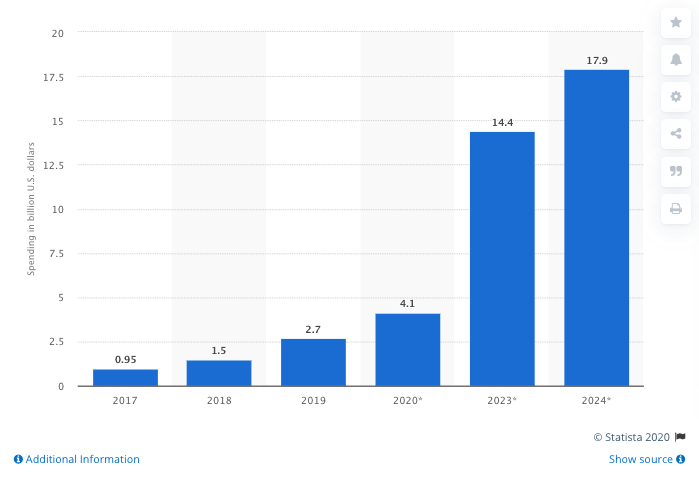
(Image showing worldwide spending on blockchain. Source: Statista)
Because of this, we may see the distribution of blockchain-based medical record become more prominent in healthcare practices domestically before larger universal organisations mobilise to embrace the technology. With this in mind, for patients looking to embrace the greater levels of privacy afforded by blockchain, they could compare private health insurance companies to explore which are already offering some form of blockchain integration.
The advantages offered by blockchain technology is still only just beginning to be realised. When this technology is infused with AI and big data, the possibilities for blockchain range way beyond that of privacy, and doctors could soon use it to instantly spot trends in new viruses, better understand the effects of treatments and collaborate with other professionals around the world without any form of delay.
The world of healthcare may have spent the past two decades evolving at a relatively slow pace, but the arrival of blockchain within the industry will undoubtedly be a shot in the arm for medical care innovation.