



A technology and automation approach to invoice management frees up expensive F&A resources which can transition to higher value strategic activities. It strengthens vendor negotiating power, allows favorable payment terms, and improves cash flow visibility.
An Office of Inspector General (OIG) audit showed the U.S. Environmental Protection Agency (EPA) risking close to $1.2 billion of taxpayer funds by using manual invoice processing. This outdated system not just deprived EPA of prompt payment discounts, but also invited interest penalties and crippled performance of critical duties.
No documents could be provided showing that authorities has performed their duties. Manual processing also made EPA non-compliant to federal laws, regulations and agency policies.
Business losses due to manual invoicing ¦
Enterprises receiving invoices from suppliers in paper form, email, fax, mails and in various electronic formats is not a new thing. Nor are the challenges these invoices pose.
- Significant time and dollars is spent in processing invoices manually.
- Invoices are error prone and often result in delayed payments.
- Supplier goodwill is eroded, leading to deliberated deliveries, less willingness to fix defects, slower responses to queries, and rigid payments terms.
90% of business data, transactions and records are in an unstructured format and nowhere is this more prominent than within the Accounts Payable department. “ Gartner
¦substantiated by data
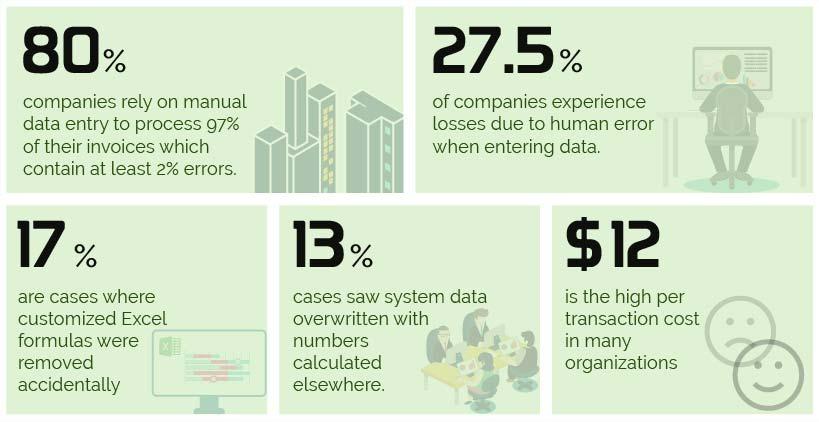

The chaos presents an opportunity
For companies manually handling invoice data, technology presents a huge opportunity to improve efficiency and reduce operational costs by automating the end to end accounts payable process. Especially when machine learning (ML) and robotic process automation (RPA) are radically and positively changing the way document are processed.
Accurately processed invoice data provide better insights to strengthen organizational negotiating power. Businesses are better equipped to partner with major suppliers to share risk, extend payment terms and increase warranty periods.
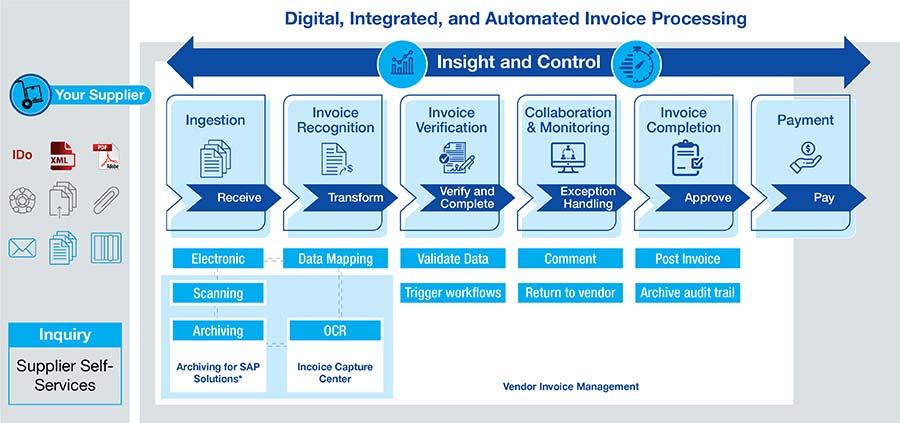
See how companies have automated invoice processes to get more competitive
Invoice capture process automated
A pharmaceutical company in Switzerland used automation to reduce process complexities and strengthen corporate cost management. The workflow for inbound collection of invoices from across multi-functional printers (MFPs), scanners, fax, e-mail and other electronic systems was standardized and automated. The ROI for implementing automation was realized in less than two months and a 90% improvement in the overall processing time was achieved.
The company used ML and AI to identify vendors. Based on this intelligence, invoices were sorted and routed to concerned departments for approvals. This not only eliminated the need to sort the documents before they were processed but significantly reduced errors and delays.
Templetised bots for extraction and validation of key data points
When a media Moghul from Switzerland automated credit note processing, there was 100% reduction in manual efforts, 60% improvement in the processing time and the accuracy of their invoice data skyrocketed. The company realized its ROI in just 3 months. So how did this happen?
- Templated bots were used instead of creating unique templates for individual vendors.
- Automated invoice workflow used defined labels to locate specific data points such as vendor name and address, Tax I.D. numbers, the amount due, invoice numbers, dates etc. on the invoice image.
- ML techniques were used to remember where the data point was earlier located, to speed up the task in a repeat instance.
- Towards completion, the workflow would do a database lookup to retrieve information such as Vendor ID or Project Code from the legacy system or the ERP.
Attended bots to route invoices for review and approval
All group companies and regional offices of a building material supplier in the UK achieved routing of accurate, verified invoices to target audiences as scheduled, according to pre-determined criteria. The result was a 100% compliance on TAT SLA and a 54% reduction in the workforce.
Customized computation and attended bots were used to implement rules such as:
- Invoices over a certain amount were diverted to a specifically designated official for additional review & manual approval.
- Invoices associated with a specific project or vendors were flown through automated workflow, with payment requests getting initiated in the ERP system “ only when the invoice was scanned and validated.
Flexible, dynamic solution for distributed invoice processing
A German HR service provider was challenged with implementing a decentralized invoice process while retaining the centralized framework and policies. All approving authorities of the multiple group companies and regional offices needed their own customized approval workflows.
The company improved processing speed by 75%, while reducing manual efforts and overall costs by 10% & 60% respectively. Cost associated with automation was realized within 3 months of implementation. So how did the company manage this?
- A dynamic and distributed invoice processing workflow was implemented.
- An automated workflow ensured data entry of multiple invoices locally but which could be reviewed from any location through web browsers or mobile apps.
On-time payment scheduling increases market credibility
A leading German accounting service provider looking to strengthen market credibility adopted automated invoicing to ensure immediate payment of invoices on arrival. Easy access to accurate invoice data allowed both finance teams and management to get a clear picture of the transaction and the related vendor. This facilitated prompt and informed business decision. It improved vendor experience in the market, positively impacting goodwill. Automated invoice processing turned the tables, and they:
- Realized ROI of AP automation process in 5 months
- Achieved 100% data accuracy
- Witnessed 25% reduction in manual efforts
- Saw 65% improvement in processing time
The processed invoices were stored in a secured digital archive directly connected to the AP system enabling authorized users to search, retrieve and access invoices from any browser. The archive also supported reporting and audits that could be tied to a records management system for document disposition at appropriate time.
Conclusion
Invoice processing, though essentially a core operational function is often viewed as a non-exciting back-office activity by many organizations. Businesses hence often neglect this function while developing strategies to grow or build competitive advantage. Without managing invoice processing effectively, enterprises can easily lose value on their team’s effort, mistakenly cost the company literal money, or even damage their professional relationships. Its time businesses take a more strategic approach towards automating invoice processing.
Automation and process improvement in invoice processing will enhance the accuracy of cash flow forecasts, position the business to improve liquidity, mitigate potential funding gaps and deliver higher profits.