
Gartner just released the new Hype Cycle for Emerging Technologies of 2013 and one of the remarkable items on this year’s Hype Cycle for Emerging Technologies is that Gartner tones down the expectations of big data. In the 2012 edition of the Hype Cycle for Emerging Technologies, Gartner predicted that it would take 2-5 years before big data would reach the plateau of productivity. In this year’s edition Gartner adjusted that prediction to 5-10 years. The closely related trend of the Internet of Things still required over 10 years to reach the plateau of productivity, just like it was predicted last year.
A new item in the Hype Cycle is the term Prescriptive Analytics. This is an expression used to define systems that make specific recommendations for key decisions by analysing vast amounts of data. It is said to be the next step in analytics, which began as descriptive, followed by predictive (which reached the plateau of inflated expectations last year). Prescriptive analytics not only foresees what will happen and when it will happen, but also why it will happen. In addition, prescriptive analytics will be able to make suggestions regarding decision options for future opportunities or risks. It will even show the implication of each of the options. Prescriptive analytics will be able to continually add and update data to improve its predictions. Gartner predicts that it will take another five to ten years before prescriptive analytics will hit mainstream.
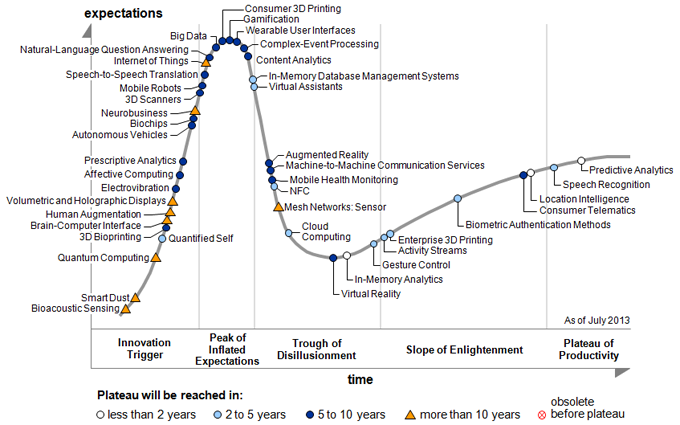
The reasons why it will take longer for big data to hit mainstream and why it will be driven into the through of disillusionment, Gartner said, is that “tools and techniques are being adopted ahead of learned expertise and any maturity/ optimization, which is creating confusion. The second is “the inability to spot big data opportunities by the business, formulate the right questions and execute on the insights”. It is exactly the difficulty organisations face to spot the right use cases as well as the problems organisations face in formulating the right questions why we have developed the Big Data Strategy Model.