



Artificial intelligence (AI) has shifted from a bold experiment to a strategic necessity. Recent studies show that 88% of C-level decision-makers want to accelerate AI adoption in 2025. Yet, just a fraction of AI initiatives delivers the expected results.
Traditional AI models demand vast, meticulously labeled datasets. For many organizations, gathering, cleaning, and annotating such volumes is prohibitively expensive, time-consuming, and even impossible due to data scarcity or privacy restrictions. These bottlenecks delay deployment and drive up costs.
This is where few-shot learning (FSL) offers a breakthrough. By enabling models to learn new tasks from only a handful of examples, FSL bypasses the heavy data requirements of traditional AI, transforming what has long been a roadblock into an advantage.
In this article, ITRex AI consultants explain what few-shot learning is and how companies can use it to facilitate AI deployment and scaling.
What is few-shot learning, and why should you care?
The few-shot learning approach reflects the way humans learn. People don’t need to see hundreds of examples to recognize something new – a few well-chosen instances often suffice.
Few-shot learning definition
So, what is few-shot learning?
Few-shot learning, explained in simple terms, is a method in AI that enables models to learn new tasks or recognize new patterns from only a few examples. Often as few as two to five. Unlike traditional machine learning, which requires thousands of labeled data points to perform well, few-shot learning significantly reduces the dependency on large, curated datasets.
Press enter or click to view image in full size
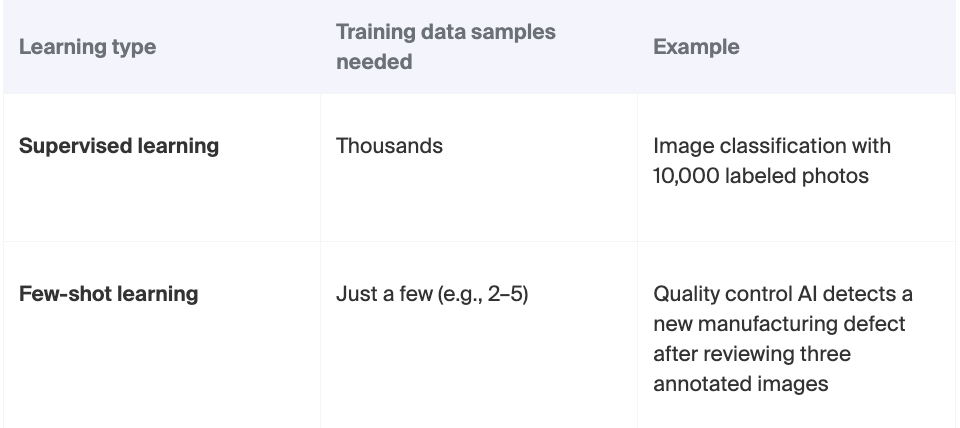

Let’s take a business analogy of rapid onboarding. A seasoned employee adapts quickly to a new role. You don’t need to send them through months of training. Just show them a few workflows, introduce the right context, and they begin delivering results. Few-shot learning applies the same principle to AI, allowing systems to take in limited guidance and still produce meaningful, accurate outcomes.
What are the advantages of few-shot learning?
Few-shot learning does more than enhance AI performance – it changes the economics of AI entirely. It’s a smart lever for leaders focused on speed, savings, and staying ahead. FSL will:
- Cut costs without minimizing capabilities. Few-shot learning slashes the need for large, labeled datasets, which is often one of the most expensive and time-consuming steps in AI projects. By minimizing data collection and manual annotation, companies redirect that budget toward innovation instead of infrastructure.
- Accelerate deployment and time to market. FSL enables teams to build and deploy models in days, not months. Instead of waiting for perfect datasets, AI developers show the model a few examples, and it gets to work. This means companies can roll out new AI-driven features, tools, or services quickly – exactly when the market demands it.
For example, few-shot learning techniques reduced the time needed to train a generative AI model by 85%. - Enhance adaptability and generalization. Markets shift and data evolves. Few-shot learning enables businesses to keep up with these sudden changes. This learning approach doesn’t rely on constant retraining. It helps models adapt to new categories or unexpected inputs with minimal effort.
How does few-shot learning work?
Few-shot learning is implemented differently for classic AI and generative AI with large language models (LLMs).
Few-shot learning in classic AI
In classic AI, models are first trained on a broad range of tasks to build a general feature understanding. When introduced to a new task, they use just a few labeled examples (the support set) to adapt quickly without full retraining.
- Pre-training for general knowledge. The model first trains on a broad, diverse dataset, learning patterns, relationships, and features across many domains. This foundation equips it to recognize concepts and adapt without starting from scratch each time.
- Rapid task adaptation. When faced with a new task, the model receives a small set of labeled examples – the support set. The model relies on its prior training to generalize from this minimal data and make accurate predictions on new inputs, refining its ability with each iteration. For instance, if an AI has been trained on various animal images, FSL would allow it to quickly identify a new, rare species after seeing just a handful of its photographs, without needing thousands of new examples.
Press enter or click to view image in full size
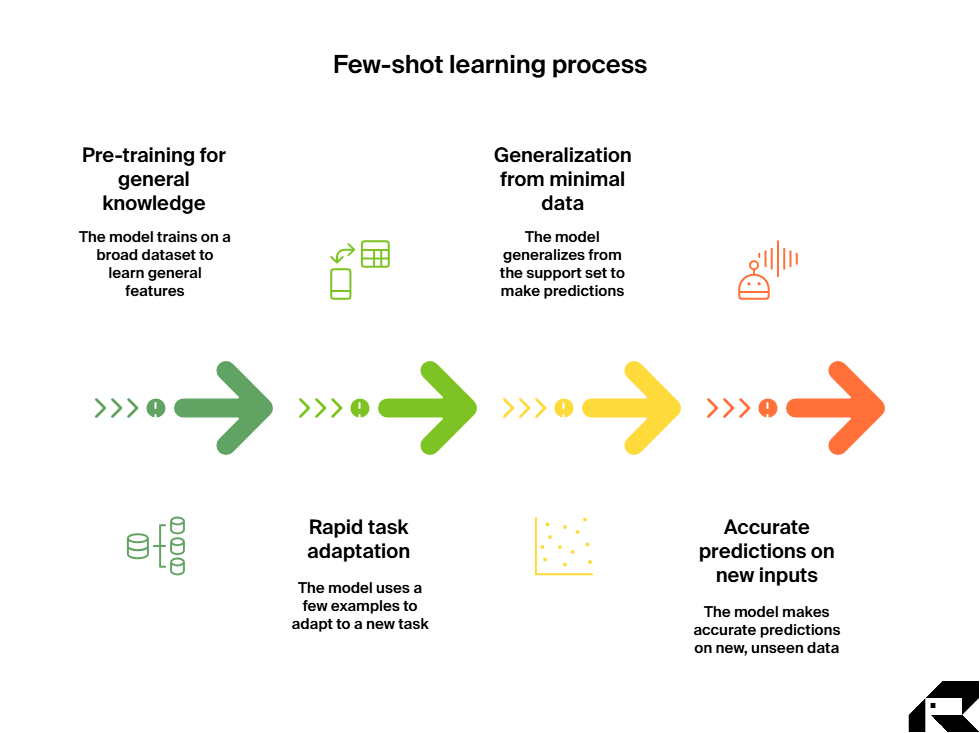

Few-shot learning replaces the slow, data-heavy cycle of traditional AI training with an agile, resource-efficient approach. FSL for classic AI often relies on meta-learning or metric-based techniques.
- Meta-learning – often called “learning to learn” – trains models to adapt rapidly to new tasks using only a few examples. Instead of optimizing for a single task, the model learns across many small tasks during training, developing strategies for quick adaptation.
- Metric-based approaches classify new inputs by measuring their similarity to a few labeled examples in the support set. Instead of retraining a complex model, these methods focus on learning a representation space where related items are close together and unrelated items are far apart. The model transforms inputs into embeddings (numerical vectors) and compares them using a similarity metric (e.g., cosine similarity, Euclidean distance).
Few-shot learning in LLMs
In LLMs, few-shot learning often takes the form of few-shot prompting. Instead of retraining, you guide the model’s behavior by including a few task-specific examples directly in the prompt.
For instance, if you want the model to generate product descriptions in a specific style, you include two to five example descriptions in the prompt along with the request for a new one. The model then mimics the style, tone, and format.
Few-shot vs. one-shot vs. zero-shot learning: key differences
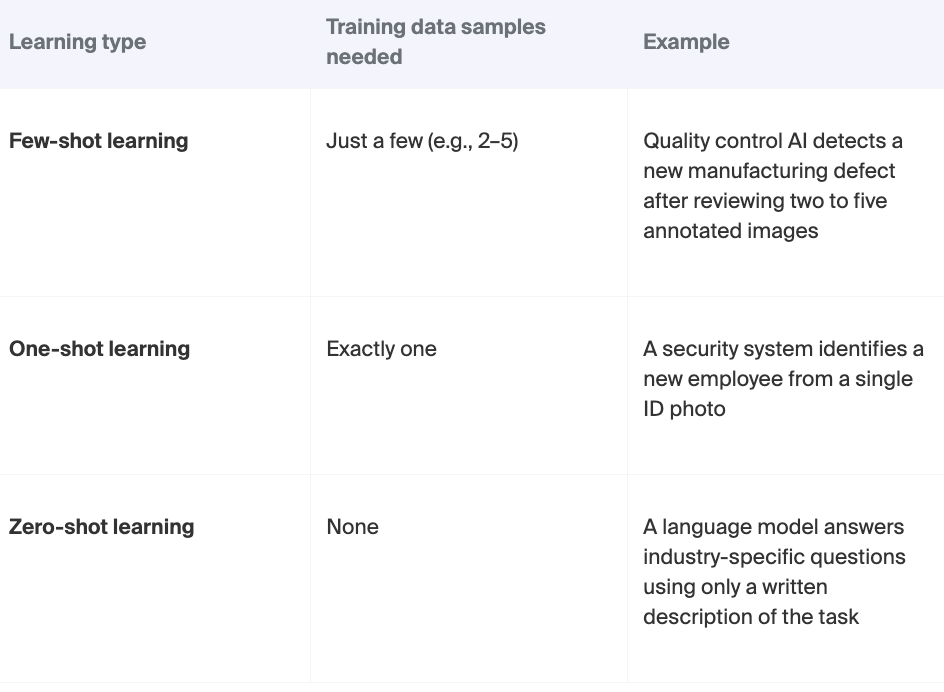
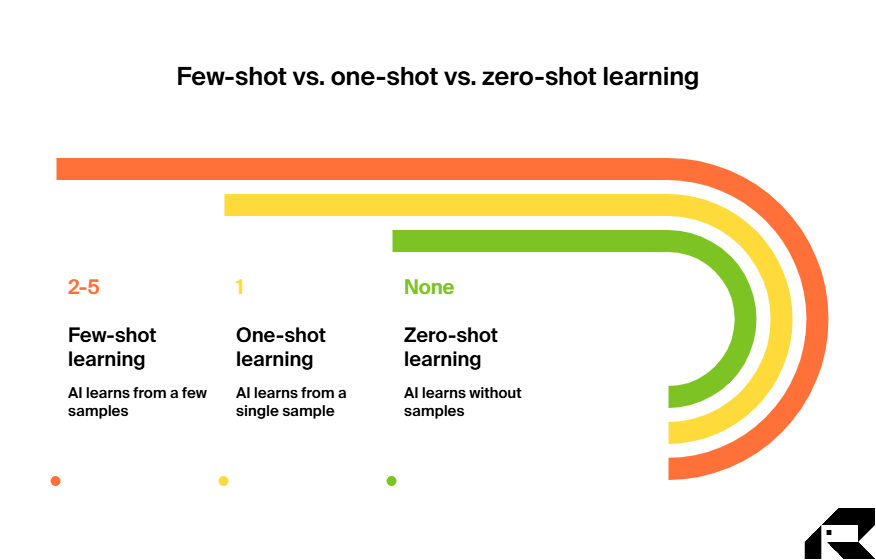
In addition to few-shot learning, companies can also use one-shot and zero-shot learning. Each offers unique ways to deploy AI when data availability is limited. Understanding their differences is key to matching the right approach to your business needs.
- Few-shot learning. The model learns from a small set of labeled examples (typically 2-5). Ideal when you can provide some representative data for a new product, process, or category but want to avoid the time and cost of collecting thousands of samples.
- One-shot learning. The model learns from exactly one labeled example per category. This is well-suited for scenarios where categories change often or examples are hard to obtain.
- Zero-shot learning. The model learns without any task-specific examples. It relies solely on its prior training and a description of the task. Zero-shot is valuable when there is no data available at all, yet quick deployment is essential.
Press enter or click to view image in full size

Press enter or click to view image in full size

When to avoid few-shot learning?
Few-shot learning offers speed and efficiency, but it is not always the optimal choice. In some cases, fine-tuning or traditional supervised learning will deliver more reliable results. These cases include:
- When precision is critical. If the task demands near-perfect accuracy, such as in critical medical diagnostics or fraud detection, relying on only a few examples may introduce unacceptable error rates. Fine-tuning with a larger, task-specific dataset provides greater control and consistency.
- When data is readily available and affordable. If your organization can easily collect and label thousands of examples, traditional supervised learning may yield stronger performance, especially for complex or nuanced tasks where broad variability must be captured.
- When the task is highly domain-specific. Few-shot models excel at generalization, but niche domains with unique terminology, formats, or patterns often benefit from targeted fine-tuning. For instance, a legal AI assistant working with patent filings must interpret highly specialized vocabulary and document structures. Fine-tuning on a large corpus of patent documents will deliver better results than relying on a few illustrative examples.
- When the output must be stable over time. Few-shot learning thrives in dynamic environments, but if your system is stable and unlikely to change, like a barcode recognition system, investing in a fully trained, specialized model is a better choice.
Real-world examples: few-shot learning in action
Let’s explore the different use cases of few-shot learning in enterprise AI and business applications.
Few-shot learning in manufacturing
Few-shot learning accelerates manufacturing quality control by enabling AI models to detect new product variations or defects from just a handful of examples. Also, when factories produce highly customized or limited-edition products, few-shot learning can quickly adapt AI systems for sorting, labeling, or assembly tasks with minimal retraining, which is ideal for short production runs or rapid design changes.
Few-shot learning example in manufacturing
Philips Consumer Lifestyle BV has applied few-shot learning to transform quality control in manufacturing, focusing on defect detection with minimal labeled data. Instead of collecting thousands of annotated examples, researchers train models on just one to five samples per defect type. They enhance accuracy by combining these few labeled images with anomaly maps generated from unlabeled data, creating a hybrid method that strengthens the model’s ability to spot defective components.
This strategy delivers performance comparable to traditional supervised models while drastically reducing the time, cost, and effort of dataset creation. It allows Philips to adapt its detection systems rapidly to new defect types without overhauling entire pipelines.
Few-shot learning in education
This learning technique allows educational AI models to adapt to new subjects, teaching styles, and student needs without the heavy data requirements of traditional AI models. Few-shot learning can personalize learning paths based on just a handful of examples, improving content relevance and engagement while reducing the time needed to create customized materials. Integrated into real-time learning platforms, FSL can quickly incorporate new topics or assessment types.
Beyond personalized instruction, educational institutions use FSL to streamline administrative processes and enhance adaptive testing, boosting efficiency across academic and operational functions.
Few-shot learning example from the ITRex portfolio
ITRex built a Gen AI-powered sales training platform to automate onboarding. This solution transforms internal documents, including presentation slides, PDFs, and audio, into personalized lessons and quizzes.
Our generative AI developers used an LLM that would study the available company material, factoring in a new hire’s experience, qualifications, and learning preferences to generate a customized study plan. We applied few-shot learning to enable the model to produce customized courses.
Our team provided the LLM with a small set of sample course designs for different employee profiles. For example, one template showed how to structure training for a novice sales representative preferring a gamified learning experience, while another demonstrated a plan for an experienced hire opting for a traditional format.
With few-shot learning, we reduced the training cycle from three weeks with classic fine-tuning to just a few hours.
Few-shot learning in finance and banking
Few-shot learning enables rapid adaptation to new fraud patterns without lengthy retraining, improving detection accuracy and reducing false positives that disrupt customers and drive up costs. Integrated into real-time systems, it can quickly add new fraud prototypes while keeping transaction scoring fast, especially when combined with rule-based checks for stability.
Beyond fraud prevention, banks also use few-shot learning to streamline document processing, automate compliance checks, and handle other administrative tasks, boosting efficiency across operations.
Few-shot learning example in finance:
The Indian subsidiary of Hitachi deployed few-shot learning to train its document processing models on over 50 different bank statement formats. These models are currently processing over 36,000 bank statements per month and maintain a 99% accuracy level.
Similarly, Grid Finance used few-shot learning to teach its models to extract key income data from diverse formats of bank statements and payslips, enabling consistent and accurate results across varying document types.
Addressing executive concerns: mitigating risks and ensuring ROI
While few-shot learning offers speed, efficiency, and flexibility, it also brings specific challenges that can affect performance and return on investment. Understanding these risks and addressing them with targeted strategies is essential for translating FSL’s potential into measurable, sustainable business value.
Challenges and limitations of few-shot learning include:
- Data quality as a strategic priority. Few-shot learning reduces the volume of training data required, but it increases the importance of selecting high-quality, representative examples. A small set of poor inputs can lead to weak results. This shifts a company’s data strategy from collecting everything to curating only the most relevant samples. It means investing in disciplined data governance, rigorous quality control, and careful selection of the critical few examples that will shape model performance and reduce the risk of overfitting.
- Ethical AI and bias mitigation. Few-shot learning delivers speed and efficiency, but it can also carry forward biases embedded in the large pre-trained models it depends on. AI engineers should treat responsible AI governance as a priority, implementing bias testing, diversifying training data where possible, and ensuring transparency in decision-making. This safeguards against misuse and ensures FSL’s benefits are realized in a fair, explainable, and accountable way.
- Optimizing the “few” examples. In few-shot learning, success hinges on picking the right examples. Take too few, and the model underfits – learning too little to generalize. Poorly chosen or noisy examples can cause overfitting and degrade performance. So, treat selection as a strategic step. Use domain experts to curate representative samples and validate them through quick experiments. Pair human insight with automated data analysis to identify examples that truly capture the diversity and nuances of the task.
- Sensitivity to prompt quality (few-shot learning for LLMs). In LLM-based few-shot learning, the prompt determines the outcome. Well-crafted prompts guide the model to produce relevant, accurate responses. Poorly designed ones lead to inconsistency or errors. Treat prompt creation as a critical skill. Involve domain experts to ensure prompts reflect real business needs, and test them iteratively to refine wording, structure, and context.
- Managing computational demands. Few-shot learning reduces data preparation costs, but it still relies on large, pre-trained models that can be computationally intensive, especially when scaled across the enterprise. To keep projects efficient, plan early for the necessary infrastructure – from high-performance GPUs to distributed processing frameworks – and monitor resource usage closely. Optimize model size and training pipelines to balance performance with cost, and explore techniques like model distillation or parameter-efficient fine-tuning to reduce compute load without sacrificing accuracy.
Few-shot learning: AI’s path to agile intelligence
Few-shot learning offers a smarter way for businesses to use AI, especially when data is scarce or needs to adapt quickly. It’s not a magic solution but a practical tool that can improve efficiency, reduce costs, and help teams respond faster to new challenges. For leaders looking to stay ahead, understanding where and how to apply FSL can make a real difference.
Implementing AI effectively requires the right expertise. At ITRex, we’ve worked with companies across industries, such as healthcare, finance, and manufacturing, to build AI solutions that work – without unnecessary complexity. If you’re exploring how few-shot learning could fit into your strategy, we’d be happy to share what we’ve learned.
Sometimes the best next step is just a conversation.
FAQs
How is few-shot learning different from zero-shot learning?
Few-shot learning adapts a model to a new task using a handful of labeled examples, allowing it to generalize based on both prior training and these task-specific samples. Zero-shot learning, by contrast, gives the model no examples at all – only a description of the task – and relies entirely on its pre-existing knowledge. Few-shot typically delivers higher accuracy when even a small amount of relevant data is available, while zero-shot is useful when no examples exist.
How does few-shot learning improve large language models?
In LLMs, few-shot learning takes the form of few-shot prompting. By embedding a few carefully chosen input-output examples in the prompt, you guide the model’s reasoning, format, and tone for the task at hand. This improves consistency, reduces ambiguity, and helps the LLM align more closely with business requirements without retraining or fine-tuning.
How do you create effective few-shot learning prompts?
Effective prompts are concise, relevant, and representative of the task. Include a small set of high-quality examples that cover the range of expected inputs and outputs. Keep formatting consistent, use clear instructions, and test variations to find the structure that yields the most accurate results. In high-stakes business contexts, involve domain experts to ensure examples reflect real-world use cases and terminology.
Why is few-shot learning important for adapting AI models?
Few-shot learning allows models to adjust to new categories, formats, or patterns quickly – often in hours instead of weeks. This agility is crucial for responding to evolving markets, changing customer needs, or emerging risks without the cost and delay of full-scale retraining. It enables organizations to extend AI capabilities into new areas while keeping operational momentum.
How does few-shot learning reduce the need for large training datasets?
FSL leverages the general knowledge a model has acquired during pre-training and uses a few task-specific examples to bridge the gap to the new task. This eliminates the need for massive, fully labeled datasets, cutting down data collection, cleaning, and annotation costs. The result is faster deployment, lower resource consumption, and a more favorable ROI on AI initiatives.
Originally published at https://itrexgroup.com on August 26, 2025.