


The application of virtual reality (VR) in aviation presents endless possibilities, within perhaps the most worthy industry. For instance, VR can considerably enhance passenger experience with in-flight entertainment and features, it can assist the flight crew during and in between flights, provide immersive training, and significantly increase safety within a potentially dangerous industry.
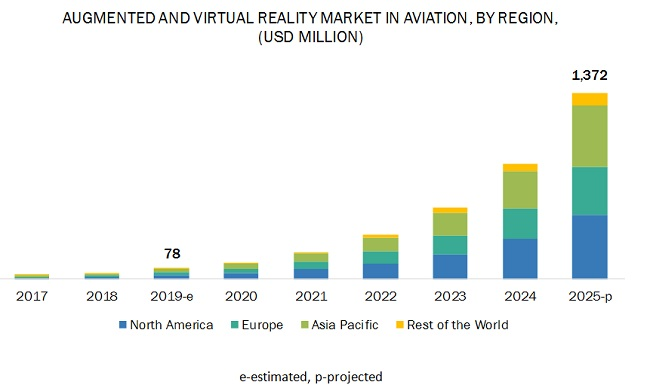
AR and VR market growth in aviation 2017 – 2025 forecast: (Marketsandmarkets)
Whilst the applications of virtual reality are by no means exclusive to the aviation industry, the success of implementing the technology in aviation can be materialized into lessons for alternative sectors. Those operating in finance, marketing, retail, construction, and healthcare can all look to aviation as a pioneer of introducing VR simulations into its operations to learn more about how they can do the same.
Virtual reality in aviation
The past decade has given VR a lot of attention, thanks to some of its amazing features and applications. In effect, virtual reality is essentially a way to allow users to immerse themselves in and interact with a completely simulated environment.
VR is delivered through VR headsets worn by the user to immerse themselves in a new interactive environment. These can be PC-connected headsets, or standalone – each offering different levels of immersion. The former relies on being connected to a computer that generates digital content. Standalone headsets are relatively inexpensive and don’t require computer processing powers. Rather, the user simply inserts their smartphones into the headset to experience VR.
What was once an exciting prospect in gaming and entertainment has found its way to one of the most complex industries. VR in aviation has the capacity to completely transform the industry. From saving costs and improving outcomes by training with 3D interactive models, to immersing flying passengers in a virtual space; VR knows no bounds.
For instance, aircraft maintenance companies such as MyTechnic put together specialist teams to cost-effectively and strategically deliver maintenance to a range of aircraft. When coupled with VR, engineers and maintenance teams are able to inspect aircraft models remotely, in order to organize a comprehensive maintenance service.
VR training
Aviation was indeed one of the first industries to put VR to work in the training space. In fact, flight simulators have been used to train pilots for more than 80 years. Since then, there have been many advancements in technology that have made these simulators more sophisticated, but none quite advanced as virtual reality.
VR training has ushered in a wave of professional pilot training, with far-reaching consequences for the aviation industry, and of course, beyond. Traditionally, a flight simulator has been created by chopping off the cockpit of an aircraft, which is then mounted onto a hexapod platform, allowing the part of the plane to move 6 degrees. With the help of video displays, pilots were then able to look out over landscape and runways. This was an incredibly convenient training method since trainee pilots could interact with a real airplane, save fuel as well as wear-and-tear on the engines. The videos could replace hazardous conditions and system failures without putting anyone in any real danger.
The issue arose when it became clear that there were only so many aircraft that could be dismantled and only so many trainee pilots could access the cockpit at any given time. VR training is a way to train pilots far beyond the capabilities of traditional flight simulators. The immersive VR training experience puts pilots in a realistic training scenario. Training sessions created by the likes of Mesmerise, for instance, can be used again and again, saving costs on training resources.
Another added benefit of VR training is that there are no limitations on the availability of different types of aircraft for different types of aircraft training. The power of VR is extended to different industries since there are really no limitations to the training environment that you can create. VR training is extremely versatile and portable – saving billions across the aviation industry and cutting training budgets significantly in other sectors.
Flight crew VR training
The role of the cabin crew can be mirrored in the roles found across many different industries. They need to be trained and prepared to offer high customer service and hospitality, to attend to a person in the event of a medical emergency, to deal with dangerous situations, and to be ready to lead an emergency landing. These specs are also imperative skills needed across the hospitality, entertainment, and healthcare industries. Here’s what we can learn from aviation.
Historically, the job and skillset of a pilot could have only been learned in the air. To gain high skills and confidence in such a demanding and trusting position has always been learned on the job. For aviation and other industries, virtual reality has revolutionized this process. Vantage Airport Group explored the capabilities of VR training to improve safety. By implementing a VR training course, they were able to reduce training time, increase knowledge retention and improve safety standards.
The solution was both immersive and interactive using the Oculus Rift, allowing trainees to recreate reality and navigate different scenarios. The beauty of such VR headsets is that they can recreate the training environment for any job role – be it in the office, on the shop floor, or operating heavy machinery. Costs can be saved, efficiencies increased and safety ensured across industries using VR.
VR experiences
Passenger air flights can be as long as 12 hours. People have been known to pass the time by sleeping, reading books, listening to music, or watching movies. The immersive nature of VR in entertainment can make both long and short-haul flights more bearable. The application of VR for entertainment in flights is a perfect example of improved customer experience, which can ultimately be applied across sectors where customers are either kept waiting or are in need of entertainment.
VR is the best route for escapism and since flying isn’t everyone’s cup of tea, a passenger might opt to utilize virtual reality to transport themselves to their happy, calm place. This approach can be applied to help people in anxiety-inducing situations like hospitals prior to surgery, dentists and during therapy treating PTSD. For those on the opposite end of the spectrum, thrill-seekers might want to enjoy a view of the airplanes outside surroundings from an immersive birdseye view.
In a nutshell, the applications of virtual reality in the aviation industry are vast and are by no means exclusive to aviation. From maintenance and aircraft repairs to training and passenger entertainment – these VR use cases can and should be utilized across other sectors for maximum efficiencies and minimal costs.
