


Definition
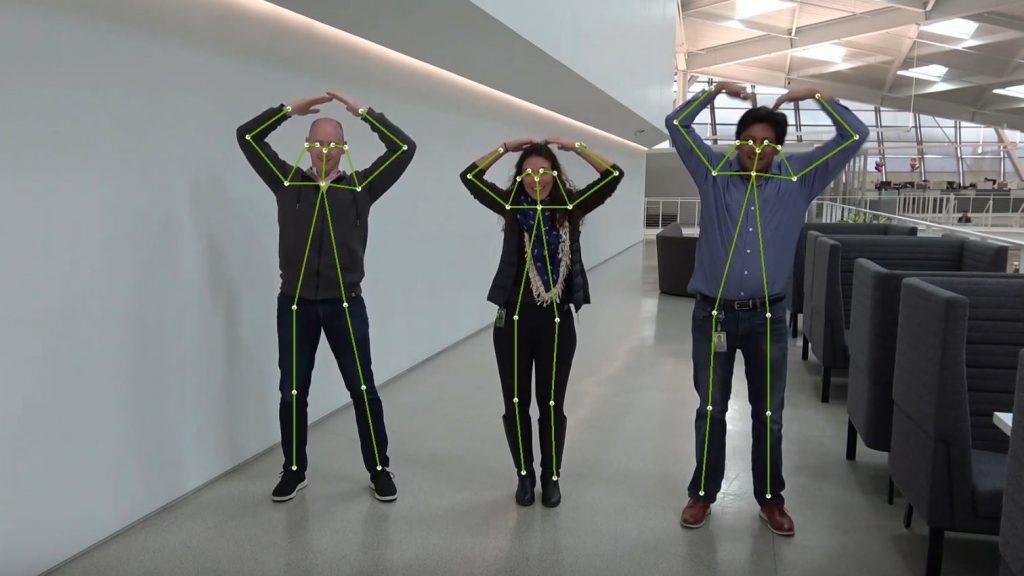
Human Pose Detection is a broadly researched topic when it comes to Deep Learning. It’s mainly used to detect locations of people’s joints, which form a “skeleton”. Some of its applications include human action recognition, fun mobile applications, motion capture, virtual and augmented reality, sport, robotics, etc.
Research on 3D Human Body Position Estimate is less mature compared to the 2D case. There are two main approaches: the first one is to detect a 2D pose, and then other approach is to reconstruct a 3D pose. Research on 3D position detection is ongoing, so there is little information because of the lack of useful datasets.
Most analyses focus on rebuilding 3D poses from a single image, and only a few of them concentrate on multi-view. Some consider depth in addition to the RGB image. Many works put into consideration a single frame, while others prioritize continuity constraints. So 3D position detection is generally more computationally intensive and real-time. Most 3D pose models use supervision. However, some other models are semi-supervised or completely self-unsupervised.
Why is 3D harder than 2D?
Generally, recovering 3D pose from 2D RGB images is quite more complex than 2D pose analysis. This is due to the more ambiguities and the bigger 3D position space.
Various 3D Body Pose Detection Access
Human pose detection can be categorized into two categories:
Model-based generative methods
Discriminative methods
- The pictorial structure model is among the most common generative models. The PSM treats the body as an articulated structure. The model typically comprises two descriptions: the first one is the framework appearance of all the body parts, and then the second is the spatial relationship between the adjoining parts.
- Discriminative methods, moreover, view detection as a regression issue. After getting features from an image, a mapping is obtained from the feature space to the pose space. Due to the articulated structure of the human skeleton, the joint locations are considerably connected.
- Deep learning approaches: Rather than manually dealing with the structural dependencies, another more direct approach is to embed the structure into the mapping function and understand the representation that unravels the dependencies between output variables. In this approach, frameworks need to discover the patterns of the human position from data.
Single-person 3D Pose Analysis
Lots of works for human pose detection for a single person use a single movie or picture. Regardless of the uncertainty in the depth of dimension, frameworks trained on 3-D Ground Truth show better achievement for a single person without occlusions. Like humans, an impartial network can learn to predict the depth from a single picture in case it has already handled similar examples.
3D Multi-Person Position
Occlusions – the top-1 issues in multi-person 3D Positions. Moreover, there are nearly no interpreted multi-person 3D Position datasets such as the Human 3.6 dataset. Lots of multi-person datasets either do not have effective GT or are not practical.